



Little Red Classrooms: Young Envoys Scholarship Program
Investigations
SUMMARY
For decades, the Chinese government and its affiliates have been engaged in a global soft power campaign called the ‘Belt and Road Initiative’ designed to advance the People’s Republic of China’s (PRC) political and cultural agenda. This ongoing Initiative includes various forms of programming intentionally aimed at American students from K-12 through university level meant to influence how youth in the United States view China.
In 2023, Defending Education released a report titled Little Red Classrooms: China’s Infiltration of American K-12 Schools which exposed how the PRC’s Ministry of Education and proxies fostered relationships with American K-12 schools and school districts to influence perceptions of the Asian nation. Through what the Ministry called “Confucius Institutes” (university level) and “Confucius Classrooms” (K-12), the PRC sponsored trips to China, funded entire university Confucius programs, and provided course textbooks and small grants to K-12 schools.
While Confucius programming appears to have ceased operation at the majority of participating universities and K-12 schools following pressure from the federal government, another project seems to have popped up in its place. The Young Envoys Scholarship (YES) program, run by the China Education Association for International Exchange (CEAIE), states that it facilitates study abroad opportunities for American youth “to deepen and expand cross-cultural understanding among countries.” CEAIE notes on its Chinese website that it is guided by “Marxism-Leninism” and Xi Jinping Thought on Socialism and “always adhere to the leadership of the Party and integrate the Party’s work into the entire process of the association’s operation and development.”
This follow up report to Little Red Classrooms is intended to highlight the ongoing efforts of PRC and CCP linked organizations to influence American students’ perceptions of the communist country. This report includes over 83 universities and 27 K-12 schools spanning 31 states that have been involved in the YES program and includes links to newsletters that feature glowing responses from those who benefitted from the PRC fully funded experience.
KEY TAKEAWAYS
Program Background
- In November 2023, Chinese President Xi Jinping invited 50,000 U.S. students to study abroad in China over the next five years as part of an initiative called the Young Envoys Scholarship (YES) program.
- The YES program is run by the China Education Association for International Exchange (CEAIE), an organization guided by “Marxism-Leninism” and Xi Jinping Thought on Socialism.
- CEAIE vows to “always adhere to the leadership of the Party and integrate the Party’s work into the entire process of the association’s operation and development.”
- U.S. lawmakers have identified CEAIE as part of China’s “United Front“ system, an international influence operation aimed at neutralizing opposition to CCP policy.
- CEAIE’s leadership includes numerous Communist Party officials. Its Secretary General, Yang Jun, has pledged to “strengthen the comprehensive and strict governance of the Party.”
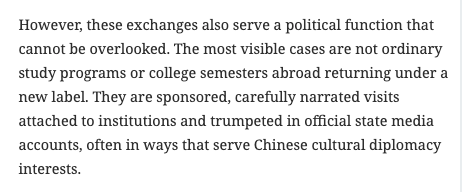
- The Diplomat recently noted that these U.S.-China exchanges “serve a political function” for China as “sponsored, carefully narrated visits attached to institutions and trumpeted in official state media accounts, often in ways that serve Chinese cultural diplomacy interests.”
- In 2025, Rep. John Moolenaar (R-MI) wrote letters to local school leaders warning that “student trips to China, funded by CCP-affiliated organizations, serve as propaganda and influence operations rather than genuine cultural exchanges.”
- The YES program is sponsored by organizations and businesses with concerning links to the CCP, including the United States Heartland China Association (USHCA); the U.S.-China Business Council (USCBC); and Wanxiang Group.
United States Involvement
- Roughly 83 universities and 27 K-12 schools have been documented as participating in China’s Young Envoys Scholarship (YES) program.
- Several university trips involved direct engagement with United Front-linked or state propaganda bodies, including a University of Chicago delegation visiting the Beijing People’s Association for Friendship with Foreign Countries and a Columbia University delegation attending a trip organized by the China-United States Exchange Foundation.
- Muscatine High School’s 2024 trip was personally arranged by Xi Jinping, who wrote to a student calling her his “friend.” Muscatine students in turn gifted Xi a flag reading, “Grandpa Xi, Here We Are.”
- Lincoln High School in Washington has a long-running relationship with Xi Jinping, who visited the school in 2015 and invited 118 students/teachers to China; YES materials feature students calling themselves a “China fan” and praising Xi’s messages as “heartwarming.”
- Indiana University’s 2025 exchange partner, Xi’an Jiaotong-Liverpool University, was flagged in a 2025 Australian Strategic Policy Institute report for ties to sanctioned, Russia-linked, and military/critical-technology-connected entities.
- Carleton College promoted a student’s positive experience at Beijing Normal University, a school the New York Times reported has a “malicious tip-off” culture in which students inform on professors who stray from CCP narratives, and where a professor was previously fired for criticizing Mao and praising Western civilization.
YOUNG ENVOYS SCHOLARSHIP PROGRAM
China Education Association for International Exchange (CEAIE)
The Young Envoys Scholarship (YES) program was founded in 2024 is operated by the China Education Association for International Exchange (CEAIE). In November 2023 in San Francisco, Chinese President Xi Jinping invited 50,000 U.S. students to study abroad in China over the next five years as part of an initiative called the Young Envoys Scholarship (YES) program.
The YES program says international exchanges are a “key pillar and powerful enabler to deepen and expand cross-cultural understanding among countries” that “provide a nurturing environment for young people to move and see the world.” The Chinese Embassy has waived visa processing fees for YES program participants.
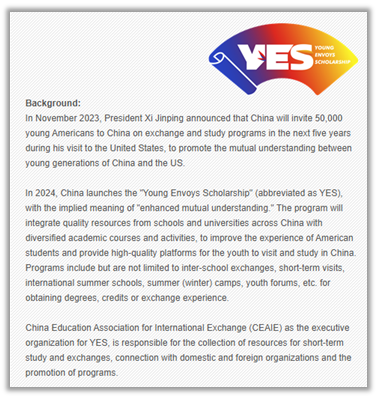
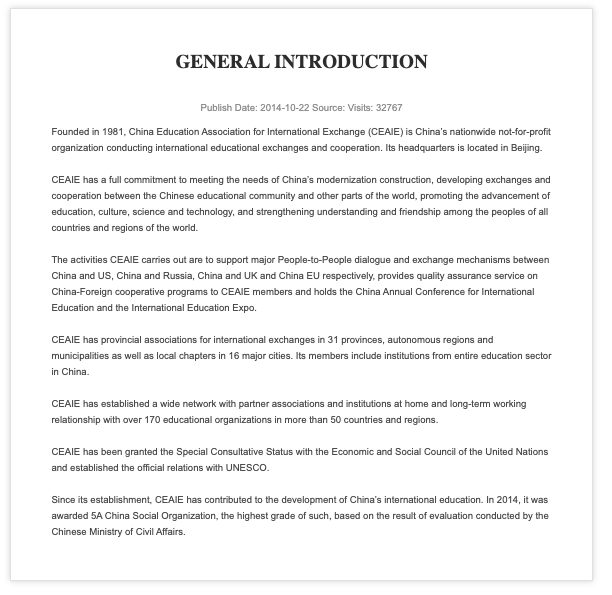
On its English language site, the CEAIE describes itself as China’s “nationwide not-for-profit organization conducting international educational exchanges and cooperation” aimed at “strengthening understanding and friendship among the peoples of all countries and regions of the world.” In addition to China-U.S. exchanges, CEAIE supports exchange programs with Russia, the UK, and the EU.
CEAIE oversees 31 provincial associations, local chapters in 16 major cities, and its members include institutions from the “entire education sector in China.” CEAIE has “established a wide network with partner associations and institutions at home and long-term working relationship with over 170 educational organizations in more than 50 countries and regions.” CEAIE says it is “committed to enhancing its soft power through more engagements in bilateral and multilateral cooperation.”
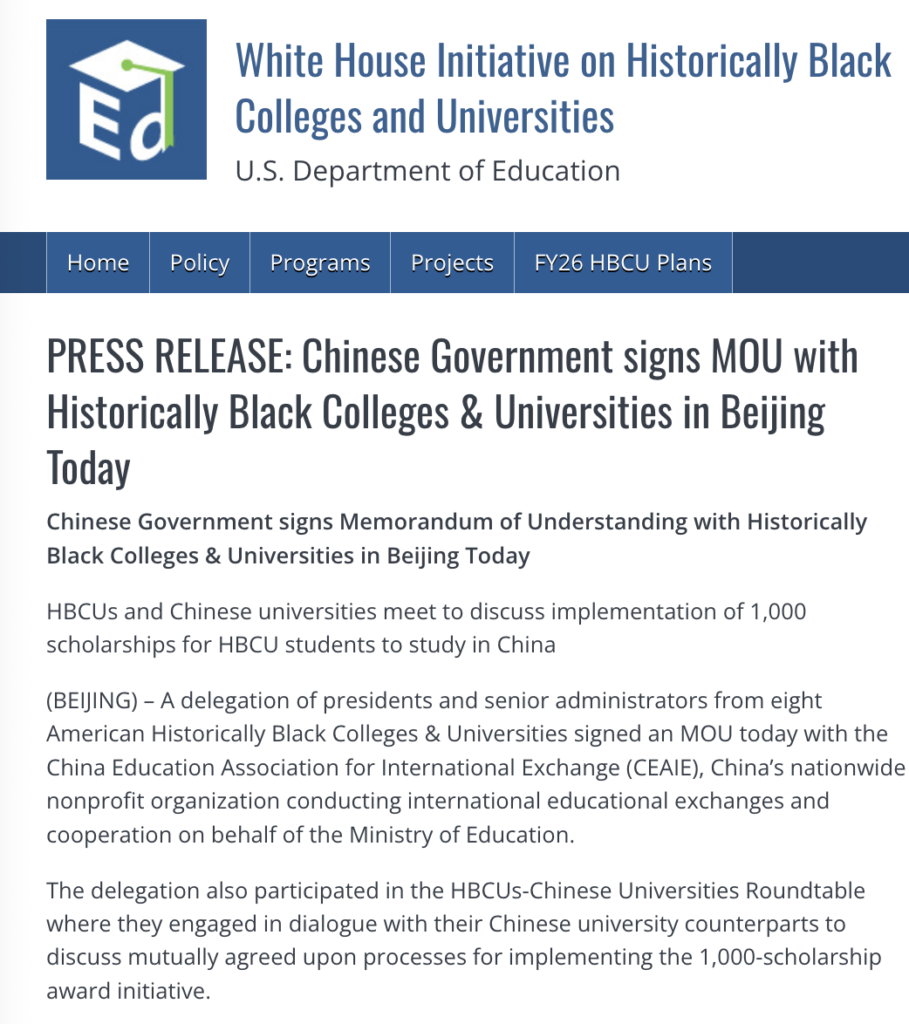
In 2014, “presidents and senior administrators from eight American Historically Black Colleges & Universities signed an MOU” with CEAIE to implement a “1,000-scholarship award initiative.” The press release noted that the “HBCU trip to China is the culmination of the collective works of the Chinese government and the China-U.S. Exchange Foundation (CUSEF)” which “hosted and organized the first meeting of the HBCUs with Vice Premier Liu during the HBCU’s first visit to China in September 2013.”
Chinese Communist Party (CCP) Ideology at CEAIE
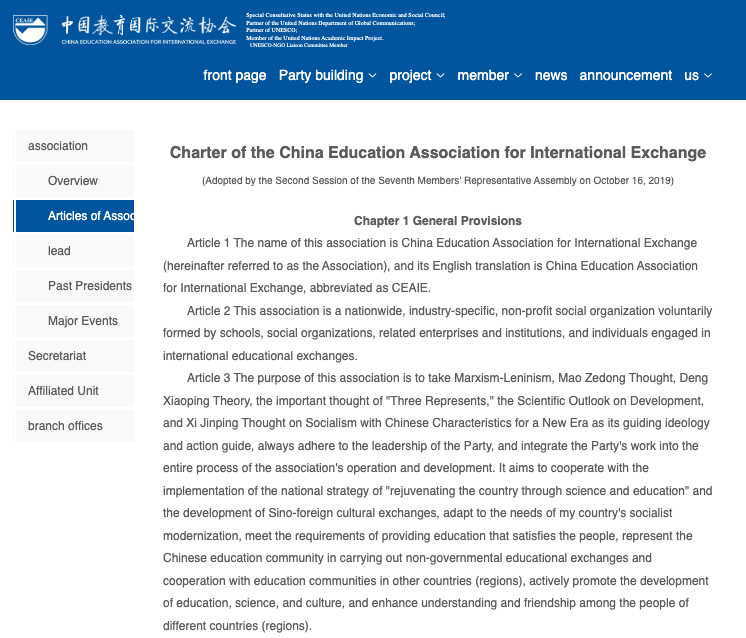
On its Chinese language site, the CEAIE says its purpose is to “take Marxism-Leninism, Mao Zedong Thought, Deng Xiaoping Theory … and Xi Jinping Thought on Socialism with Chinese Characteristics for a New Era as its guiding ideology and action guide.”
The CEAIE vows to “always adhere to the leadership of the Party and integrate the Party’s work into the entire process of the association’s operation and development.”
CEAIE “adheres to the overall leadership of the Communist Party of China … carries out Party activities and provides necessary conditions for the activities of Party organizations.”
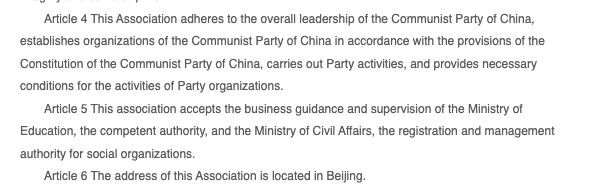
CEAIE adds that it “implements the Party’s line, principles, and policies, leads mass organizations such as trade unions and the Communist Youth League, educates and manages Party members, guides the masses, unites and rallies foreign affairs workers, and promotes the development of the cause.”
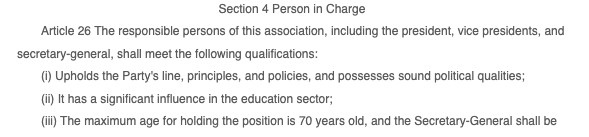
U.S. lawmakers have described CEAIE as an element of China’s “United Front” system – an international influence operation that aims to co-opt and neutralize sources of potential opposition to the policies and authority of the CCP.
In 2025, Rep. John Moolenaar (R-MI) wrote letters to local school leaders warning that “student trips to China, funded by CCP-affiliated organizations, serve as propaganda and influence operations rather than genuine cultural exchanges.” Moolenaar specifically noted that organizations like CEAIE have been “publicly identified by U.S. intelligence agencies as CCP front groups tasked with advancing Beijing’s United Front work, which seeks to co-opt local leaders and neutralize opposition to CCP policies.”
In 2018, the U.S.-China Economic and Security Review Commission noted that United Front work often operates through “connections that are difficult to [publicly] prove … making those who seek to identify the negative effects of such influence vulnerable to accusations of prejudice.”
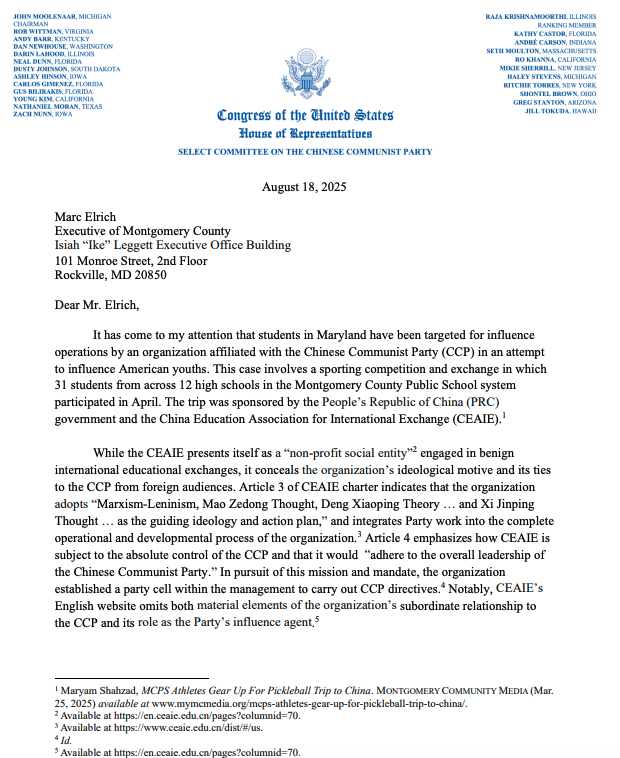
Leadership
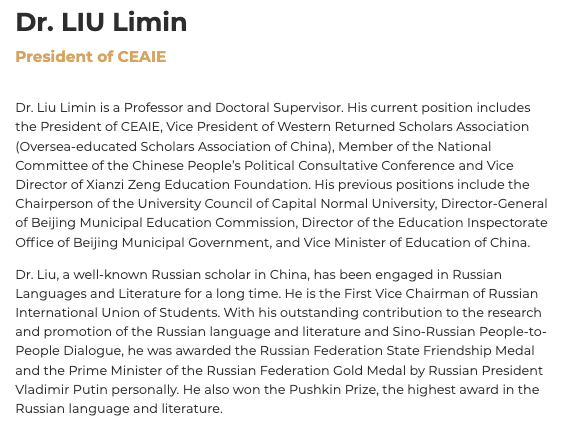
CEAIE’s leadership consists of a president, multiple vice presidents, and a secretariat office. CEAIE’s president, Liu Limin, is the former Vice Minister of Education of China and a current member of the National Committee of the Chinese People’s Political Consultative Conference (CPPCC), the highest-ranking entity overseeing United Front work.
CEAIE’s vice presidents include the Party Secretary of Zhejiang University; the former Party Secretary of Fudan University; the former Party Secretary of Huazhong University; and a Party Member of the Chongqing Municipal People’s Congress.
CEAIE Secretary General Yang Jun has pledged to “thoroughly study and implement General Secretary Xi Jinping’s important thoughts on the Party’s self-revolution,” “further strengthen the Party’s leadership,” and “strengthen the comprehensive and strict governance of the Party.”
Exchange Programs As A Vehicle For Chinese Influence
A recent op-ed in the Diplomat noted that these U.S.-China exchanges “serve a political function” for China and are not ordinary study abroad programs, but “sponsored, carefully narrated visits attached to institutions and trumpeted in official state media accounts, often in ways that serve Chinese cultural diplomacy interests.” Chinese government officials have used U.S. students’ involvement in the program as a political messaging tool pushing carefully controlled narratives.
According to the FBI, foreign nations like China “seek to improve their economies and militaries by stealing intellectual property from a world technology leader like the United States” and employ students to help achieve this goal.
Sponsors
The YES program is also sponsored by the United States Heartland China Association, which has come under fire for its ties to the United Front system, the U.S.-China Business Council (USCBC), and Wanxiang Group. Additional sponsors include Air China; Visa; UnionPay International; China Southern; Hainan Airlines; and Jiaxiang Education Group.
U.S.-Heartland China Association
USHCA describes itself as a bipartisan organization that aims to “build bridges and promote opportunities between the peoples of the American Heartland Region and the People’s Republic of China.”
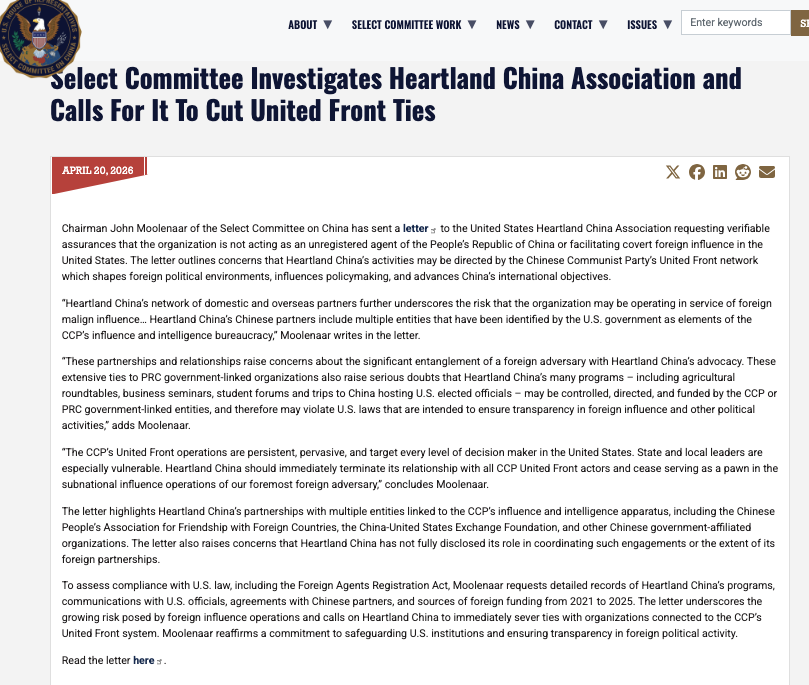
USHCA has come under fire from U.S. journalists and politicians, such as Rep. Jim Banks (R-IN) and Sen. Marco Rubio (R-FL), for routinely partnering with organizations tied to CCP influence operations. In April 2026, Rep. John Moolenaar (R-MI) wrote that USHCA “may be operating in service of foreign malign influence,” adding, “Heartland China’s Chinese partners include multiple entities that have been identified by the U.S. government as elements of the CCP’s influence and intelligence bureaucracy.”
U.S.-China Business Council
USCBC is a “nonpartisan, nonprofit association of more than 270 American companies that do business in China” and works to expand U.S. business opportunities in China.
In 2023, Rep. Mike Gallagher (R-WI) condemned USCBC for organizing a “welcome dinner” for Xi Jinping in San Francisco and selling tickets to Xi’s table for $40,000. Gallagher wrote, “It is unconscionable that American companies might pay thousands of dollars to join a ‘welcome dinner’ hosted by the very same CCP officials who have facilitated a genocide against millions of innocent men, women, and children in Xinjiang.”
Wanxiang Group
Wanxiang Group has been described as the largest China-based automotive components company by revenue. Xi Jinping praised Wanxiang’s founder for being “consistent with the Party Central Committee” and said he “always actively implements what our Party committees and governments at all levels advocate.”
Wanxiang CEO Lu Weiding said in 2019, “Upholding our original aspiration and mission, every Party member must have a firm belief in Marxism, a steadfast conviction in socialism with Chinese characteristics and communism, and unwavering loyalty to the Party and the people.”
CASE STUDIES – UNIVERSITY
University of Chicago (Illinois)
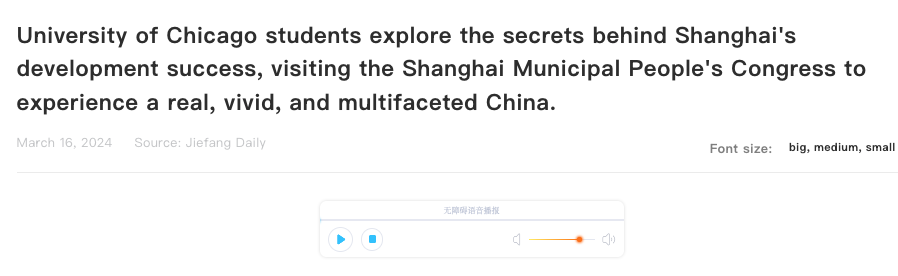
In March 2024, a delegation of “33 young student representatives” from the Harris School of Public Policy at the University of Chicago visited the Beijing People’s Association for Friendship with Foreign Countries. Chinese People’s Association for Friendship with Foreign Countries and its affiliates belong to China’s “United Front” international propaganda operation, which aims to advance the CCP’s global agenda. U.S. officials are known to have been unwittingly “coopted into promoting party narratives and burnishing the PRC’s reputation” through CPAFFC activities.
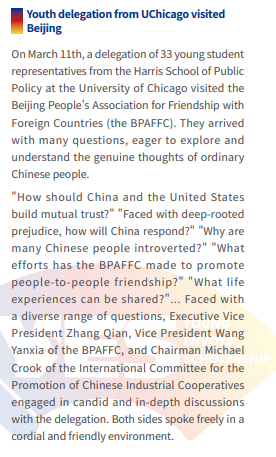
Students met with Executive Vice President Zhang Qian, Vice President Wang Yanxia of the BPAFFC, and Chairman Michael Crook of the International Committee for the Promotion of Chinese Industrial Cooperatives.
Chinese state media amplified the trip and emphasized the Municipal People’s Congress passing the Shanghai Municipal Household Waste Management Regulations after listening to American students’ suggestions on “how should Shanghai respond to climate change.” A student said she was “impressed by Shanghai’s active listening to citizens’ voices” and “want[ed] to understand how Shanghai [balances interests regarding urban environmental issues] and whether it can be applied on a larger scale.” Chinese state media said students “held discussions with students from the University of Chibasin on topics such as China’s economic development, foreign policy, and China-US economic and trade cooperation.”
Indiana University (Indiana)
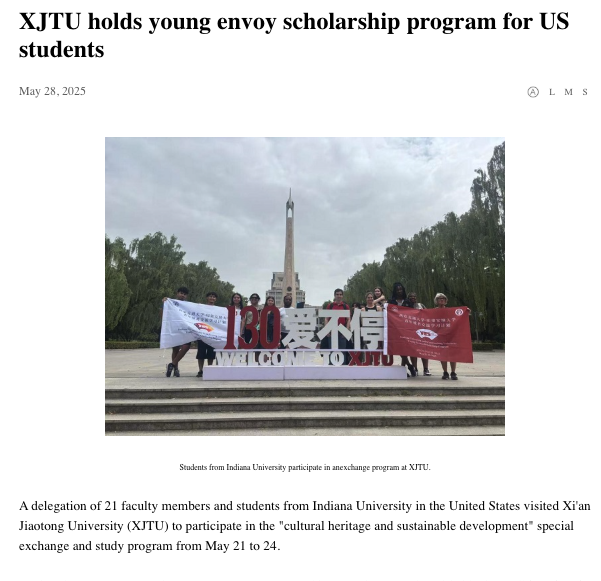
In 2025, a delegation of 21 faculty members and students from Indiana University participated in a four-day exchange program at Xi’an Jiaotong University focused on “cultural heritage and sustainable development.” The delegation toured research facilities at Xi’an Jiaotong University, including the National Experimental Teaching Demonstration Center for Mechanical Fundamentals and the Overseas Dispersed Chinese Cultural Relics Digital Engineering Laboratory, a joint project with the University of Chicago.
The program included visits to major cultural and historical sites in Xi’an, including the Xi’an Museum, the Ming Great Wall, and the Emperor Qinshihuang’s Mausoleum Site. At the conclusion of the exchange, Chinese and American participants jointly signed a commitment letter supporting cultural heritage protection and sustainable development initiatives at both local and global levels.
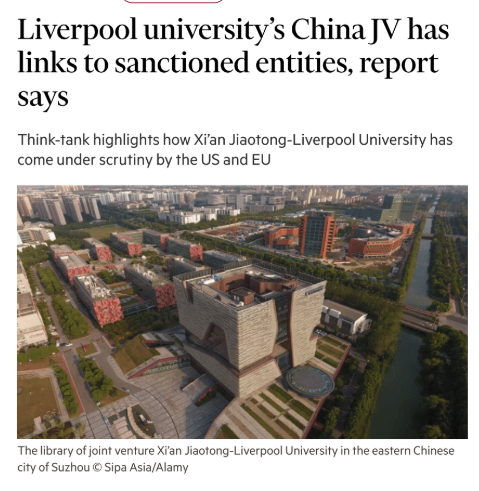
A 2025 report by the Australian Strategic Policy Institute alleged that Xi’an Jiaotong-Liverpool University maintains relationships with entities subject to U.S. and EU sanctions, including a China–Russia cooperation center and research collaborations involving organizations tied to military and critical technology sectors.
The report highlighted that XJTLU’s Centre for China-Russia Humanitarian Cooperation and Development is co-led by Artem Semenov, who is affiliated with Rossotrudnichestvo, an organization sanctioned by the European Union in 2022 as a vehicle for Kremlin “soft power and hybrid influence.”
According to the report, XJTLU has pursued partnerships with blacklisted technology organizations, including the National Supercomputing Center in Wuxi and the Shanghai Institute of Microsystem and Information Technology, prompting scrutiny over potential links between Western academic institutions, sensitive technology research, and Chinese military-civil fusion activities.
Carleton College (Minnesota)
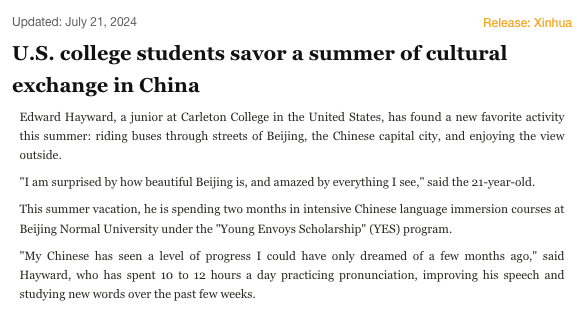
In 2024, the YES program’s website featured a story highlighting the experience a student from Carleton College had while studying in China during the summer at Beijing Normal University. In 2017, BNU fired assistant professor of classical Chinese, Shi Jiepeng, for “expressing views outside the mainstream of society,” which included social media posts where he criticized historical figures like Mao Zedong and advocated for the adoption of Western civilization. The administration cited violations of political discipline.
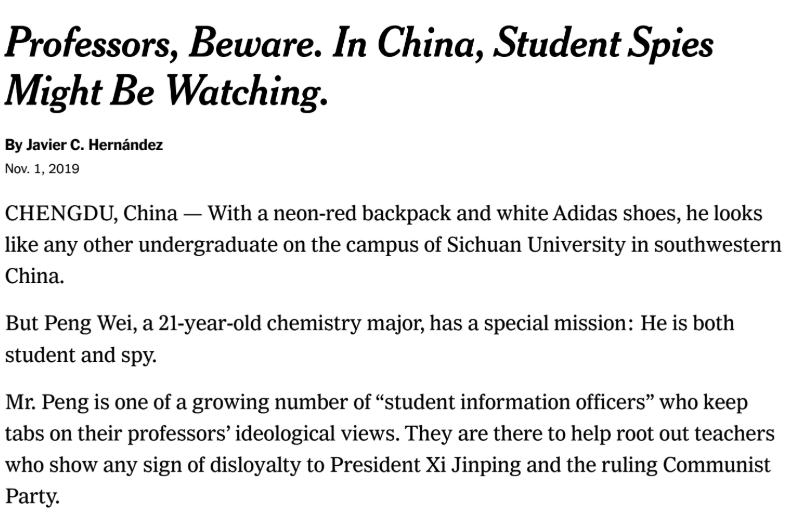
According to the New York Times, BNU has a “malicious tip-off” culture where student informers monitor and report professors for straying from CCP narratives. The student’s story was promoted by both Carleton College and the Chinese Communist Party.
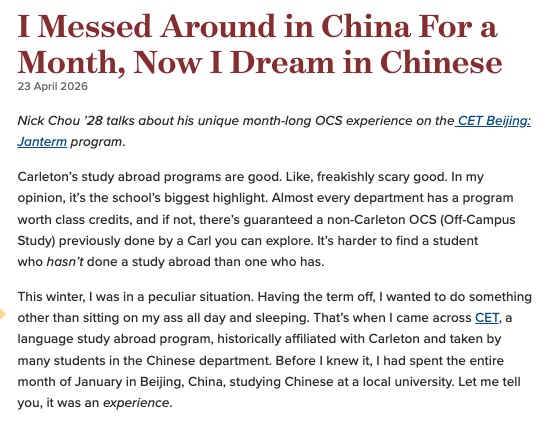
In 2026, Carleton College featured a positive story by another student who studied in China and now claimed to “dream in Chinese.”
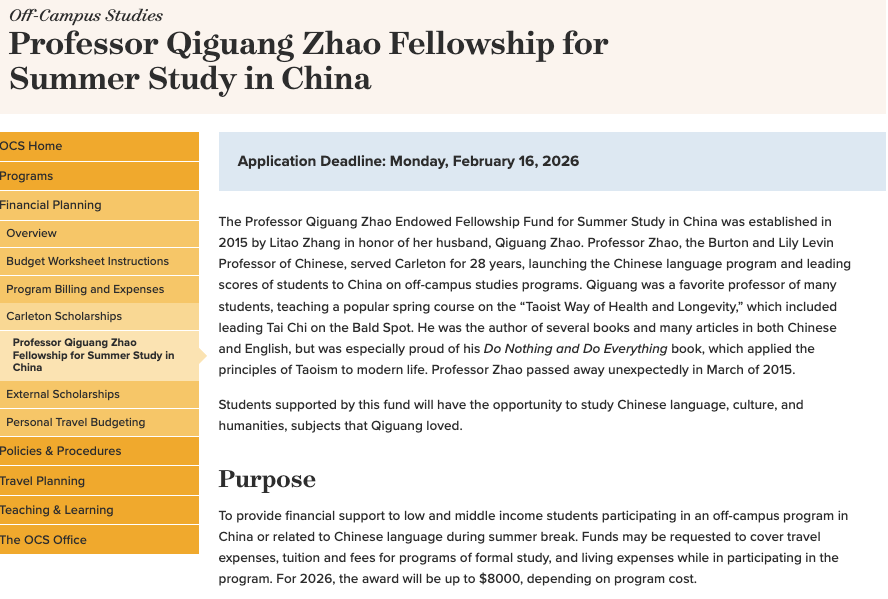
Carleton College also offers the Professor Qiguang Zhao Fellowship for Summer Study in China which has the purpose of providing “financial support to low and middle income students participating in an off-campus program in China or related to Chinese language during summer break.”
Columbia University (New York)
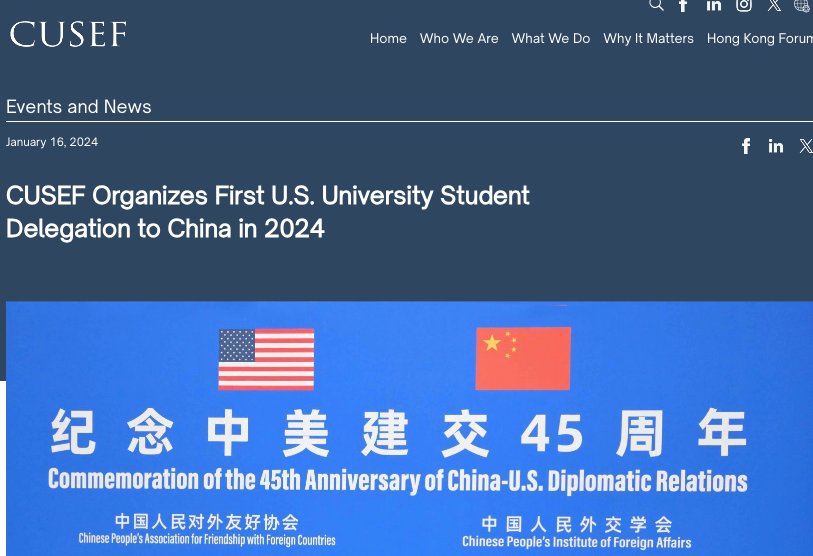
In January 2024, Columbia University’s School of International and Public Affairs (SIPA) sent a delegation of 29 students to China as part of the YES program. During the 10-day trip, “students interacted with think tanks, universities, high-tech enterprises and nonprofit organizations” and “were also invited to attend the ‘Commemoration of the 45th Anniversary of the China-U.S. Diplomatic Relations’” at the Diaoyutai State Guesthouse.
The event was organized by the China-United States Exchange Foundation, which U.S. officials have described as an “instrument of the CCP’s approach to political warfare, including influence operations intended to shape Americans’ views toward the People’s Republic of China (PRC) government.”
Elmira College (New York)
In December 2025, Elmira College signed a partnership agreement with Shenzhen Technology University to expand academic and cultural exchanges, including study-abroad opportunities between the two institutions.
As part of the agreement, Elmira College announced that its students would be eligible to participate in Shenzhen Technology University’s Young Envoys Scholarship Program, a two-week summer program established and funded by China’s Ministry of Education.
Elmira College described the YES program as providing scholarships for outstanding students, particularly business students, to travel to China for academic, cultural, and industry-focused experiences.
According to Elmira College, YES participants visit major Chinese technology companies such as Lenovo and BYD, engage with business leaders, and tour Shenzhen Technology University’s research laboratories and technology facilities.
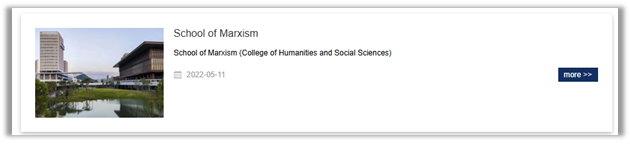
Shenzhen Technology University features a School of Marxism that teaches “the localization of Marxism in China” and “the theory of ruling party and its practice in the new era.”
Trinity University (Texas)
In 2024, Trinity University organized a three-week Sino-US Joint Student Geological Field Trip in collaboration with students from Guizhou University, which “laid a solid foundation for academic exchanges and cooperation in the field of earth science research between Chinese and American universities.”
The “field trip … provided students with valuable practical experience in exploring Triassic carbonate platform evolution, the end-Permian mass extinction, and the Triassic marine biotic recovery.” It “also served as a precious opportunity to advance collaborative research between both sides.” This trip “marks the fourth joint expedition organized by Guizhou University and Trinity University,” with previous trips occurring “in 2009, 2012, and 2017.”
Other schools involved in the trip included Chengdu University of Technology, Kunming University of Science and Technology, Northwest University, and the College of Resource and Environment Engineering of Guizhou University.
Chinese and American students “made like-minded friends and formed deep friendships” and “both American and Chinese students and teachers expressed a desire to continue enhancing exchange and collaboration in scientific research, teaching, and talent cultivation in future projects, to produce more achievements.”
An American student said “Guizhou is truly remarkable …I am grateful for the collaboration between the professors from Trinity University and Guizhou University, which has offered me new insights into Earth science. I like the inclusive teaching and … I look forward to continuing exchanges and collaborative research with my new Chinese friends.”
Another American student said “I have never left the U.S. before. Working and communicating with Chinese students has taught me so much. … It is a wonderful experience. … I hope to keep in contact with Chinese students and build a lifelong friendship. I love China’s beautiful landscape and hope to return someday to explore more.”
Guizhou University Vice President Zhou Shaoqi said he “hopes to further [deepen the] cooperation between Chinese and American universities in the realms of research and teaching.” Both universities “expressed their commitment to further deepen cooperation in the field of earth science, including research, teaching, talent exchange, and development.”
Bates Technical College (Washington)
In October 2024, 22 faculty members and students from Bates Technical College participated in the “2024 China-U.S. Youth Cultural Exchange Program” at Nanjing Vocational University of Industry Technology. The program’s theme was “Exploring the Ancient Capital of Six Dynasties, Experiencing the Beauty of China” with the “primary goal [of] strengthening student exchanges between Chinese and American vocational institutions and enhancing American students’ understanding of and identification with Chinese society and culture.”
A BTC student, “expressed his fascination with China’s rich history and cultural heritage,” and “recount[ed] his experiences to family and friends upon returning to the U.S., hoping that more American students would study and engage in exchanges in China.”
“The camp helped plant a seed of love for China among the faculty and students” and “served as a bridge for communication between Sino-U.S. vocational institutions and fostered bilateral cultural exchanges and mutual understanding.”
In a “thank-you letter” to the program, BTC president Dr. Lin Zhou “praised the meticulous planning and seamless organization which had provided an unforgettable learning experience for all participants.” Lin Zhou stated: “This exchange between American and Chinese vocational students will also leave a lasting and profound impact on the entire Bates Technical College community.”
City University of Seattle (Washington)
Between March 24 and April 1, 2026, City University of Seattle sent 12 individuals to Hangzhou and Shanghai at the expense of the “Chinese host.”
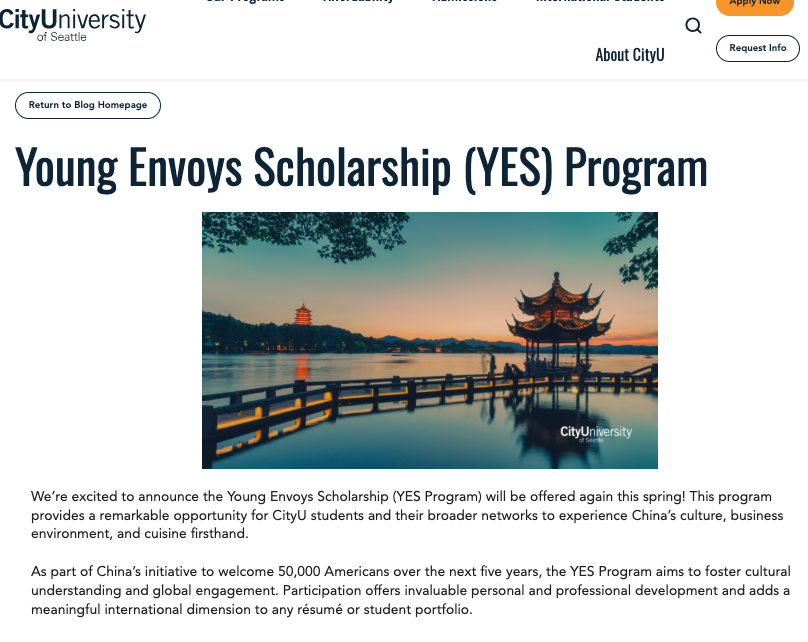
The university accepted “U.S. citizens between 13 to 45 years old, including CityU students, friends, and relatives” and “participants receive[d] a 5-year F visa, with the visa application fee waived by the Chinese embassy.” Participants attended the Cross Border E-commerce & Digital Trade Bootcamp in Hangzhou, where they met with representatives from Alibaba Group.
The travel brochure entices prospective students to not “miss the chance to know the mysterious eastern country China.”

CASE STUDIES – K-12
Muscatine Community School District (Iowa)
Muscatine High School
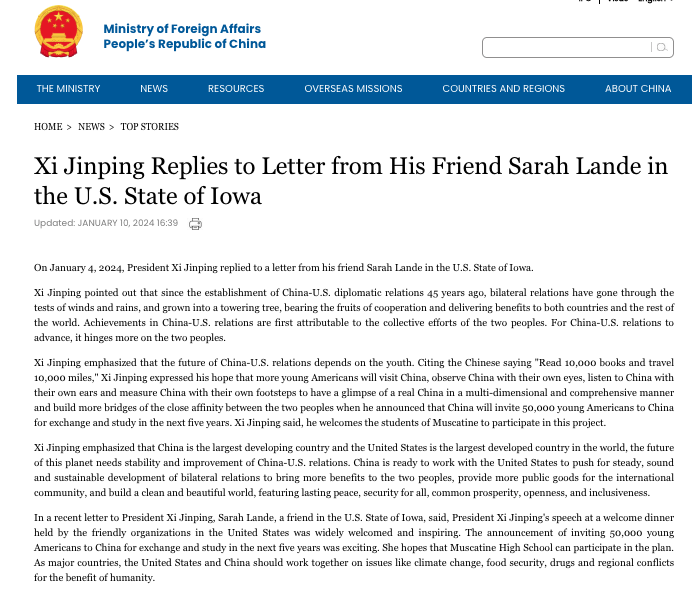
In January 2024, the Muscatine Community School District in Iowa announced a group of 24 students and four educators would travel to China as guests of China’s minister of education and that the trip was fully funded by the Chinese government.
Chinese President Xi Jinping personally wrote to his “friend,” inviting the school to China for the exchange.
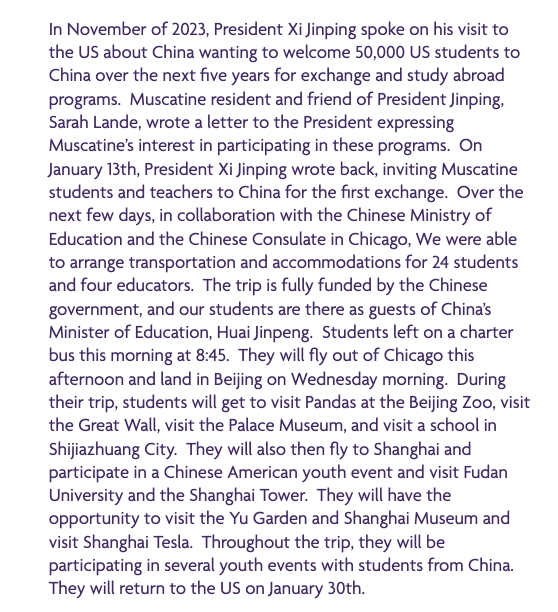
The invitation was amplified by Chinese state media, which said the students would “observe China with their own eyes, listen to China with their own ears and measure China with their own footsteps.”
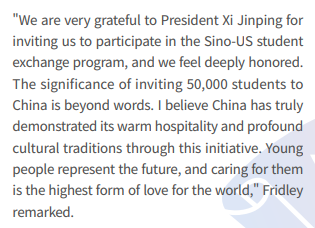
Muscatine High School’s principal said the school was “very grateful to President Xi Jinping for inviting us to participate” in the YES program, adding that China “has truly demonstrated its warm hospitality and profound cultural traditions through this initiative.”
In February 2024, Chinese Embassy coverage detailed how the students had given gifts to President Xi, including a “school flag with Chinese characters ‘Grandpa Xi, Here We Are’.” The embassy added, “After the visit, the students of the delegation wrote a letter to President Xi, sharing their joy and happiness during the visit and thanking him for inviting them to China.”
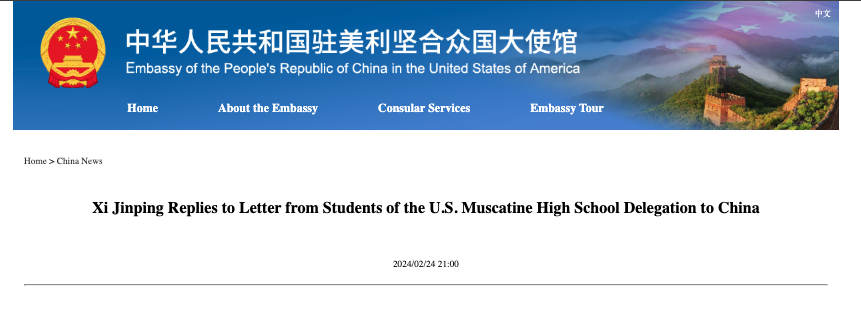
After the trip, one Iowa lawmaker called for the cancellation of any upcoming exchange trips to China, stating, “The Chinese Communist Party is not a friend … The Chinese have an agenda, and they are pushing their influence throughout the world.”
In a press release, Representative Mariannette Miller-Meeks (R-IA) called the trip “a national security concern and a reminder of the CCP’s widespread influence across the U.S.,” warning that “school systems may be unaware of CCP tactics and the threat they pose to students and U.S. national security.”
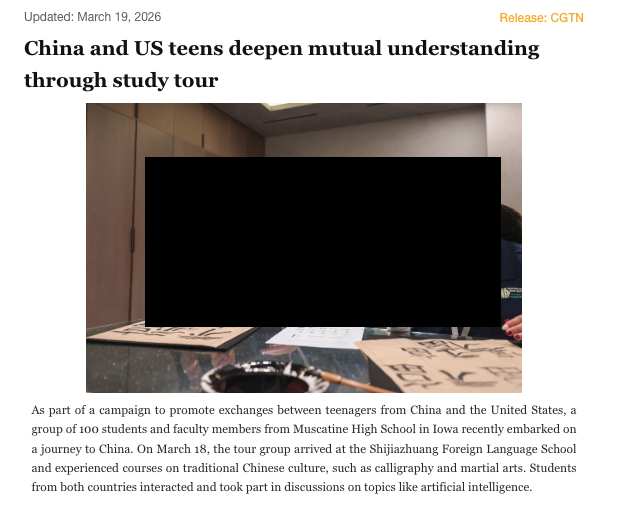
According to a press release from YES, a group of 100 students and faculty members from Muscatine High School began another exchange trip in March 2026.
Intercultural Montessori Language School (Illinois)
On June 11, 2024, a delegation of 33 teachers and students from Chicago’s Intercultural Montessori Language School visited Soong Ching Ling School in Shanghai as part of a China-U.S. youth exchange. The YES program wrote that Chicago and Soong Ching Ling share a “great love that transcends time and space” and highlighted Chicago’s support for China during the COVID-19 pandemic.
The exchange highlighted the legacy of Joan Hinton, an American scientist who moved to China in 1948 with support from Soong Ching Ling and “dedicated her entire effort to the cause of China’s socialist construction.”
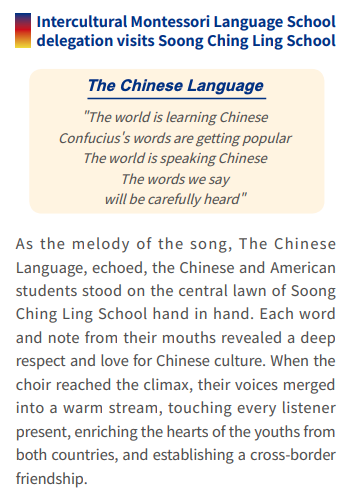
Students from both schools participated in music and performing arts activities, including an orchestra performance by Soong Ching Ling School students and a Tai Chi Fan demonstration by the American delegation.
In 2025, Roderick Shaw, head of the Intercultural Montessori Language School, praised the YES program to state-run media outlet China Daily.
Valley View Community School District 365-U (Illinois)
Romeoville & Bolingbrook High Schools
On June 12, 2024, delegations from Bolingbrook High School and Romeoville High School “visited the High School Affiliated to Southern University of Science and Technology” through the YES program, which organizers described as a “bridge for China-U.S. education and culture exchange.” The Shenzhen school promoted its model of “international, digital, and innovative education,” stating that the exchange would allow Chinese and American students to “explore the frontiers of science and technology together.”
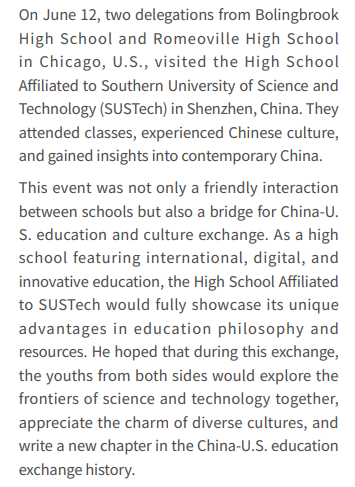
American students participated in specialized courses and demonstrations including Wing Chun martial arts, flight simulation centered on China’s C919 airliner, and general technology instruction focused on laser manufacturing. Organizers explicitly linked the exchange to broader diplomatic objectives, expressing hope that participants would “inject youth vitality into a stable, healthy, and sustainable development of China-U.S. relations.”
The program emphasized long-term relationship building among students, stating that “the seeds of friendship have quietly taken root in the hearts of the youths from both countries and will grow and flourish.”
Tacoma Public Schools (WA)
Lincoln High School
In March 2024, 10 Lincoln High School students visited China as part of the YES program. Chinese media reported that students said, “China has always been a place that I have admired and been a dream of mine to go to” and, “If I could say anything to President Xi, I’d really just want to thank him for planting the seed of relation between Tacoma and China.”
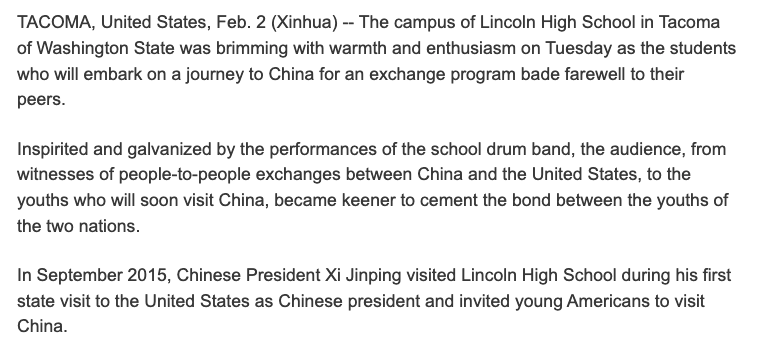
The high school’s principal said the “firsthand experience of China differed significantly from what was learned from textbooks.” In 2015, Xi Jinping personally visited Lincoln High School and invited 118 students and teachers to visit cities including Hong Kong, Fuzhou, Chengdu, and Beijing as guest of the Chinese government.
The YES program has used quotes from Lincoln High School students to praise the Chinese government, including “I felt a warm welcome,” “President Xi Jinping’s message is very heartwarming,” and “I am a China fan.” One teacher said she “strongly agreed with President Xi Jinping’s message that ‘the future is in the hands of the youth.'”
In 2026, the board approved another trip to China which included partnering with “The Chinese People’s Association for Friendship with Foreign Countries (CPAFFC), for touring purposes. CPAFFC is one of the major foreign affairs organizations of the People’s Republic of China.”
UNIVERSITIES
Alabama
Troy University
University of Alabama at Birmingham
Arizona
Northern Arizona University
- In January 2026, YES approved the Jiangsu University–Northern Arizona University “Language and Business Marketing Theme School,” with a focus of “improving Chinese proficiency and practical Chinese cross-border e-commerce.”
- The program seeks to help students “gain a deeper understanding of China’s business environment and social culture, and building a platform for interaction and professional practice among young people from China and abroad.”
- Jiangsu University will use the approval as an “opportunity to further expand exchanges and cooperation with friendly foreign universities.”
University of Arizona
- In July 2024, the University of Arizona accompanied Rosemont Ridge Middle School and Oregon International Ballet Academy to “[visit] China for a cultural exchange” through YES.
California
California State University Long Beach
California State University Monterey Bay
California State University Northridge
- In 2024, California State University, Northridge partnered with Huazhong University of Science and Technology to form the HUST-CSUN Summer School, which brought together Chinese and American students for a month of joint coursework, cultural exchange, and mutual credit recognition through co-taught business courses led by faculty from both universities.
- The program emphasized engagement through visits to Chinese and multinational enterprises, including Jianmin Pharmaceutical Group and Valeo’s Wuhan operations, exposing American students to traditional Chinese medicine, advanced manufacturing, and Chinese corporate management practices.
- Participants took part in cultural-centered activities designed to strengthen, including Chinese language lessons, calligraphy, Jingchu cultural experiences, bamboo weaving, and tours of major Wuhan historical landmarks.
- The YES program highlighted student testimonials at the program’s conclusion which described the program as highly impactful and encouraged broader participation by U.S. students.
East Los Angeles College
Harvey Mudd College
Laney College
Pitzer College
San Jose State University
Stanford University
University of California, Berkley
University of California, Davis
University of California, Los Angeles (UCLA)
- UCLA and Shadong University have collaborated on the Waystation Initiative, which supports the “voluntary return of international archaeological and ethnographic objects to the nation or community of origin.”
- “The Waystation Initiative comprises a suite of programs and resources including a certificate for UCLA graduate students, community engagement workshops, a broad stakeholder network, and the development and dissemination of new standards for the voluntary return of cultural objects.”
University of Redlands
University of Southern California (USC)
- In March 2026, the USC Viterbi School of Engineering advertised an “exclusive exchange opportunity for American youth to visit Shijiazhuang Tiedao University, a leading institution in China’s High-Speed Rail and infrastructure sector.”
Colorado
University of Denver
Connecticut
Wesleyan University
Yale University
- From July to August 2024, Shandong University hosted a month-long archaeology summer program series, which included students from Yale University, in which “participants discussed cutting-edge interdisciplinary topics on archaeological theory, economic archaeology, maritime archaeology, paleopathology, human origins and evolution, settlement archaeology, and discoveries in overseas archaeology.”
- Shadong University and Yale University created the “Joint International Research Laboratory of Environmental and Social Archaeology.”
- “These collaborative platforms … have played a significant role in advancing people-to-people and cultural exchanges between China and the U.S.”
- From July to August 2025, Yale students “visited Bayannur, Hohhot, and Beijing, taking part in cultural and academic exchanges … gaining firsthand insights into the grandeur, heritage, and vitality of Chinese civilization.”
Florida
Rollins College
Hawai’i
University of Hawai’i
- From July to August 2025, University of Hawaii students “visited Bayannur, Hohhot, and Beijing, taking part in cultural and academic exchanges … gaining firsthand insights into the grandeur, heritage, and vitality of Chinese civilization.”
Idaho
University of Idaho
Illinois
Augustana College
Northwestern University
University of Illinois
- In May 2024, “22 students from the University of Illinois at Urbana-Champaign arrived at the Haining International Campus of Zhejiang University. Together with 7 students from the Zhejiang University‒University of Illinois at Urbana-Champaign Institute (ZJ‒UIUC), they embarked on a 14-day ‘Global Classroom Summer Program’ journey.”
Indiana
Franklin College
University of Notre Dame
- In October 2024, 11 University of Notre Dame students “participated in a week-long cultural exchange program at Zhejiang University of Finance and Economics (ZUFE)” during which “they explored the countryside, entered enterprises, and visited museums, learning about the beauty of Zhejiang Province and appreciating China’s traditional culture alongside its modern civilization.”
- In addition to educational activities, students partook in “a traditional form of Chinese Qigong,” which involved “deep breaths followed [by] slow and gentle body movement while the mind followed ones’ breathing, leaving beautiful snapshots of the moment.”
Maryland
Johns Hopkins University
- In January 2024, Johns Hopkins University sent a delegation of 17 students from its School of Advanced International Studies to Beijing and Kunming for one week.
- According to YES, “through these visits, American students gained knowledge on Sino-US relations and China’s foreign investment.”
- In 1981, JHU and Nanjing University jointly established the Center for Chinese and American Studies.
Morgan State University
- In 2025, Morgan State University biology student Rosie Reynolds was awarded a two-week trip to China through the YES program that will “allow Reynolds to explore current social, economic and scientific developments in China.”
- Morgan State administrator Megan DeVirgillis touted the award as an “excellent example of how our students are developing their own global competencies while advancing mutual understanding between communities.”
Massachusetts
Boston University
Harvard University
- In February 2026, Harvard University students attended the Zhi-Xing China: U.S.-China Youth Leaders Dialogue to discuss “Green Development, Technological Innovation, and Social Governance.”
Massachusetts Institute of Technology (MIT)
- In February 2026, MIT students attended the Zhi-Xing China: U.S.-China Youth Leaders Dialogue to discuss “Green Development, Technological Innovation, and Social Governance.”
Salem State University
Stonehill College
Tufts University
Williams College
Michigan
Michigan State University
University of Michigan
- From July to August 2024, Shandong University hosted a month-long archaeology summer program series, which included students from the University of Michigan.
- According to YES, “the exchange of ideas sparked innovative views, promoting transnational and interdisciplinary interaction in archaeological research and strengthening the inheritance and innovation of traditional Chinese culture.”
- From July to August 2025, University of Michigan students “visited Bayannur, Hohhot, and Beijing, taking part in cultural and academic exchanges … gaining firsthand insights into the grandeur, heritage, and vitality of Chinese civilization.”
Wayne State University
Missouri
Missouri State University
Northwest Missouri State University
Nebraska
Bellevue University
New Hampshire
Dartmouth College
New Jersey
Kean University
- In 2006, with the assistance of Xi, who was then secretary of the Communist Party of China Zhejiang Provincial Committee, Wenzhou University and Kean University formally signed an agreement about the founding of Wenzhou Kean University.
- In June 2024, Xi communicated with current and former presidents of Kean University, with Dr. Dawood Farahi saying he was “deeply honored” to receive President Xi’s greetings and said “It is the foresight of President Xi that has opened up the way for our undertaking.”
Princeton University
Rutgers University
Stevens Institute of Technology
New York
Cornell University
Fordham University
Long Island University
New York University
- In February 2026, New York University students attended the Zhi-Xing China: U.S.-China Youth Leaders Dialogue to discuss “Green Development, Technological Innovation, and Social Governance.”
New York University Stern School of Business
Rensselaer Polytechnic Institute
The Juliard School
University of Rochester
North Carolina
Duke University
University of North Carolina at Chapel Hill
Oklahoma
Northeastern State University
University of Tulsa
Pennsylvania
Curtis Institute of Music
Indiana University of Pennsylvania
- In 2024, a “delegation of 15 students and faculty from Indiana University of Pennsylvania arrived in China at the invitation of Beijing Foreign Studies University to participate in a two-week ‘Discover China’ Sino-U.S. students exchange program.”
Millersville University
Northampton Community College
University of Pennsylvania
- In May 2024, “45 faculty and students from the University of Pennsylvania and over 50 faculty and students from Southeast University embarked on a summer study journey … connecting China and the U.S. across national borders, in the form of two-week workshops.”
Tennessee
Sewanee: The University of the South
Texas
St. Mary’s University
Utah
Brigham Young University
Utah Valley University
Virginia
College of William & Mary
George Mason University
- In July 2025, at least one George Mason University student participated in “Chinese Law International Summer School 2025,” organized by the China EU School of Law at the China University of Political Science and Law. The program comprised 24 international law students.
- The program promoted “understanding Chinese law and experiencing Chinese culture” and “building bridges between Chinese and international rule of law.”
- The curriculum included “core courses such as Overview of the Chinese Legal System, Chinese Legal Culture and Traditions, Chinese Constitutional Law, and Regulation of Market Access Through Licensing in China: Legal and Economic Analyses.”
- Students also visited “various legal practice institutions, including Zhong Lun Law Firm, Xiaomi Corporation, and the Beijing Arbitration Commission.”
- A George Mason University student said he was “thankful for the support from the host school to facilitate his participation,” and that “the experience had far exceeded his expectations, allowing him to witness firsthand a China he had only read about and to forge valuable friendships [and] expressed his hope to return to China in the future.”
University of Virginia
Washington
Washington State University
Wisconsin
University of Wisconsin – Eau Claire
K-12 SCHOOLS
California
Clayton Valley Charter High School
Irvine Unified School District
Irvine International Academy
- In June 2024, a delegation of students and teachers from Irvine International Academy visited Chengdu University of Technology Experimental Primary School, where the children at the school “warmly welcomed their American counterparts with beautiful chorus and dance” and “together, they learned to play a spear in traditional Sichuan Opera.”
Los Angeles Unified School District
John C. Fremont High School
Mark Twain Middle School
- In June 2024, a delegation from Mark Twain Middle School arrived at the “Western District of Chengdu Zongbei Joint Middle School,” where they attended history, mathematics, geography, sports, physics, and biology classes, participated in Chinese cultural lessons, and “used their pens to depict their visions of a beautiful future.”
Vaughn Next Century Learning Center
- In March 2024, students from Vaughn Next Century Learning Center visited Suzhou High School of Jiangsu Province, whose students “stepped forward to greet their American friends.”
- The YES newsletter emphasized that “our American friends savored the unique cultural meaning and spiritual pursuit that is so characteristic of the Chinese people.”
- American students were “warmly invited“ to revisit Suzhou High School in 2035 to celebrate the school’s millennium anniversary and “enthusiastically chanted” the slogan “Together for a Shared Future!”
The International School of San Francisco
- In April 2024, 43 students from the International School of San Francisco (formerly the French American International School) arrived at Xidian University to begin a course on “Exploring Chinese Culture.”
West Contra Costa Unified School District
De Anza High School
Pinole Valley High School
Florida
American Heritage Schools
- In 2026, American Heritage Schools sent a delegation of 31 students and faculty to China as part of the YES program.
- The 12-day trip focused on “high-level STEM collaboration and international diplomacy.”
- Students participated in exchanges at Nanjing Jinling High School, Changzhou Tianjiabing Senior High School, and Changzhou Vocational Institute of Engineering.
- The program included an exclusive tour of Li Auto’s manufacturing facility.
- Participants engaged in extensive cultural and historical programming in Jiangsu Province, including visits to the Ming Dynasty City Wall, Confucius Temple, Nanjing Imperial Examination Museum, Yuejiang Tower, Nanjing Hongshan Forest Zoo, and Xuanwu Lake.
- The trip concluded in Shanghai with a visit to American Heritage Learning Center.
Illinois
Chicago Public Schools
Walter Payton College Preparatory High School
Maryland
Montgomery County Public Schools
Massachusetts
Phillips Academy
New Jersey
West Orange Public Schools
West Orange High School
- As of June 2026, a group of students from West Orange High School is participating in the YES program through South China Normal University, featuring “lectures, company visits and cultural activities across Guangzhou and Foshan.”
New York
City School District of New York
Albany High School
North Carolina
Wake County Public School System
Heritage High School
Ohio
Highland Local Schools
- In February 2025, the Highland Local Schools Board of Education approved a November 2025 student trip to China proposed by Chinese language teacher Sunny Zhang, with planned visits to Shanghai, Jiaxing, Huzhou, and Hangzhou.
- The program included a student exchange component allowing participants to shadow a Chinese high school for one day, providing direct exposure to China’s educational system and student life.
- Most travel expenses were to be subsidized through a scholarship from the China Education Association for International Exchange through the YES program, with participating students responsible for registration fees, visa costs, airfare, and travel insurance.
- School officials planned to take between 20 and 30 students with faculty chaperones, while Superintendent Catherine Aukerman stated that the China exchange would be done at no financial cost to the school district.
Oregon
West Linn-Wilsonville School District
Rosemont Ridge Middle School
- In July 2024, students from Rosemont Ridge Middle School, accompanied by other institutions, “formed a delegation [to] Zhixing China” and “visited Beijing Bayi School for an in-depth artistic exchange with the Bayi Dance Troupe.”
Utah
Alpine School District
Cascade Elementary
- In May 2024, the Chinese government wrote that students from Cascade Elementary School had visited China in “recent months” as part of the YES program.
Washington
Steilacoom Historical School District
Steilacoom High School
- In March 2024, 14 Steilacoom High School students visited China in a joint delegation with Lincoln High School.
- Deputy Consul General Song Guoxuan, based in San Francisco, “expressed his hope that they will embrace the experience with open minds.”
Tacoma Public Schools
Foss High School
YOUNG ENVOYS SCHOLARSHIP PROGRAM NEWSLETTERS
Volume 1: January – March 2024
Volume 2: April – May 2024
Volume 3: June 2024
Volume 4: June 2024
Volume 5: July 2024
Volume 6: July 2024
Volume 7: July 2024
Volume 8: August 2024
Volume 9: September – October 2024
Volume 10: June – August 2024
Volume 11: September – October 2024
Volume 12: November – December 2024
Volume 13: January – March 2025
Volume 14: April 2025
Volume 15: May 2025
Volume 16: May – June 2025
Volume 17: June – July 2025
Volume 18: June – July 2025
Volume 19: June – July 2025
Volume 20: July – August 2025
Volume 21: January – March 2026
Stay Informed