



DEI in AI: University Influence
Investigations
Introduction
Artificial Intelligence (AI) is quickly becoming a part of every industry, every field, and a majority of jobs. Within the next few years, most K-12 schools and colleges will integrate AI into their curricula. This will potentially come through assisting educators with lesson plans, helping students with research assignments, and even creating specialized feedback for each student. The integration of AI into education is not a matter of if but when. As the nation’s schools begin to adopt this relatively new technology, many colleges and universities have already claimed the mantle to steward diversity, equity, and inclusion (DEI) initiatives into AI tools before K-12 schools adopt them.
The goal of these institutions of higher education is to implement DEI ideology into AI before it can be fully integrated into America’s education system. If DEI is embedded in AI before schools adopt these new tools, then DEI becomes institutionalized in the nation’s schools through AI once those tools are implemented. Defending Education has compiled the following list of colleges and universities that are using their platforms and resources to institutionalize DEI — or elements of it — as a core component of AI tools before schools fully adopt them.
These institutions will often use the phrase “algorithmic bias” with “equity” or even in the place of the word equity. Algorithmic bias is associated with the claim that AI systems are typically created by white or Asian men, and as a result, the answers that AI systems may provide to students or educators will be influenced by these specific white and Asian men who created them. In reality, most AI systems are built to provide the most accurate and truthful answers, regardless of anyone’s race or identity. The goal of these colleges and universities is to embed DEI into AI tools to ensure that students receive politicized answers and receive a politicized education in the nation’s classrooms.
This list is not comprehensive. The list represents some of the most notable colleges and universities promoting the adoption of DEI in AI tools.
Key Takeaways
- The Massachusetts Institute of Technology (MIT) has an initiative called Responsible AI for Social Empowerment and Education (RAISE) that offers “free, research-based AI curricula designed to help K-12 students understand, question, and create with artificial intelligence.” RAISE’s curricula teaches students about “algorithmic bias” and how this perceived problem is an issue that should be corrected.
- The University of California, Berkeley has a program known as the “UC Berkeley AI Research Lab (BAIR).” BAIR’s mission is “to drive critical research, innovation and collaboration towards responsible and equitable AI.” BAIR accuses ChatGPT of exacerbating discrimination for using “Standard American English” as the default.
- Columbia University has a “Social Intervention Group” (SIG) with a project called the “AI for Social Good and Society (AI4SGS) Initiative” with the purpose of advancing “research, education, and training at the intersection of artificial intelligence and social good.” This group has a project called “Human-Centered Benchmarks for Evaluating AI Chatbot Equity.” SIG explains for this project: “To ensure AI chatbots are safe and effective for LGBTQ+ communities, SIG researchers developed a human-driven benchmarking tool to evaluate outputs from popular chatbots.”
- Virginia State University has a “Center for Responsible AI” (CRAI) initiative that the school claims was created to “ensure AI is woven thoughtfully and equitably into the fabric of education, research, and public life at Virginia State University and throughout the Commonwealth of Virginia.” Areas of focus include “digital equity,” “responsible AI in smart cities, public administration, and law,” and “sustainability and conservation.”
- Morgan State University has a “Center for Equitable Artificial Intelligence and Machine Learning Systems” (CEAMLS) with a mission to “facilitate the development, deployment, and verification of socially responsible and equitable artificial intelligence systems.” Through CEAMLS, the university has outreach to young students by hosting “national convenings that challenge the status quo, launched outreach programs that engage K–20 students in the principles of responsible AI, and led collaborative research projects that model how equity and innovation can advance together.” One publication listed from CEAMLS is notably titled “What is the Future of Work in the Generative AI Era? A Marxist and Ricardian Analysis.”
Institutions of Higher Learning
Massachusetts Institute of Technology
The Massachusetts Institute of Technology (MIT) has an initiative called Responsible AI for Social Empowerment and Education (RAISE). MIT explains that this program’s mission is “to rethink and invent a more positive and inclusive future of education and learning in the era of AI” and that “our work informs, engages, and empowers millions of teachers, learners, innovators, researchers, and leaders worldwide.” The university claims that RAISE is the “MIT’s home for AI education.”
MIT also directly references equity on the RAISE homepage when discussing how people can be involved with the project: “We’d love to hear from you whether you are an educator, funder, or curious collaborator – reach out and let’s connect. Stay in the loop with our mailing list for our latest resources, events, and work in equitable AI education.”

MIT RAISE offers “free, research-based AI curricula designed to help K-12 students understand, question, and create with artificial intelligence.” One curriculum for students is called “AI and Ethics.” The description for this curriculum states: “Students explore the mechanics of AI systems, including algorithms, datasets, and prediction, while developing critical thinking around topics like algorithmic bias, optimization, and socio-technical systems.”
The name of the curriculum document is “An Ethics of Artificial Intelligence Curriculum for Middle School Students.” A significant focus of this curriculum is on “algorithmic bias.” There are activities for students in this curriculum, such as “Ethical Matrix” and “Intro to Supervised Machine Learning and Algorithmic Bias.” In the “Ethical Matrix” activity, students are to “identify the stakeholders who care about their peanut butter and jelly sandwich.” The “Intro to Supervised Machine Learning and Algorithmic Bias” activity has the following description:
Then students are asked to build a cat-dog classifier but are unknowingly given a biased dataset. When the classifier works better on cats than dogs, students have the opportunity to retrain their classifiers with their own new datasets.
The following were slides accompanied with the activities in the curriculum.
MIT RAISE hosted an “AI & Education Summit” in July 2025. The following description was provided for one of the speakers at this summit: “[Speaker] oversees Corporate Social Responsibility, Diversity, Equity, and Inclusion, Sustainability and ESG Reporting, and the Braze for Impact Fund.”
MIT RAISE explains that the program “collaborates with organizations to design tailored, impactful solutions that build AI fluency at every level of education — drawing from the full breadth of MIT’s expertise and research.” These efforts include equipping “K-12 educators with engaging, age-appropriate AI resources that make it easy to introduce students to the fundamentals of artificial intelligence” and offering “accessible, interdisciplinary AI education designed for both college and university students as well as lifelong learners and professionals.”
MIT also explains that the RAISE programs are “designed to be accessible, inclusive, and culturally responsive — ensuring they can be easily translated, adapted to diverse learning environments, and implemented in ways that reflect local contexts.”
University of California, Berkeley
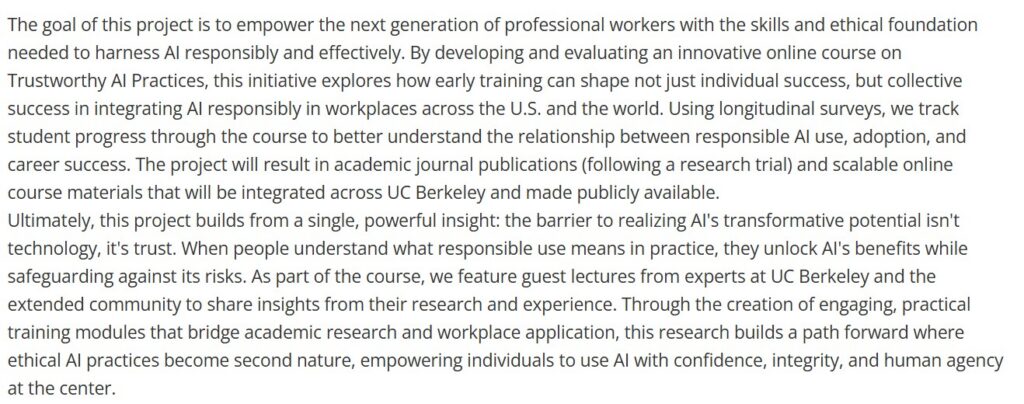
The University of California, Berkeley has a program known as the UC Berkeley AI Research Lab (BAIR). The initiative “conducts cutting-edge research and projects, while supporting an inclusive community of researchers across AI and social science disciplines to advance understandings around theories and practices for responsible AI.” The university explains that this includes “topics spanning transparency, fairness, equity, privacy, safety, security, accountability as well as broader considerations of labor and environmental impacts.”
UC Berkeley provides the following description for the BAIR program: “Our mission is to drive critical research, innovation and collaboration towards responsible and equitable AI. We envision a world in which AI supports all humans to flourish.” A major initiative of BAIR is to create “research projects that are multidisciplinary, while building from research collaborations with other organizations and groups within and outside of UC Berkeley.” This includes “variety of research topics related to responsible and equitable AI design, development and deployment.”
The university also emphasizes “workshops and convenings” for “researchers, industry leaders, and policymakers to learn from and connect with each other on topics of responsible AI.” Community building is also a focus of the program: “We support community building amongst UC Berkeley researchers exploring responsible and equitable AI across campus. We do this through our workshops, as well as regular newsletters that share happenings, events, and opportunities.”
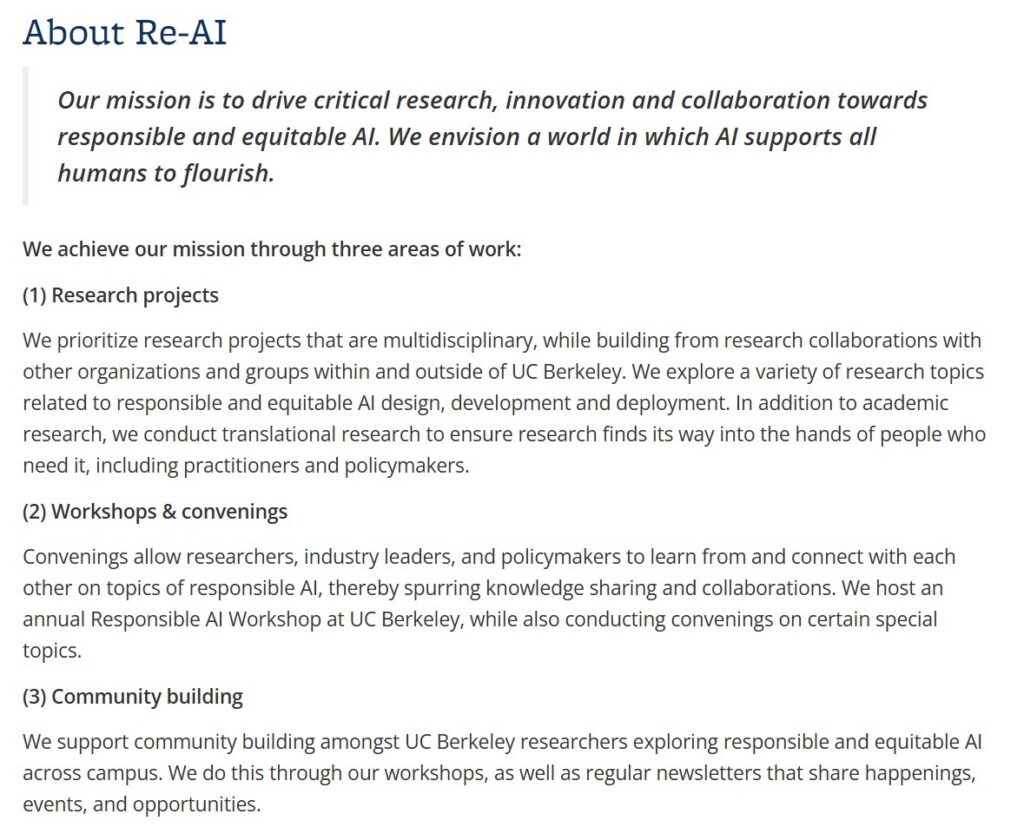
UC Berkeley’s BAIR program explicitly accuses ChatGPT of exacerbating discrimination for using “Standard American English” as the default and claims that this is equivalent to discriminating against people based on their race and ethnicity. The university states:
Over 1 billion people around the world speak varieties such as Indian English, Nigerian English, Irish English, and African-American English. Speakers of these non-“standard” varieties often face discrimination in the real world. They’ve been told that the way they speak is unprofessional or incorrect, discredited as witnesses, and denied housing–despite extensive research indicating that all language varieties are equally complex and legitimate. Discriminating against the way someone speaks is often a proxy for discriminating against their race, ethnicity, or nationality. What if ChatGPT exacerbates this discrimination?
BAIR researchers also appeared to publish a study on the issue. The authors came to the following conclusion in this study:
Disparities in output quality for speakers of minoritized varieties may hamper their ability to use language models; furthermore, harmful responses can perpetuate discriminatory ideologies. As language model usage increases globally, these tools risk reinforcing power dynamics that harm minoritized language communities.
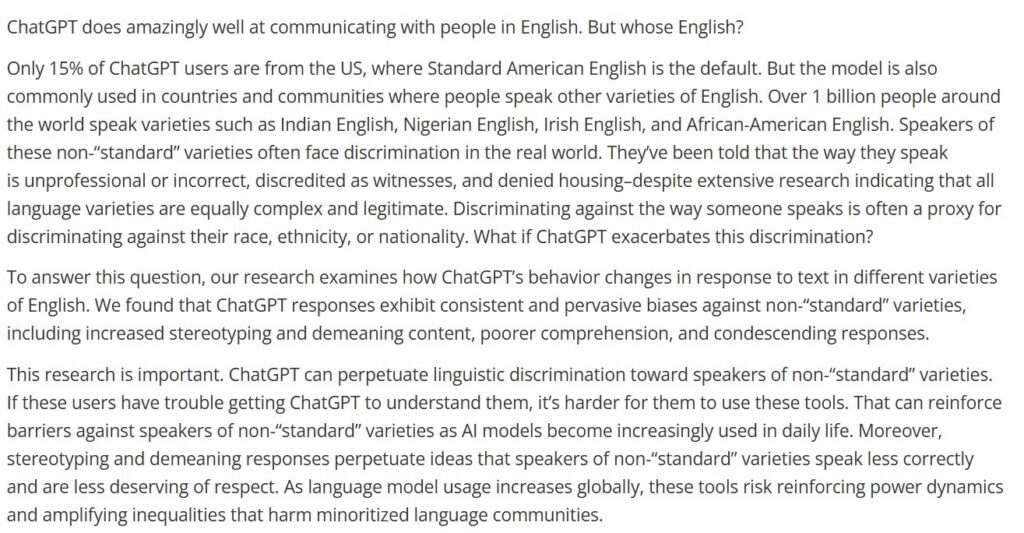
UC Berkeley’s BAIR team is working on a project labeled as “Gender Equity & Generative AI.” In the description for this project, the university explains that generative AI is often “built on large, powerful foundation models which are known to have pervasive biases along the lines of gender, race, ethnicity, nationality, language, and more.” AI tools are then described as “stereotype machines” because they are “pattern recognition and prediction machines.” The university further explains:
The powerful models underlying generative AI tools learn from data that is scraped from online which reflects inequality and discrimination that exists in the world, which the tools then learn from. Current efforts to mitigate bias in these large foundation models by companies tend to be bandaid solves, versus addressing underlying issues, while also relying on technical teams to solve problems as opposed to integrating broader social science and gender expertise.
The goal of the project is to “seek to better unpack gender biases in open text to image models, while also informing a gender equity benchmark.” The university claims that the team “will explore several innovations to mitigate biases.”
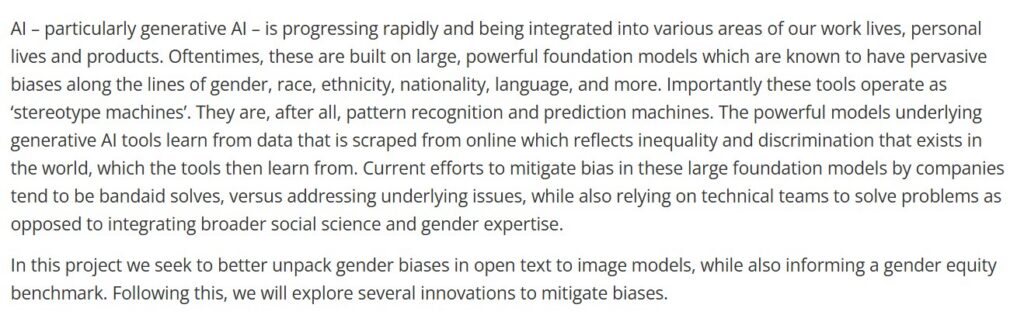
The BAIR team is working on an online course currently labeled as “Trustworthy AI.” The goal of the course will be to “empower the next generation of professional workers with the skills and ethical foundation needed to harness AI responsibly and effectively.” The university further explains:
By developing and evaluating an innovative online course on Trustworthy AI Practices, this initiative explores how early training can shape not just individual success, but collective success in integrating AI responsibly in workplaces across the U.S. and the world. Using longitudinal surveys, we track student progress through the course to better understand the relationship between responsible AI use, adoption, and career success.
The university promotes a “Responsible AI Workshop” that “delves into the latest research around responsible and equitable AI at BAIR and the UC Berkeley campus, while also supporting community building and conversation on this critical topic.” A learning objective is to “learn about and be inspired by exciting recent research related to responsible & equitable AI at UC Berkeley.”
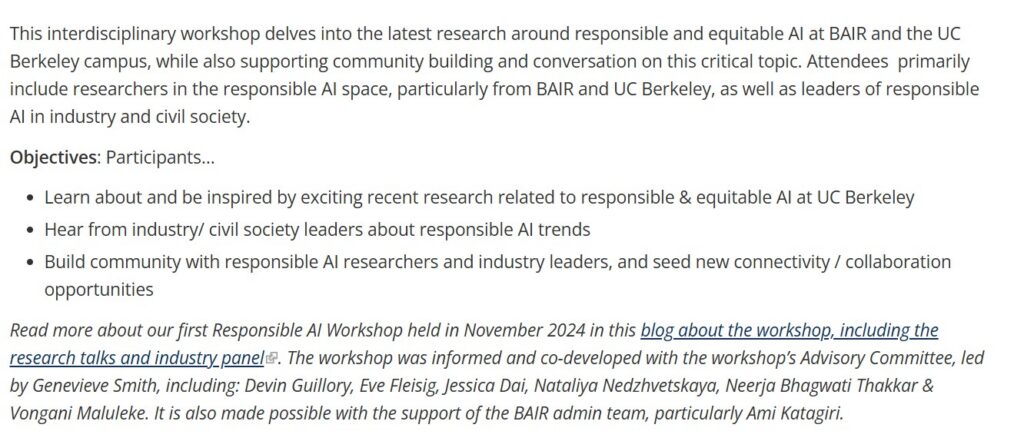
The first Responsible AI Workshop was held in November 2024. This workshop notably included a panel that featured “responsible AI leaders from Salesforce, Mozilla, Google, and Anthropic.” BAIR explained in a blog post that the workshop was “hosted by BAIR’s Responsible & Equitable AI (RE-AI) Initiative.”
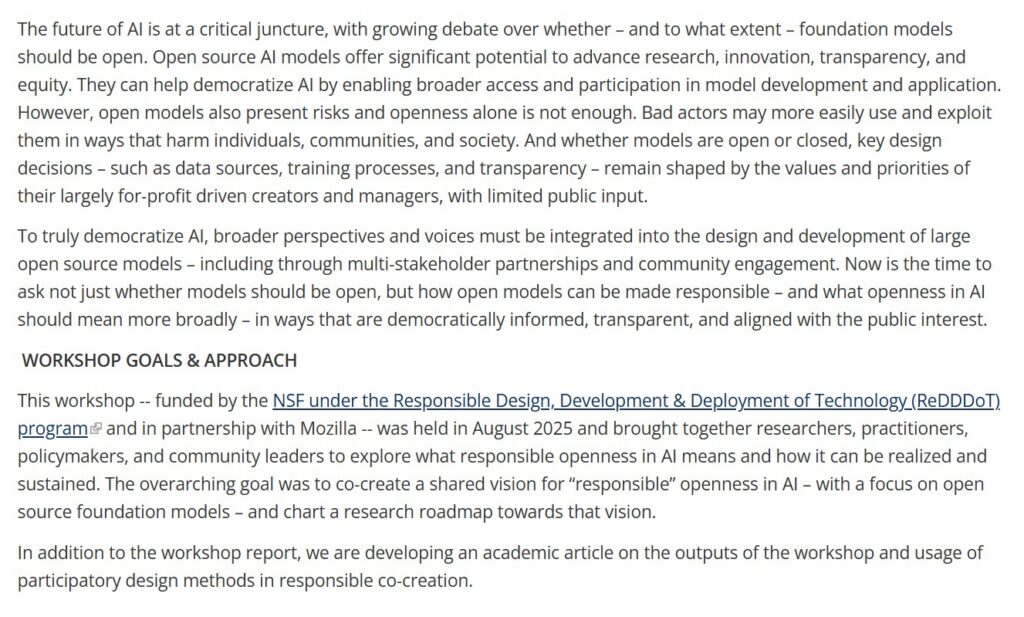
In August 2025, BAIR took part in a workshop titled “Toward the promise of open source AI: Co-creating a vision for responsibility & research roadmap.” BAIR explained that this workshop was funded by the National Science Foundation (NSF) and in partnership with Mozilla. When explaining in the workshop report why the workshop was held in the first place, BLAIR stated: “Open source AI models offer significant potential to advance research, innovation, transparency, and equity. They can help democratize AI by enabling broader access and participation in model development and application.” Participants included representatives from Meta, Microsoft, and MIT.
A pillar of this workshop included the topic of “economic and social justice” where “equitable access” was discussed. Another topic discussed was “applications and public good” where the idea of “no standalone actions, but implied in public services, health, and climate discussions” was also mentioned.
Columbia University
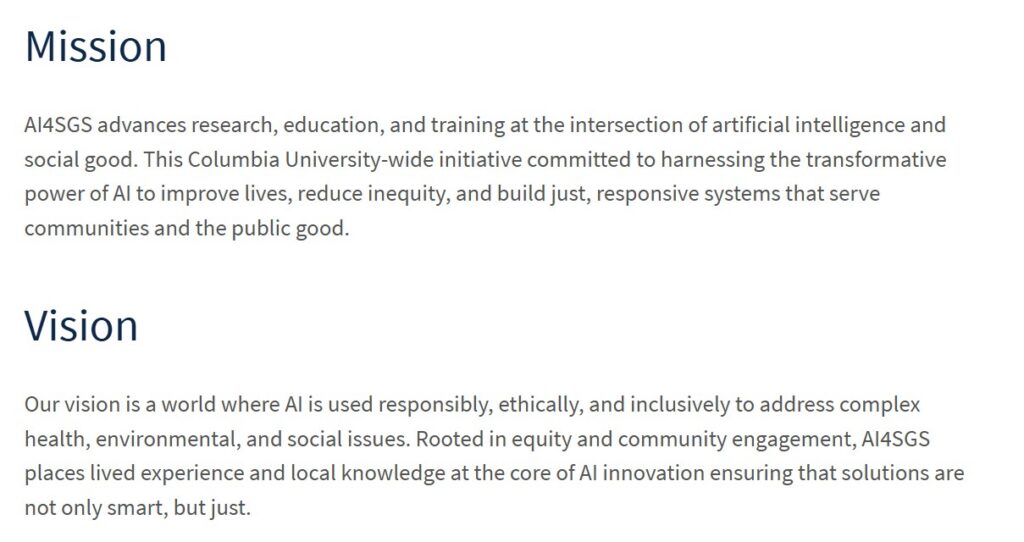
Columbia University has a “Social Intervention Group” with the purpose of developing and implementing “evidence-based sustainable solutions to emerging health and social issues affecting diverse populations domestically and globally and is training the next generation of scientists from underrepresented affected communities to address these issues.” This group has a project called the “AI for Social Good and Society (AI4SGS) Initiative” with the purpose of advancing “research, education, and training at the intersection of artificial intelligence and social good.”
This is part of the university-wide initiative to “harnessing the transformative power of AI to improve lives, reduce inequity, and build just, responsive systems that serve communities and the public good.” Columbia University then provides the following vision for this project:
Our vision is a world where AI is used responsibly, ethically, and inclusively to address complex health, environmental, and social issues. Rooted in equity and community engagement, AI4SGS places lived experience and local knowledge at the core of AI innovation ensuring that solutions are not only smart, but just.
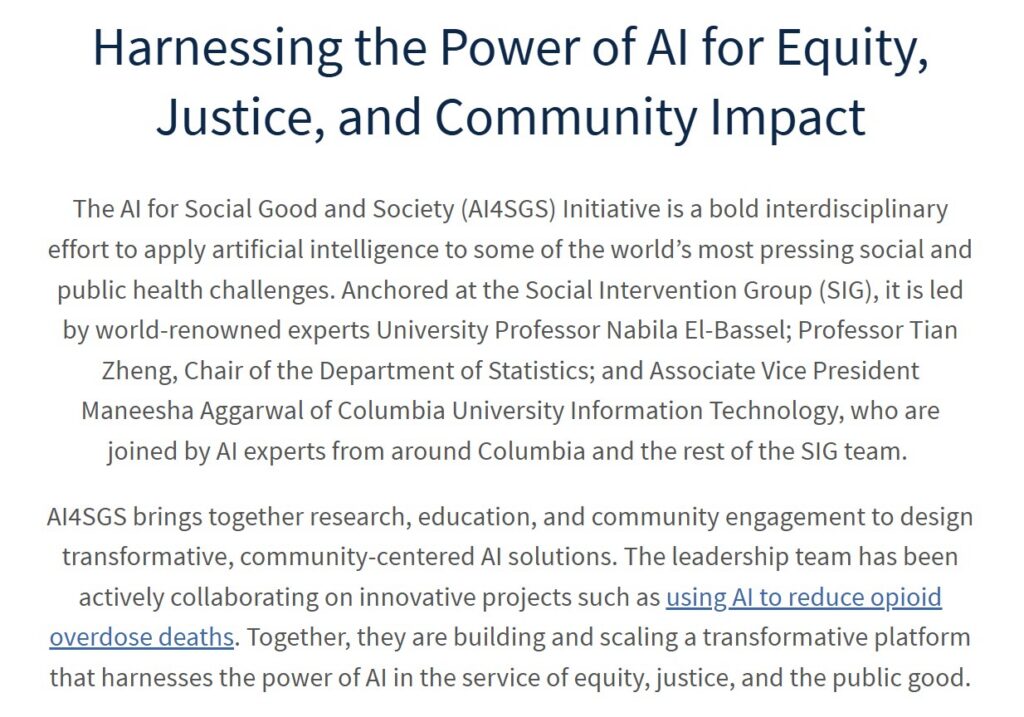
Columbia University’s Social Intervention Group (SIG) has a page online titled “Artificial Intelligence for Social Good and Society Initiative.” This group explains on the page that “our projects use AI to tackle urgent public challenges like the overdose crisis, climate vulnerability, and social service access, with a focus on real-world implementation.” In a subsection titled “Ethical AI for Public Health Equity,” SIG states that it is “developing and testing algorithms that prioritize fairness and mitigate bias in health and social service systems.” SIG also intends for AI to be “rooted in justice”:
AI is rapidly reshaping our world but without intentional design, it risks reinforcing the very inequities we seek to eliminate. Now is the time to ensure that AI serves the public good. AI4SGS is building a transformative platform for innovation—one rooted in justice, humility, and real-world impact.
The SIG group has two publications listed. One is titled “Artificial Intelligence and Stigma in Addiction Research: Insights From the HEALing Communities Study Coalition Meetings.” This is not a topic that would seemingly involve political “equity” issues. However, equity is listed as a core component in the abstract of the report:
This paper describes how artificial intelligence (AI) was used to analyze meeting minutes from community coalitions participating in the HEALing Communities Study. We examined how often coalitions discussed stigma when selecting evidence-based practices (EBPs), variations in stigma-related discussions across coalitions, how these discussions addressed race, ethnicity, and racial inequity, and whether the frequency of stigma discussions was associated with the proportion of minoritized populations in each community.
The following question was also listed as part of the examination within the report: “Was the discussion of stigma framed within the context of race, ethnicity, and racial inequity?”
The other report listed by SIG is titled “The Practical, Robust Implementation and Sustainability (PRISM)-capabilities model for use of Artificial Intelligence in community-engaged implementation science research.” The purpose of this report is to introduce the “PRISM-Capabilities model for AI to promote a human-centered approach that emphasizes collaboration, transparency, and inclusivity when using AI within [community-engaged research (CER)].” The report praises this model by stating that it “ensures that AI solutions are culturally relevant and tailored to community priorities, fostering equitable and effective outcomes.”
Equity is a core component throughout this report. At one point, the report explains: “AI could also integrate demographic and other contextual data to guide equitable resource allocation and performance using indicators such as race, income, geography, or criminal-legal system involvement.” The report also later explains: “To ensure ethical and equitable CER, we propose that all stakeholders involved in CER adopt an ethical checklist guided by the six phases of the PRISM-Capabilities model for AI.”
Columbia University has a projects page where one project is labeled as “Human-Centered Benchmarks for Evaluating AI Chatbot Equity.” SIG explains for this project: “To ensure AI chatbots are safe and effective for LGBTQ+ communities, SIG researchers developed a human-driven benchmarking tool to evaluate outputs from popular chatbots.” Responses were assessed by experts through “validity, reliability, usability, bias, and safety, revealing significant equity gaps that automated tools often miss.”
Another project on this page is titled “Structuring AI Prompts to Support LGBTQ+ Health Equity.” The following description is provided for this project: “Researchers tested how different prompt structures can shape AI chatbot responses to better support LGBTQ+ populations. Using the RISEN framework: Role, Instructions, Steps, End-goal, and Narrowing, they examined how prompts influenced the quality and inclusivity of responses from leading chatbots like ChatGPT, Claude, and Gemini.” One usage case “focused on mental health strategies for queer BIPOC youth.”
Teachers College of Columbia University also has an “Advancing Equitable Technology and Algorithms in Society” initiative known as the AEQUITAS Lab. The university explains that this initiative is “at the intersection of responsible AI and social equity, informing responsible integration of advanced technologies and algorithms in society.”

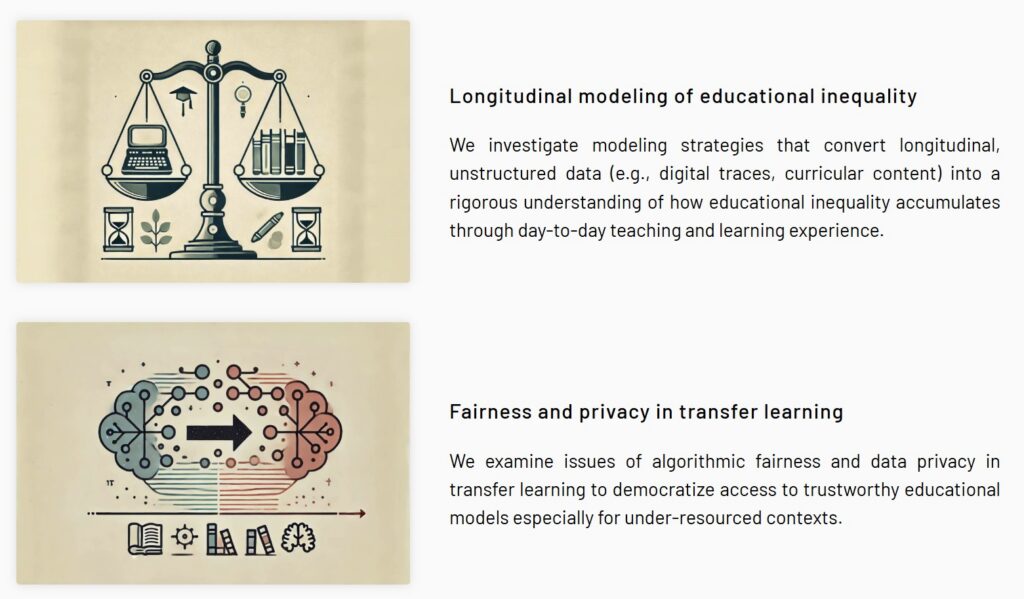
This AEQUITAS Lab has a page listing ongoing research projects. One project is titled “Longitudinal modeling of educational inequality” that consists of investigating “modeling strategies that convert longitudinal, unstructured data (e.g., digital traces, curricular content) into a rigorous understanding of how educational inequality accumulates through day-to-day teaching and learning experience.” Another project is titled “Fairness and privacy in transfer learning” that consists of examining “issues of algorithmic fairness and data privacy in transfer learning to democratize access to trustworthy educational models especially for under-resourced contexts.”
The lab also has a list of publications that includes one report titled “When the Past Misleads: Rethinking Training Data Expansion Under Temporal Distribution Shifts.” The report makes the argument that predictive AI models being trained on historical data can lead to bias. The report states:
In the common situation where historical data is used to train a machine learning model to predict future outcomes, the “more data is better” assumption means a preference for including more data from earlier time periods in addition to recent data to generate predictions for a given future timepoint. While this strategy aims to improve model robustness, it may introduce outdated patterns that divert from more recent data points. This divergence is known as distribution shift in statistics and machine learning research.
The report makes the argument for “algorithmic fairness” in that “machine learning models should yield equitable outcomes across diverse demographic groups.”
Virginia State University
Virginia State University has a “Center for Responsible AI” (CRAI) initiative that the school claims is a “beacon of leadership and innovation in the rapidly evolving field of artificial intelligence.” The university also claims that CRAI was created to “ensure AI is woven thoughtfully and equitably into the fabric of education, research, and public life at Virginia State University and throughout the Commonwealth of Virginia.” The center was established in 2025.
CRAI claims to “provide science-based advisement to strengthen policy at the local, state, national, and international levels.” Areas of focus include “digital equity,” “responsible AI in smart cities, public administration, and law,” and “sustainability and conservation.” The goal of this center is to directly affect education. The following goals were provided to influence AI in schools:
- K–12 Education and Outreach: Inspiring future innovators through hands-on STEM and AI programs designed to build foundational skills and spark interest early and often.
- Undergraduate Education: Providing students across disciplines with opportunities to engage in AI-focused coursework, collaborative projects, and research experiences that integrate technical rigor with ethical responsibility.
- Graduate Programs: Advancing specialized knowledge in AI through master’s and doctoral-level research to equip students to push the boundaries of discovery and tackle real-world challenges.
- Postdoctoral Training: Supporting advanced scholars with mentorship, resources, and access to interdisciplinary collaborations that accelerate breakthroughs in responsible AI research and applications.
The university promotes an “AI Living Labs Network” with the purpose of reimagining “collaborative AI development through its original Constellation Model—a network where knowledge, application, ethics, and community co-create impact.” This network “helps to shape the future of ethical, socially responsive artificial intelligence” and has a mission to create a “collaborative environment where research, education, and real-world application converge for responsible, equitable AI innovation.” This is achieved through “ethical principles, inclusiveness, and measurable social impact.”
This network has a “Constellation Model” to “describe how responsible AI emerges through the interplay of multiple areas, each forming a critical ‘constellation’ within a larger adaptive system.” One of the “constellations” of this model is labeled as “Ethics Constellation: Policymakers, ethicists, and interdisciplinary specialists ensuring that AI technologies align with justice, transparency, and societal values.” One area of focus is also labeled as “AI for Social Impact.”
Another CRAI initiative is called the “Forum for Real‑World AI Measurement and Evaluation” (FRAME). The university describes this initiative as “building the next generation of AI evaluation by measuring system behavior in real contexts, not just on optimized tests.” This initiative “formalizes real-world AI evaluation methods and translates evaluation outcomes into decision-ready evidence” by combining “large‑scale trials of AI systems with structured observation of how people actually use them, what outcomes they generate, and how those outcomes arise in context.”
In the mission for FRAME, the university explicitly explains that the intention is to influence society through AI: “FRAME’s mission is to generate systematic, decision‑ready evidence about how AI systems behave in real‑world contexts to help policymakers, practitioners, and communities govern AI deployments in line with their operational realities and societal goals.”
Morgan State University
Morgan State University has a “Center for Equitable Artificial Intelligence and Machine Learning Systems” (CEAMLS) with a mission to “facilitate the development, deployment, and verification of socially responsible and equitable artificial intelligence systems and to ensure the public is well informed of how evolving technologies in this space affect their health, prosperity, and well-being.”
The webpage for CEAMLS prominently features a video titled “AI and Algorithmic Bias” that is dated August 18, 2022. One of the speakers in the video claims that perceived algorithmic bias is “projecting the bias that human beings have” into artificial intelligence. This speaker claims that AI facial recognition is an example of algorithmic bias because of demographics that an AI system is trained using. He then provided a supposed example of an AI system used for college admissions preferring names that looked European.
The “about” page for CEAMLS reiterates that equity is a core component of this initiative:
We bring together faculty, students, policymakers, and industry partners to interrogate how AI systems are built, whom they serve, and what standards should guide their use. From technical innovation to ethical frameworks, we believe equitable AI is not a niche issue; it is foundational to the integrity and success of modern systems.
That page also explains that the university uses CEAMLS for outreach to young students as well:
Over the past year, CEAMLS has expanded its impact through a range of initiatives. We’ve hosted national convenings that challenge the status quo, launched outreach programs that engage K–20 students in the principles of responsible AI, and led collaborative research projects that model how equity and innovation can advance together. Our annual symposium and Summer AI Research Institute continue to grow as vital platforms for critical dialogue and practical training. And through our partnerships with institutions, foundations, and government agencies, we are shaping how AI is studied, taught, and governed.
CEAMLS produces research to “formalize best practices for data preparation, model training, deployment, and evaluation — building scalable frameworks that promote fairness, transparency, and accountability.” This includes “rigorous testing protocols that identify and reduce algorithmic bias before AI models reach the public.”
As part of the initiative’s research, there are several labs with different types of ongoing AI investigations. One is titled “Children’s Education in Computing Exploration (CECE) Lab.” The description for this lab states: “We make investigating AI fun with hands-on, standards-aligned education. Through our student workshops and an open curriculum for teachers, we prepare children to excel in emerging technologies.”
Another lab is called “Quantitative and Qualitative AI Ethics Lab (QQAEL).” The following description is provided for this lab:
Current projects in the lab include critical and constructive work on resolving conflicts between incompatible fairness metrics (“fairness impossibility”); disentangling different concepts and contexts of bias and providing guidance on when biases are ethically acceptable or unacceptable; and exploring how and why “proxies” can, in general, align or fail to align with the values they’re used to measure.
CEAMLS has a “K-12 AI Learning” program that “aims to expand access to artificial intelligence education by providing free, standards-aligned curriculum and experiential learning opportunities for students and educators.” Part of this program is a “CECE Lab Teacher Education Summer Cohort” that serves as a “professional learning experience designed specifically for K–12 educators interested in expanding their knowledge and application of artificial intelligence, STEM integration, computational thinking, and challenge-based learning in classroom settings.” This includes “curriculum development, instructional innovation, and student instructional practice designed to strengthen AI and STEM education practices for K–12 students.” The current program date is listed as June 22 – July 31, 2026. Participants will be awarded a $4,000 stipend.
CEAMLS has a list of publications for 2025 that notably include numerous reports on AI and bias, including “Algorithmic Bias Detection: A Focus on Skin Tone and Gender Fairness in Computer Vision Models,” “AI Biases as Asymmetries: A Review to Guide Practice,” “Bias Recognition and Mitigation Strategies in Artificial Intelligence Healthcare Applications,” “What is the Future of Work in the Generative AI Era? A Marxist and Ricardian Analysis,” “Mitigating Bias in Large Language Models Through Culturally-Relevant LLMs,” and “The Economic Precondition of Voice: How a Universal Basic Income (UBI) Can Promote Workplace Democracy.”
Morgan State University’s program also has a list of ongoing research projects. Two of these projects are titled “Exploring Algorithmic Bias in Conversational AI” and “Investigating Algorithmic Bias in Virtual Reality.”
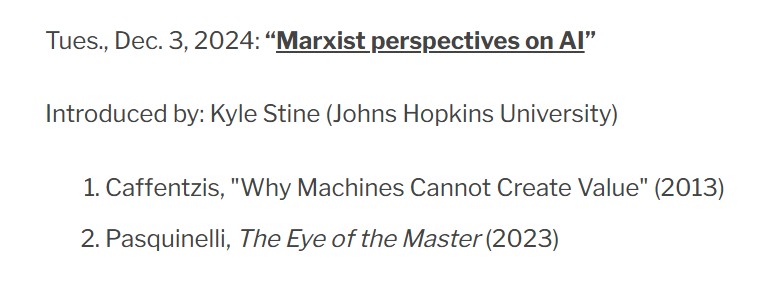
CEAMLS has an “AIM-LIFT: Artificial Intelligence and Machine Learning Interdisciplinary Forum for Theory” that serves as a “reading and discussion group on AI and its social implications.” This initiative aims “to improve AI futures through technically informed and theoretically sophisticated discussion of AI/ML in its full context, drawn from multiple disciplines, skills, and backgrounds.” One of this group’s meetings from December 3, 2024, focused on the topic of “Marxist perspectives on AI.”
CEAMLS hosts an annual “National Symposium on Effective & Ethical AI” annually. The 2025 symposium featured “critical and constructive reflection on artificial intelligence’s past, present, and future, with special attention to issues of equity and racial bias.” Topics included “AI’s carbon footprint,” “AI in K-12 education,” “AI in higher education,” “predictive policing: risks and impacts, including for biases and equity,” “AI applications for evaluation of equity and bias in policing,” and “conceptualizing diverse diversities: disciplinary, cultural, etc.”
Additional DEI in AI Initiatives in Higher Education
Seattle University
Seattle University has an “AI for Equity” program for “high school students interested in criminal justice and artificial intelligence.” The university claims that this program “teaches students about the intersection of modern technology and criminal justice issues, such as bias and equity.” Students will “evaluate solutions from a technical perspective as well as from a lens of social justice” and “create AI solutions to traditional social problems.”
Howard University
Howard University has a “Howard AI” initiative for “ethical, transformative artificial intelligence, educating the next generation of AI leaders, accelerating breakthrough research, and deploying responsible technologies that uplift communities, drive operational excellence, and advance our nation’s progress.” The initiative’s goal is to support the “development and implementation of Howard AI across Howard University and harnesses the transformative potential of AI for the betterment of society.” The four pillars of Howard AI are “Ethics and Societal Benefits,” “Research and Innovation,” “Education and Workforce Development,” and “Operational Efficiency.”
Morehouse College
Morehouse College has an initiative called “Morehouse Outreach for Responsible AI in Learning (MORAL)” with the goal of extending the college’s “historic mission of moral, ethical, and justice-centered education into the age of artificial intelligence.” The idea is to ensure that “the development and deployment of AI tools in learning environments reflect values of integrity, equity, and social responsibility.” The college intends to promote a “Model Ethical Pedagogy” that will embed “AI ethics and justice frameworks into teaching and learning practices.” Another goal is to create a “teaching framework rooted in Morehouse’s values of moral discernment, social justice, and intellectual leadership, guiding responsible AI integration across disciplines.”
University of Washington
The University of Washington has an initiative called the “Center for Responsibility in AI Systems and Experiences (RAISE)” with the goal to “improve equitable access and use as the world adapts to the proliferation of AI.” Publications listed from RAISE include “Algorithmic Behaviors Across Regions: A Geolocation Audit of YouTube Search for COVID-19 Misinformation Between the United States and South Africa,” “Towards Designing Social Interventions For Online Climate Change Denialism Discussions,” and “Assessing enactment of content regulation policies: A post hoc crowd-sourced audit of election misinformation on YouTube.”
North Carolina Central University
North Carolina Central University has an “Institute for Artificial Intelligence and Emerging Research (IAIER)” initiative with the self-described goal to leverage “AI to address complex societal, economic, and technological challenges.” One research initiative from this group is called “AI and Social Equity.” This research project focuses on “the ethical implications of AI, machine learning applications for public benefit, and methods to mitigate bias in fields such as healthcare, education, and criminal justice.” Another research initiative is called “Data-Driven AI for Social Good.” The goal for this project is to “develop AI models that analyze large datasets to inform decision-making in healthcare, education, and public policy” with a “focus on minimizing bias in data and ensuring that AI systems are broadly applicable and useful in real-world settings.”
Stay Informed