The University of North Carolina (UNC) has a student organization called “TransparUNCy” that supports the university adopting far-left policies and hiring staff who promote gender ideology. Inside Higher Ed reported that the student group “grew out of the Affirmative Action Coalition” that had “advocated for racial justice and equity in higher education.” A founder of the organization previously voiced concern about “right-wing attacks on institutions and university governance,” including “attacks on affirmative action.”
TransparUNCy was notably responsible for a “walk out” event supporting “Palestine” in 2024. This event led to a riot and vandalism throughout the campus. UNC gives “Chancellor’s Awards” as the “highest student honors for excellence in academics, extracurricular activities, and leadership.” In 2026, the university gave the “Edward Kidder Graham Award” to one of TransparUNCy’s founders for demonstrating “consistent leadership, dedication, and innovation within the [student] organization; contributed to the organization’s strength, vitality, and longevity; and assisted the organization in supporting the overall mission of the University.” She was specifically given the award for “her leadership in the student organization TransparUNCy, where she has created profound community and engagement.”
On the third anniversary of Hamas’ terrorist attack against Israel on October 7, 2023, TransparUNCy hosted an event on October 7, 2026, to “examine the state of free expression, protest, surveillance and institutional accountability at UNC in the wake of the Palestine Solidarity Encampment and the campus controversies that followed.” The event was openly promoted on the website for the UNC Center for Media Law and Policy. The description for this event stated:
Looking back on a moment that many view as a turning point in the university’s history, panelists will discuss the tensions between political dissent and administrative authority, the university’s response to student activism, the role of policing and disciplinary measures in higher education and broader questions about freedom of speech, freedom of assembly and academic freedom on campus.
TransparUNCy shared a flyer on Instagram showing that the event would feature a panel “on the Palestine student protests and why free speech is handcuffed at UNC.” UNC’s NAACP chapter notably gave a favorable response to the flyer.
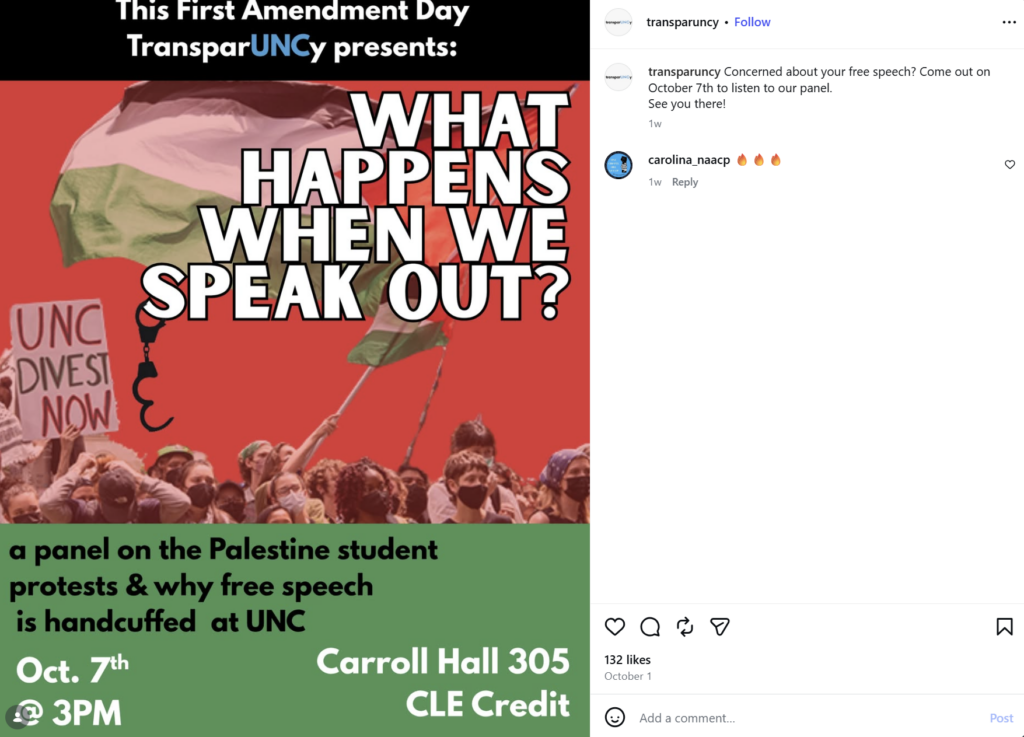
Students were able to earn Campus Life Experience (CLE) credit for attending the event. According to UNC, students are now “required to complete eight (8) CLEs over the course of their undergraduate career.” Students are required to complete at least one CLE credit in each of the four categories: “Civic Engagement, Public Service, and Academic Enhancement,” “Films, Music, & Visual and Performing Arts,” “Career Exploration & Leadership Development,” and “Campus Life and Personal Well-Being.”
For an event to be approved as CLE credit, events must “provide an opportunity to perceive and make meaning of people, culture, and ideas in new, unfamiliar or exceptional ways,” “enrich and broaden the college experience,” and “engage in career, academic, or service exploration.” UNC then explains: “The CLE team will approve or deny event submissions based on the criteria above, in addition to ensuring that the category selected by the event submitter aligns with the definition of the category.”