



AccreditED: Social Work Programs Steeped in Anti-Racism, DEI, Critical Race Theory, Privilege and Anti-Oppressive Practices
Investigations
IN THE REPORT:
Number of states: 50 plus District of Columbia
Number of colleges and universities: 350
Number of social work degree programs: 500
Number of bachelor’s programs: 284
Number of master’s programs: 217
Department of Education grant funding to social work programs in the report: $91,032,114
Membership dues and accreditation fees collected from 2016-2023: $40,265,574
SUMMARY
This purpose of this report is to expose how the Council on Social Work (CSWE) requires the integration of anti-racism and diversity, equity, and inclusion (ADEI) throughout the bachelor’s and master’s degree process. Furthermore, the organization’s 2022 Educational Policy and Accreditation Standards (EPAS) weaves ADEI into eight of the nine competencies for which institutions are required to follow for full accreditation. CSWE currently accredits around a combined 897 bachelor’s and master’s degree social work programs, of which 501 programs (55%) from all fifty states plus the District of Columbia appear to still be implementing ADEI in program competencies, curriculum, and student evaluations.
Social work programs go through the process of accreditation/ reaffirmation every eight years. Those CSWE accredited programs not included in this report (roughly 45%) appear to be operating under the 2015 EPAS, which does not include ADEI. However, according to CSWE, “all accredited programs are expected to operate under the 2022 EPAS by July 1, 2025,” unless they are in the process of accreditation/ reaffirmation – giving them one year to transition to the 2022 EPAS.
Through the collection of program handbooks, field guides, current webpages, and accreditor assessments, this report highlights those social work degree programs that appear to still promote ADEI in the curriculum and course work.
We looked at the organization’s 990 tax documents and filed Freedom of Information Act (FOIA) requests to gather financial data from institutions such as invoices and purchase orders. Using the last eight years worth of available 990s (2016-2023), CSWE collected $40,265,574 million from universities in membership dues and accreditation fees. Additionally, documents obtained through FOIAs show that colleges and universities spend between $3,700 to over $5,000 a year per degree program on membership dues, and $5,000 to $10,000 on accreditation and reaffirmation fees.
It is also important to note that during the Biden Administration, the Department of Education approved over $100 million in grants to institutions of Higher Education for social work programs. Through either the Mental Health Service Professional Demonstration Grant Program or the School-Based Mental Health Services Grant Program, funds were given to twenty-five university social worker programs to increase the number of licensed social workers, with an emphasis on growing the number of social workers in K-12 school districts. Out of those twenty-five institutions, twenty-two still appear to emphasize a commitment to ADEI and anti-oppressive practices.
This report features sections that include CSWE’s philosophy and competencies, noteworthy examples and a few extended examples, and a list of college and university social work degree programs with links to documentation such as handbooks, field guides, accreditor reports, and webpages.
Finally, the absence of an institution from this report does not necessarily mean ADEI practices are absent from programming. It means that no documentation was available to verify its engagement in ADEI.
KEY TAKEAWAYS
- Eight out of the nine competencies that are part of the Council on Social Work Education’s (CSWE) 2022 Educational Policy and Accreditation Standards include “anti-racism,” “anti-oppression,” privilege, power, and other social justice focuses.
- Over fifty percent (501 out of 897) of accredited social work programs appear to be using anti-racism and DEI in program competencies, the admissions process, and field work evaluations. Those programs that still fall under the 2015 EPAS, which do not include anti-racism and DEI, are expected to transition to the 2022 EPAS by July 1, 2025.
- The Biden Administration’s Department of Education approved $91,032,114 in grants to twenty-two university social work programs that incorporate anti-racism and other diversity, equity, and inclusion focuses.
- Per the Council on Social Work Education’s (CSWE) last four 990 tax documents (2016-2023), it has brought in over $40 Million in membership fees and accreditation fees. Exact amount is $40,265,574.
- A number of institutions utilize personal statements, essays, and questions in the application process to gauge an applicant’s commitment to anti-racism and DEI.
NOTEWORTHY EXAMPLES
- The University of Alaska Anchorage’s 2026-2027 Master of Social Work Program & Admissions Information booklet states that the purpose of the admissions writing sample is to provide evidence of the applicant’s “understanding of concepts fundamental to the social work profession such as anti-racism, diversity, equity, and inclusion and to advancing human rights and social, racial, economic, and environmental justice.” The booklet also notes that admission to the program is based on several factors such as an applicant’s “demonstration of social work values, ethics, and commitment to social justice, diversity, and anti-racism.”
- California State University, Dominguez Hills’ Master of Social Work program states that it is “grounded in Critical Race Theory and Intersectionality” and is “dedicated to advancing anti-racist social work education that addresses societal dynamics stemming from the intersectional oppression based on race, ethnicity, culture, gender, immigration, socio-economic status, and membership in other categories historically subjected to oppression, discrimination and indifference.”
- California State University, Long Beach’s School of Social Work states that it is “committed to critical race theory through a critical pedagogical framework” which “centers the perspectives and needs of the most marginalized and oppressed individuals and segments of our society and directly addresses differences in power, privilege, and status based on race as it intersects with class, gender, sexuality, immigrant status, ability, and other factors at micro, mezzo, and macro levels.” The program site also states that course content “integrates and emphasizes” concepts such as “racism is ordinary,” “interest convergence (racism serves the interests of white people),” and a “critique of neoliberalism (individual success based on merit, emphasis on the market, small government/small welfare state).”
- San Francisco State University’s (CA) School of Social Work Practicum/Internship Manual notes that it “decided to no longer use the term ‘field’ to refer to practicum/internship” in order to support “anti-racist social work practice by replacing language that could be considered anti-Black or anti-immigrant in favor of inclusive language.”
- Metropolitan State University of Denver’s (CO) Master of Social Work application states that the program is “seeking students who are committed to ADEI work in their education and professional practice” and requires a response to an essay question which asks applicants to “discuss an experience you have had with engaging in anti-racist, diversity, equity, and inclusion practice (this could be a personal lived experience)” and what specific role the applicant played in “engaging in this work.”
- Briar Cliff University’s (IA) Department of Social Work includes in its Application for Admission a set of “Personal Statement” questions such as “Anti-Racism and Social Justice: Racism remains a widespread issue in the United States, affecting the ability to achieve a just society. Describe your understanding of racism and discuss actions social workers can take to advocate for systemic change.”
- The University of Maine’s School of Social Work requires an essay for admission to its Master of Social Work which includes asking applicants to describe their “commitments to anti-racism, diversity, equity, and inclusion and plans to advance them through graduate study in social work and professional practice as a social worker.”
- Coppin State University’s (MD) Department of Social Work states that its mission is “grounded in anti-racism, diversity, equity, and inclusion” and is committed to “Black liberatory frameworks, cultural humility, and anti-oppressive practices.”
- The Rutgers University (NJ) School of Social Work program features an additional tenth competency titled “Develop Liberatory Consciousness.” The competency states that social work practitioners “understand and identify how white supremacy, racism, and other forms of stigma, prejudice, discrimination, and oppression intersect to impact groups, organizations, and communities within which they work and live.”
- The University of Portland’s (OR) Dorthy Day Social Work Program prioritizes “Anti-racism and Critical Race Theory (CRT), which names the impact of historical racism on modern life and is grounded in uplifting the race-conscious experiences of Black, Indigenous, People of Color (BIPOC) in order to radically shift dominant narratives which often obscure and constrain BIPOC expressions and insights.”
- The West Virginia University School of Social Work requires that master’s program applicants submit an essay that includes two paragraphs focused on anti-racism and DEI. Additionally, the school’s Anti-Racism Statement declares that it is “committed to anti-racism, equity, and racial justice” and denounces “white supremacy, systemic and anti-Black racism, oppression, and bigotry in any form.”
COUNCIL ON SOCIAL WORK EDUCATION
The Council on Social Work Education’s (CSWE) 2022 Educational Policy and Accreditation Standards (EPAS) for Baccalaureate and Master’s Social Work Programs requires that students are learning to integrate anti-racism, diversity, equity, and inclusion (ADEI) and anti-oppressive lenses into their practice.
The organization’s Commission on Accreditation (COA) is “responsible for formulating, promulgating, and implementing the accreditation standards for bachelor’s and master’s degree programs in social work, for ensuring that the standards define competent preparation, and for confirming that accredited social work programs meet the standards.” COA “administers a multi-step peer review accreditation process that involves program self-studies and benchmarks, site visits, and COA reviews.”
The 2022 EPAS “adopts a competency-based education framework identifying the nine social work competencies accompanied by a set of behaviors for each competency.” The EPAS “describes five elements of an integrated program design” which includes the “program mission,” “anti-racism, diversity, equity, and inclusion,” “explicit curriculum,” “implicit curriculum,” and “assessment.”

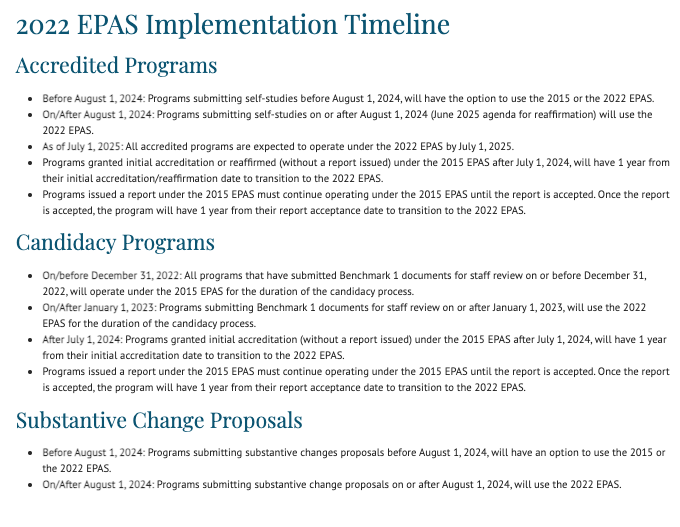
According to CSWE’s 2022 EPAS Implementation Timeline, “all accredited programs are expected to operate under the 2022 EPAS by July 1, 2025.” It continues by stating that “programs granted initial accreditation or reaffirmed (without a report issued) under the 2015 EPAS after July 1, 2024, will have 1 year from their initial accreditation/ reaffirmation date to transition to the 2022 EPAS.”
Competencies
The EPAS document includes nine social work competencies which describe the “knowledge, values, skills, and cognitive and affective processes that make up the competency at the generalist level of practice, followed by a set of behaviors that integrate the components.” Individual university programs are also allowed to expand upon the competencies by adding their own above and beyond the nine EPAS competencies.
The accreditor has woven “anti-racism,” “anti-oppression,” privilege, power, and other social justice focuses into eight of the nine competencies required for accreditation.

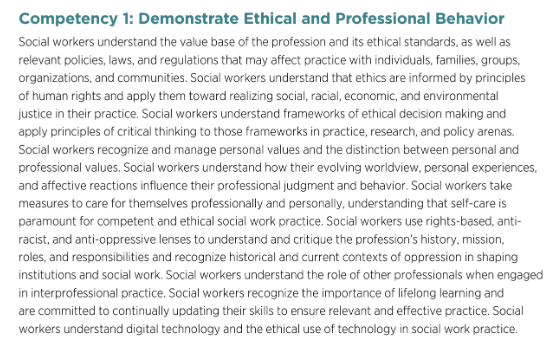
Competency 1: Demonstrate Ethical and Professional Behavior
The first competency states that social workers “use rights-based, anti-racist, and anti-oppressive lenses to understand and critique the profession’s history, mission, roles, and responsibilities and recognize historical and current contexts of oppression in shaping institutions and social work.”
Competency 2: Advance Human Rights and Social, Racial, Economic, and Environmental Justice
The second competency requires that social workers are “knowledgeable about the global intersecting and ongoing injustices throughout history that result in oppression and racism.” The competency continues by adding that social workers “critically evaluate the distribution of power and privilege in society” and “advocate for and engage in strategies to eliminate oppressive structural barriers to ensure that social resources, rights, and responsibilities are distributed equitably.”

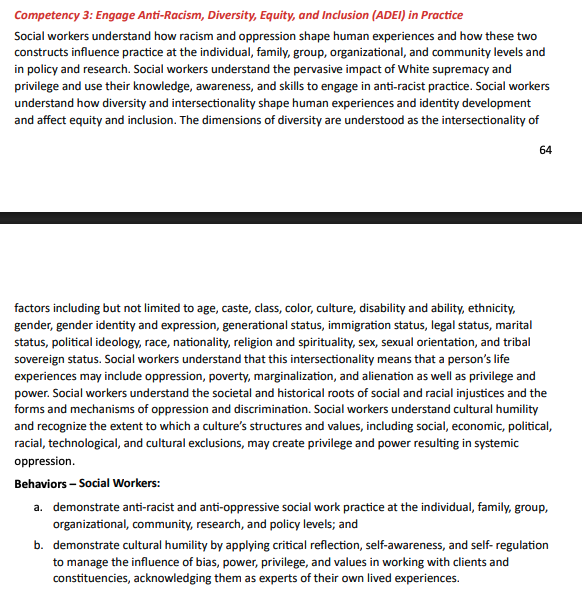
Competency 3: Engage Anti-Racism, Diversity, Equity, and Inclusion (ADEI) in Practice
Competency three states that social workers will “understand how racism and oppression shape human experiences,” will “understand the pervasive impact of White supremacy and privilege and use their knowledge, awareness, and skills to engage in anti-racist practice.” Social workers are also expected to “understand that this intersectionality means that a person’s life experiences may include oppression, poverty, marginalization, and alienation as well as privilege and power.”

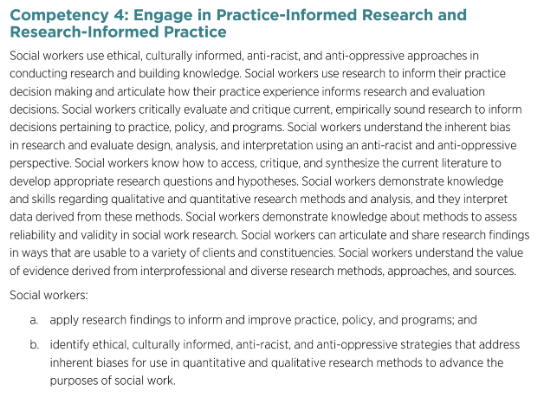
Competency 4: Engage in Practice-Informed Research and Research-Informed Practice
The fourth competency states that social workers “use ethical, culturally informed, anti-racist, and anti-oppressive approaches in conducting research and building knowledge.” Social workers will also “understand the inherent bias in research and evaluate design, analysis, and interpretation using an anti-racist and anti-oppressive perspective.”
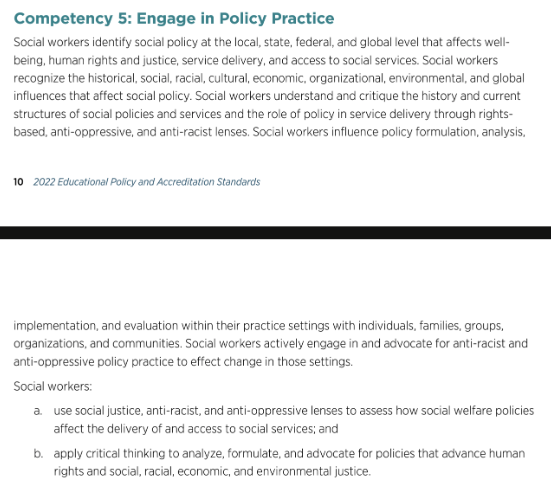
Competency 5: Engage in Policy Practice
The fifth competency states that social workers “understand and critique history and current structures of social policies and services and the role of policy in service delivery through rights-based, anti-oppressive, and anti-racist lenses” and they “actively engage in and advocate for anti-racist and anti-oppressive policy practice to effect change in those settings.”
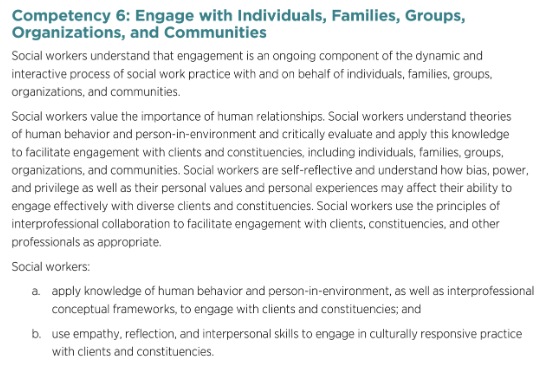
Competency 6: Engage with Individuals, Families, Groups, Organizations, and Communities
The sixth competency includes that social workers are “self-reflective and understand how bias, power, and privilege as well as their personal values and personal experiences may affect their ability to engage effectively with diverse clients and constituents.”
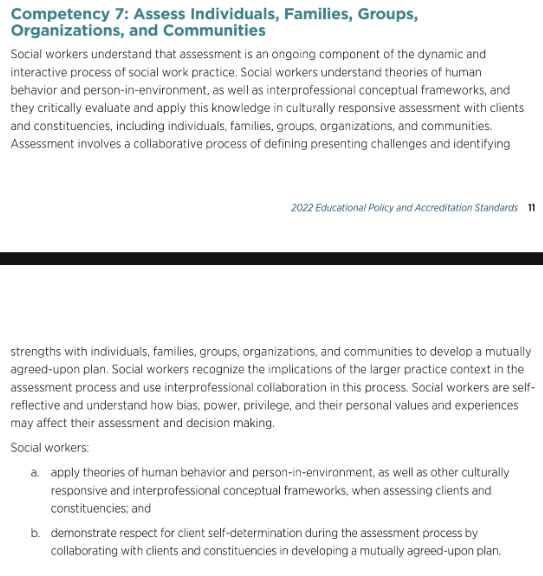
Competency 7: Assess Individuals, Families, Groups, Organizations, and Communities
The seventh competency states that social workers are “self-reflective and understand how bias, power, privilege, and their personal values and experiences may affect their assessment and decision making.”
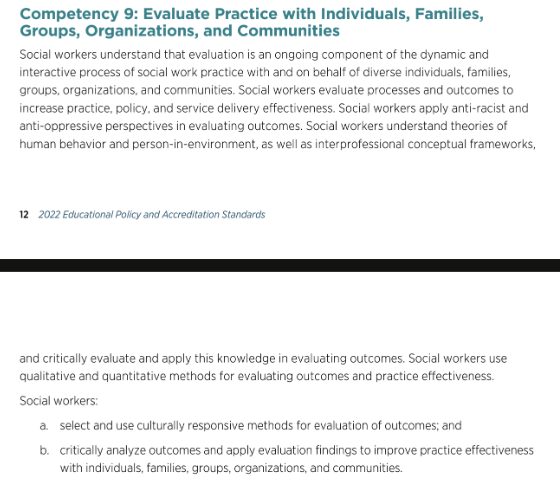
Competency 9: Evaluate Practice with Individuals, Families, Groups, Organizations, and Communities
The ninth competency states that social workers will “apply anti-racist and anti-oppressive perspectives in evaluating outcomes.”
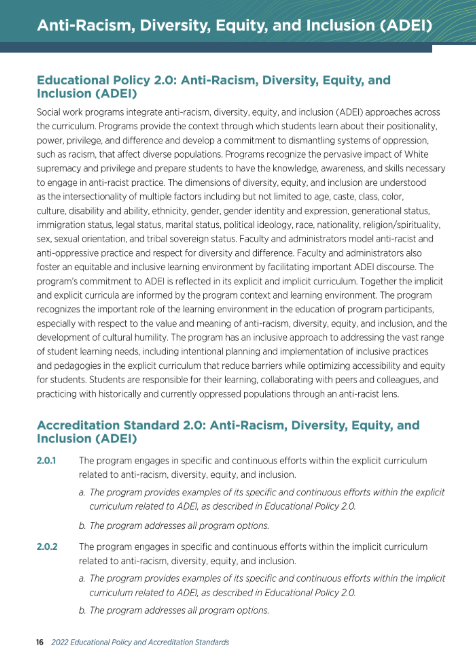
Educational Policy 2.0: Anti-Racism, Diversity, Equity, and Inclusion (ADEI)
Accredited programs must incorporate “Educational Policy 2.0” which requires integration of “anti-racism, diversity, equity, and inclusion (ADEI) approaches across the curriculum.” Programs are to “recognize the pervasive impact of White supremacy and privilege and prepare students to have the knowledge, awareness, and skills necessary to engage in anti-racist practices.” It also states that “faculty and administrators model anti-racist and anti-oppressive practice and respect for diversity and difference.”
Additionally, the “program’s commitment to ADEI is reflected in its explicit (Educational Policy 3.0) and implicit (Educational Policy 4.0) curriculum.”

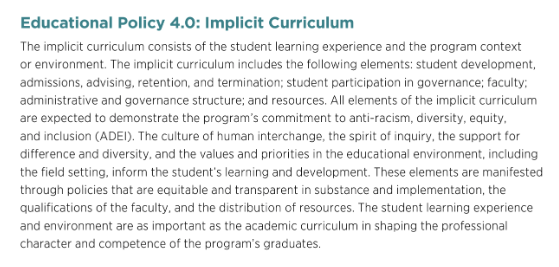
EXPANDED EXAMPLES
Arizona State University
Arizona State University’s School of Social Work Practicum Manual 2025 states that the school is “dedicated to the principles of equity, inclusion, anti-colonialism, anti-oppression and anti-racism.”
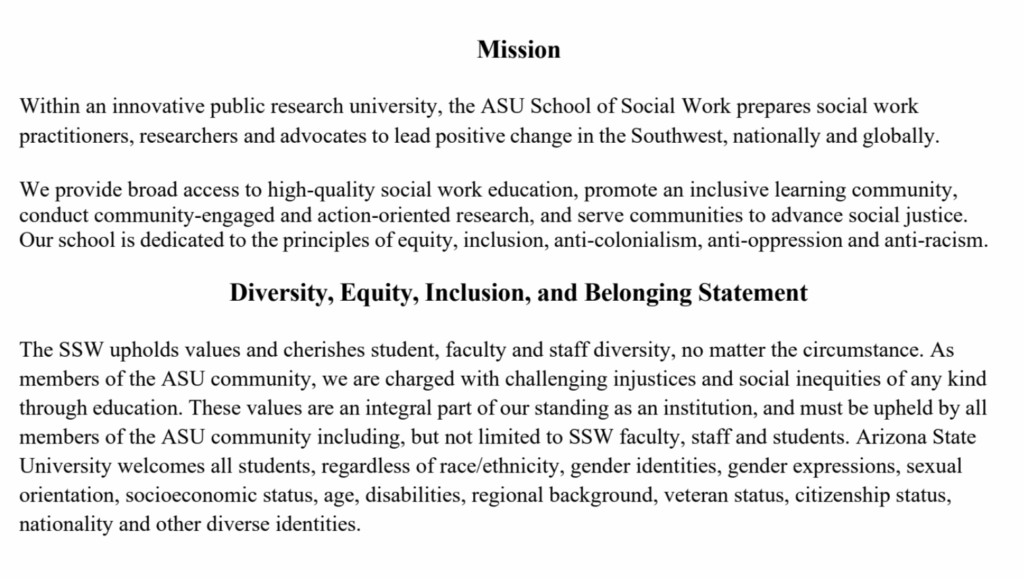
SWU 412 – First Semester Internship
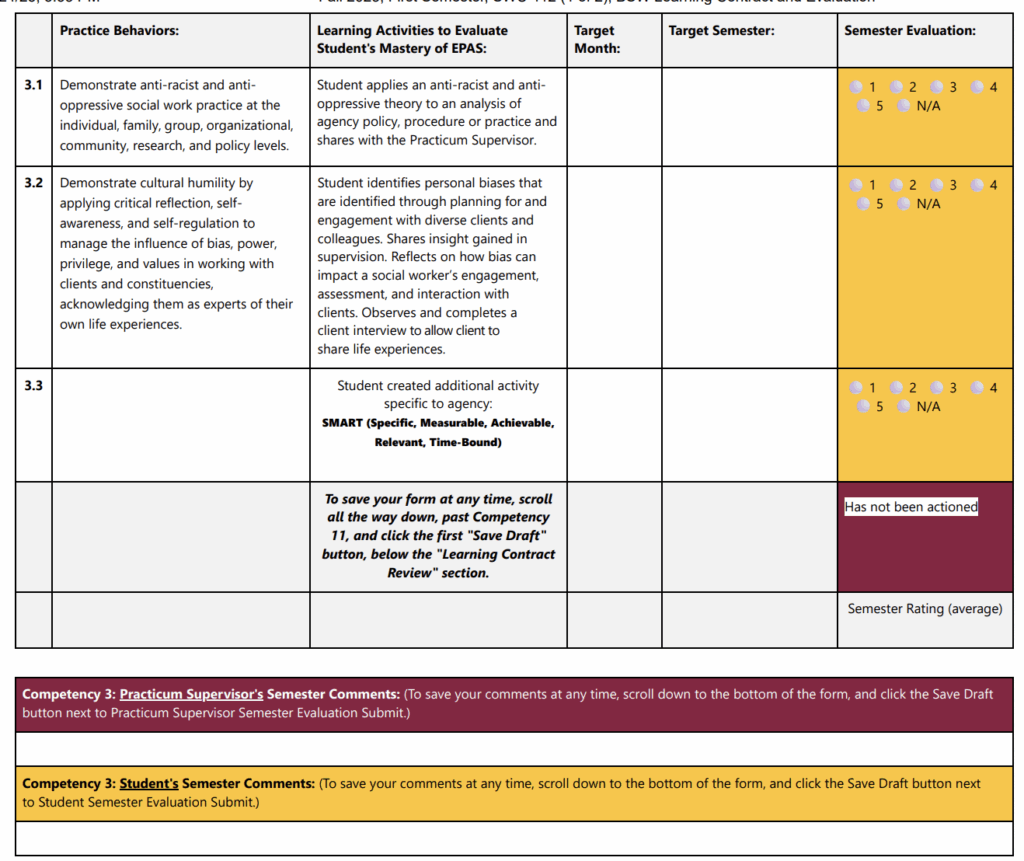
The fall 2025 course SWU 412 is the first of two semesters of the social work practicum experience for bachelor’s students. The BSW Learning Contract and Evaluation document associated with the course includes a rubric for evaluating student progress towards the mastery of the different EPAS competencies.
For example, under “Competency 3: Anti-racism, Diversity, Equity, and Inclusion (ADEI) in practice” the student is expected to “demonstrate anti-racist and anti-oppressive social work practice at the individual, family, group, organizational, community, research, and policy levels.” Additionally, the student needs to be able to apply an “anti-racist and anti-oppressive theory to an analysis of agency policy, procedure or practice and shares with the Practicum Supervisor.”
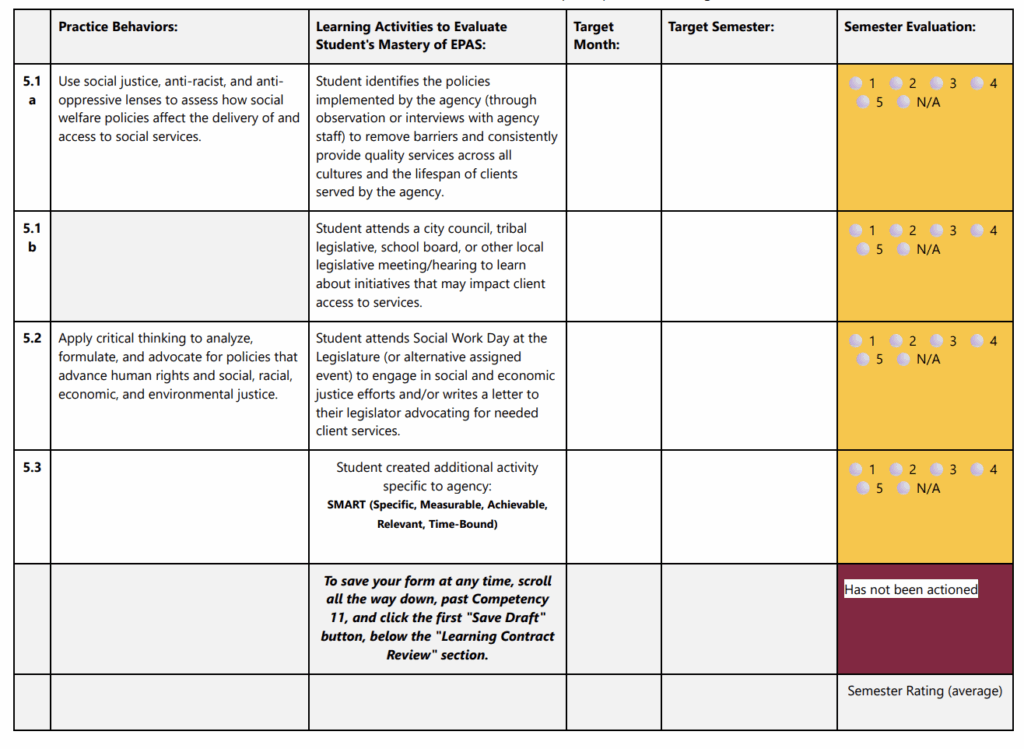
Under “Competency 5: Engage in Policy Practice,” the student is expected to “use social justice, anti-racist, and anti-oppressive lenses to assess how social welfare polices affect the diversity of and access to social services.”
Saint Francis University (PA)
The Saint Francis University (PA) Baccalaureate Social Worker Field Instruction Manual states that the field setting “where students apply human rights principles from global and national social work ethical codes to advance social, racial, economic, and environmental justice. It fosters a learning environment where anti-racism, diversity, equity, and inclusion are valued.”
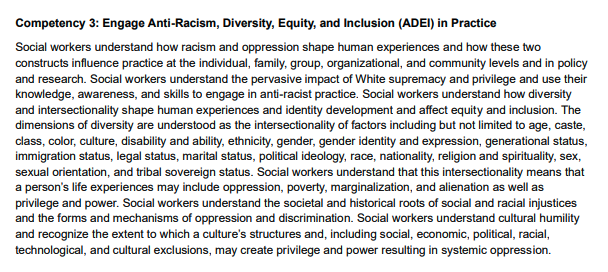
The program uses CSWE’s 2022 EPAS standards including “Competency 3: Engage Anti-Racism, Diversity, Equity, and Inclusion (ADEI) in Practice.” The competency states that “social workers understand how racism and oppression shape human experiences and how these two constructs influence practice at the individual, family, group, organizational, and community levels and in policy and research” and “understand the pervasive impact of White supremacy and privilege and use their knowledge, awareness, and skills to engage in anti-racist practice.”
As part of the field experience, overall “educational objectives” include learning “self-knowledge” which is an “increase in self-awareness as students are confronted with situations that challenge their own attitudes and values.” It prompts students by asking how they “really feel about poor people, unwed mothers, welfare rights organizations, Black Lives Matter, Me Too and other issues.”

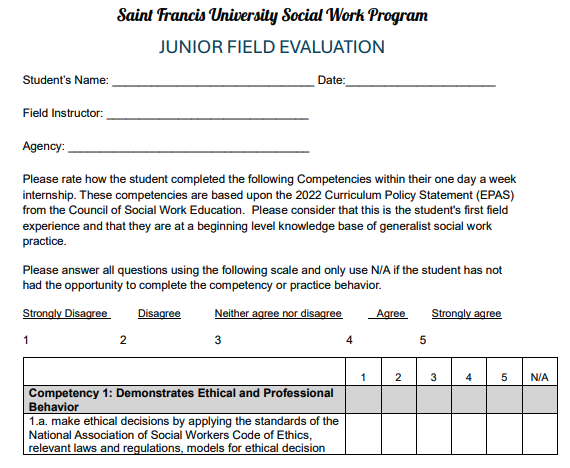
The program’s guide includes a “Junior Field Evaluation” which includes rating students based on the incorporations of the competencies into their practices. Subcategories include demonstrating “anti-racist and anti-oppressive social work practice at the individual, family, group, organizational, community, research, and policy levels.” Other subcategories include being able to “identify ethical, culturally informed, anti-racist, and anti-oppressive strategies that address inherent biases for use in quantitative and qualitative research methods to advance the purposes of social work” and to “use social justice, anti-racist, and anti-oppressive lenses to assess how social welfare polices affect the delivery of and access to social services.”

University of Montana
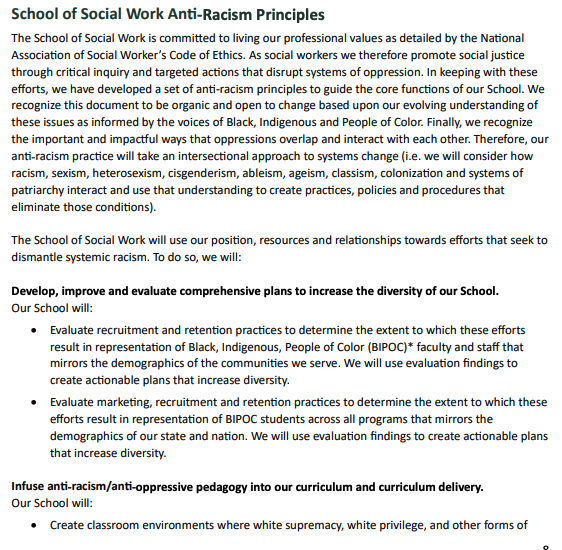
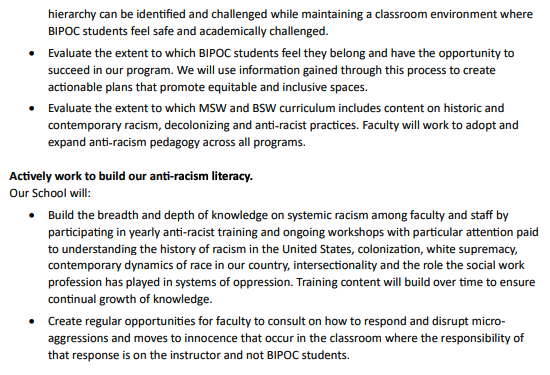
The University of Montana School of Social Work’s Master of Social Work handbook states that the program “prepares trauma-informed, anti-racist social workers who embody the profession’s commitment to social, racial, environmental, and economic justice.”
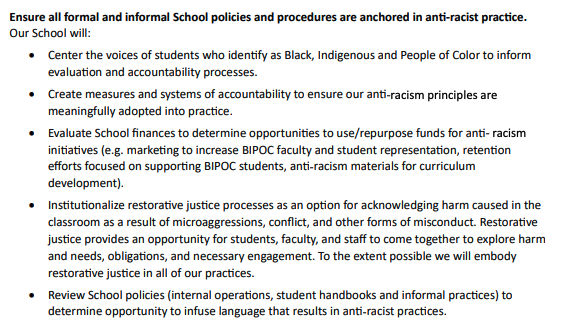
The school’s “Anti-Racism Principles” notes that it has “developed a set of anti-racism principles to guide the core functions of our School” which includes an “intersectional approach to systems change (i.e. we will consider how racism, sexism, heterosexism, cisgenderism, ableism, ageism, classism, colonization and systems of patriarchy interact and use that understanding to create practices, policies and procedures that eliminate those conditions).”
UNIVERSITIES
The following is a list of universities by state that offer a bachelor’s and/or master’s degree in social work degree that features “Anti-Racism, Diversity, Equity, and Inclusion (ADEI) in Practice” as a core competency. Below each university is a link to the most recent or currently available degree program’s handbook, field guide, website, or accreditation report. Financial documents that have been returned via a Freedom of Information Act request are also linked under those public institutions.
It should be noted that some programs have documentation that is a few years old and may not reflect an update in competencies due to the Trump Administration’s Executive Orders.
Universities marked with an * received grant funding from the Department of Education under the Biden Administration. Read the full report here.
This is not an exhaustive list and will be updated as new information is identified and vetted.
ALABAMA
Alabama A&M University
Auburn University at Montgomery
Jacksonville State University
Oakwood University
Samford University
Troy University
University of Alabama
University of Alabama Birmingham
ALASKA
University of Alaska Anchorage*
University of Alaska Fairbanks
ARIZONA
Arizona State University
Grand Canyon University
Northern Arizona University
University of Phoenix
ARKANSAS
Arkansas State University
Southern Arkansas University
University of Arkansas at Little Rock
CALIFORNIA
Azusa Pacific University
California Baptist University
California Polytechnic University Humboldt*
California State University, Bakersfield
California State University, Chico
California State University, Dominguez Hills
California State University, East Bay
California State University, Fullerton
California State University, Long Beach
California State University, Monterey Bay*
California State University, Northridge
California State University, Sacramento
California State University, San Bernardino
California State University, San Marcos
California State University, Stanislaus
Fresno Pacific University
Fresno State University
La Sierra University
Loma Linda University
National University
Samuel Merritt University
San Diego State University
San Francisco State University
San Jose State University
University of California Los Angeles
University of Southern California
Whittier College
COLORADO
Colorado Mesa University
Colorado State University
Colorado State University Pueblo
Metropolitan State University of Denver
University of Colorado Colorado Springs
University of Denver
CONNECTICUT
Central Connecticut State University
Eastern Connecticut State University
Southern Connecticut State University
University of Saint Joseph
DELAWARE
Delaware State University
DISTRICT OF COLUMBIA
Howard University
The Catholic University of America
FLORIDA
Barry University
Florida Agricultural and Mechanical University
Florida International University*
Florida Memorial University
Florida State University
Southeastern University
University of North Florida
GEORGIA
Dalton State College
Georgia State University*
Kennesaw State University*
Middle Georgia State University
Thomas University
University of Georgia
Valdosta State University
HAWAI’I
BYU Hawaii
Hawai’i Pacific University
IDAHO
BYU – Idaho
Idaho State University
Lewis-Clark State College
Northwest Nazarene University
ILLINOIS
Aurora University
Chamberlain University
Erikson Institute
Illinois State University
Lewis University
Loyola University Chicago
Southern Illinois University
The University of Chicago
University of Illinois
University of St. Francis
Western Illinois University
INDIANA
Goshen College
Huntington University
Indiana University*
Indiana Wesleyan University
Manchester University
Saint Mary’s College
University of Indianapolis
University of Saint Francis
University of Southern Indiana
Valparaiso University
IOWA
Briar Cliff University
Clarke University
Dordt University
Loras College
Luther College
Mount Mercy University
University of Iowa*
University of Northern Iowa
Wartburg College
KANSAS
Bethel College
Fort Hayes State University
Kansas State University
The University of Kansas
Washburn University
KENTUCKY
Campbellsville University
Eastern Kentucky University
Morehead State University
Northern Kentucky University
University of Kentucky
Western Kentucky University
LOUISIANA
Grambling State University
Louisiana Christian University
Louisiana State University
Southeastern Louisiana University
Tulane University
MAINE
University of Maine
University of Maine at Presque Isle
MARYLAND
Coppin State University
Frostburg State University
Hood College
Salisbury University
University of Maryland, Baltimore*
University of Maryland, Baltimore County
MASSACHUSETTS
Boston College
Boston University*
Bridgewater State University
Salem State University
Simmons University
Smith College
MICHIGAN
Andrews University
Calvin University
Eastern Michigan University
Grand Valley State University
Kuyper College
Madonna University
Michigan State University
Northern Michigan University
Sienna Heights University
Spring Arbor University
The University of Olivet
University of Detroit Mercy
Western Michigan University
MINNESOTA
Augsburg University
Bethel University
Concordia College
Metropolitan State University
Minnesota State University, Mankato
Saint Mary’s University of Minnesota
Southwest Minnesota State University
St. Catherine University
St. Cloud State University
St. Olaf College
University of Minnesota Duluth
University of St. Thomas
Winona State University
MISSISSIPPI
Belhaven University
Mississippi Valley State University
MISSOURI
Avila University
Lincoln University
Lindenwood University
Maryville University
Missouri Baptist University
Missouri Southern State University
Missouri State University
Missouri Western State University
Park University
Saint Louis University
University of Missouri – St. Louis
MONTANA
University of Montana
NEBRASKA
Creighton University
Nebraska Wesleyan University
University of Nebraska at Kearney
University of Nebraska at Omaha
NEVADA
University of Nevada, Las Vegas
University of Nevada, Reno
NEW HAMPSHIRE
Colby-Sawyer College
University of New Hampshire*
NEW JERSEY
Georgian Court University
Kean University
Montclair State University
Ramapo College
Rowan University
Rutgers University
Rutgers University – Newark
Stockton University
NEW MEXICO
Eastern New Mexico University
New Mexico State University
Western New Mexico University
NEW YORK
Adelphi University
Binghamton University*
Buffalo State University
College of Staten Island (The City University of New York)
Columbia University
Dominican University New York
Hunter College (The City University of New York )
Long Island University Brooklyn*
Marist University
Medgar Evers College (The City University of New York)
Mercy University
Molloy University
Nazareth University*
Roberts Wesleyan University
Siena University
Skidmore College
St. Bonaventure University
State University of New York at Brockport
State University of New York at Fredonia
Stony Brook University
Syracuse University
University at Albany
University at Buffalo*
York College (The City University of New York)
NORTH CAROLINA
Appalachian State University
East Carolina University
Johnson C. Smith University
Livingstone College
Meredith College
Methodist University
North Carolina Central University
North Carolina State University
Shaw University
University of North Carolina, Chapel Hill
University of North Carolina, Charlotte
University of North Carolina, Greensboro
Western Carolina University
NORTH DAKOTA
Minot State University
OHIO
Ashland University
Bluffton University
Bolwing Green State University
Capital University
Case Western Reserve University
Cedarville University
Cleveland State University
Lourdes University
Mount Saint Joseph University
Mount Vernon Nazarene University
Ohio Dominican University
Ohio State University
University of Findlay
University of Rio Grande
University of Toledo, The
Wright State University
Youngstown State University
OKLAHOMA
East Central University
Northeastern State University
Northwestern Oklahoma State University
OREGON
Eastern Oregon University
George Fox University
Pacific University
Portland State University*
University of Portland
PENNSYLVANIA
Carlow University
Commonwealth University of Pennsylvania
Eastern University
Gannon University
Kutztown University
Mercyhurst University
Messiah University
Millersville University
Millersville University and Shippensburg University Collaborative
Misericordia University
Moravian University
Pennsylvania Western University
Saint Francis University
Saint Joseph’s University
Shippensburg University
Slippery Rock University
Temple University
University of Pennsylvania
University of Pittsburgh
West Chester University
Widener University
RHODE ISLAND
Providence College
Rhode Island College
Salve Regina University
SOUTH CAROLINA
Columbia College
University of South Carolina
SOUTH DAKOTA
Augustana University
Oglala Lakota College
University of Sioux Falls
University of South Dakota
TENNESSEE
Austin Peay State University
Belmont University
East Tennessee State University
Lincoln Memorial University
Freed-Hardeman University
Middle Tennessee State University
Milligan University
Tennessee Wesleyan University
Union University
University of Memphis
University of Tennessee – Chattanooga
University of Tennessee – Knoxville
TEXAS
Abilene Christian University
Angelo State University
Baylor University*
Howard Payne University
Lamar University
Midwestern State University
Our Lady of the Lake University
St. Edward’s University
Texas Women’s College
The University of Texas Rio Grande Valley*
University of Houston Downtown
University of North Texas
University of Texas at El Paso
University of Texas at San Antonio
University of Texas – Rio Grande
UTAH
Utah State University
Utah Valley University
Southern Utah University
VERMONT
Champlain College
University of Vermont
VIRGINIA
Christopher Newport University
Ferrum College
George Mason University
Longwood University
Mary Baldwin University
Norfolk State University
Radford University
Virginia Wesleyan University
WASHINGTON
Heritage University*
Pacific Lutheran University
Saint Martin’s University
Seattle University
University of Washington*
Walla Walla University
WEST VIRGINIA
Concord University*
Shepherd University
West Liberty University
West Virginia University
WISCONSIN
Alverno College
Concordia University – Wisconsin
Mount Mary University
University of Wisconsin – Eau Claire
University of Wisconsin – Green Bay
University of Wisconsin – Madison*
University of Wisconsin – Milwaukee
University of Wisconsin – Oshkosh
University of Wisconsin – Stevens Point
University of Wisconsin – Whitewater
WYOMING
University of Wyoming
Stay Informed