
19
ToTAL NUMBER OF STATES
$100,964,880
Total amount of Department of Education grant funding
25
Number of colleges and universities receiving grants
33
Total number of colleges and universities in the report
10
Total number of syllabi
23
Total number of course catalogs/descriptions
*This report is not exhaustive and will be updated as we collect more information.
Executive Summary
Since 2021, the United States Department of Education has distributed $100,964,880 in grants to twenty-six universities to train and increase the number of social workers in K-12 schools. The funds were awarded through either the Mental Health Service Professional Demonstration Grant Program or the School-Based Mental Health Services Grant Program.
On the surface, these federal grants were given out to help mitigate mental health issues; in practice, the grant funds went to support programs that explicitly advance social justice ideologies based in critical race theory that include anti-racism and DEI. In fact, the vast majority of university social work programs that we reviewed prioritize anti-racism practices and social justice activism.
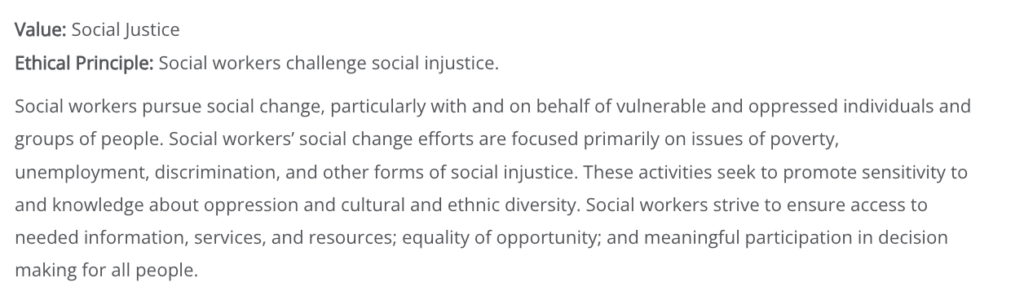
According to the National Association of Social Workers (NASW), the primary mission of the social work profession is to “enhance human well-being and help meet the basic human needs of all people, with particular attention to the needs and empowerment of people who are vulnerable, oppressed, and living in poverty” and to “promote social justice and social change on behalf of clients.”
The organization’s “ethical principles” include social workers challenging “social injustice” by pursuing “social change, particularly with and on behalf of vulnerable and oppressed individuals and groups of people” and promoting “sensitivity to and knowledge about oppression and cultural and ethnic diversity.”
Most recently, the NASW posted on X that they will “take action” and “fight” the president’s recent executive orders related to K-12.
KEY TAKEAWAYS
- The University of Alaska Anchorage Master of Social Work program states that it is “dedicated to advancing human rights, engaging in anti-racist and anti-oppressive social work practice, while pursuing justice, equity, and inclusion for all.”
- California State University, Fresno’s (CA) course SWK 213 – Theories of Diversity and Oppression requires students to write an essay on how “definitions of race and whiteness have been used to disenfranchise people of color.” The course also includes the use of critical theories and topics such as white privilege, white supremacy, and whiteness.
- Florida International University’s (FL) Project DIG received a $6 million grant from the Department of Education and focuses on “recruiting and retaining credentialed mental health providers from diverse backgrounds” and utilizes “anti-racist and anti-oppressive frameworks” in its Master of Social Work program.
- Indiana University’s (IN) Social Work Master course titled SWK 507 – Diversity, Human Rights, and Social Justice examines the “shifting landscape of diversity, oppression, power, and privilege” and includes a fundamental goal of having students “develop critical consciousness in order to gain competencies to address diversity, privilege and oppression in social work practice.”
- Boston University’s (MA) School of Social Work offers a free course titled Understanding Structural & Institutional Racism which focuses on topics such as “racial capitalism, white supremacy, and structural and institutional racism,” as well as “white supremacist ideology, its influence on American society and how it can be deconstructed and otherwise contested.”
- Nazareth University’s (NY) Social Work program states that it seeks to “promote social justice, diversity, equity, inclusion, and belonging; and serve as leaders and changemakers.” Its course titled SWK 524 – Cultural Diversity and Social Work helps students “explore intersectionality and assess feelings and attitudes about racism and oppression for enhanced awareness, understanding, and growth.”
- Miami University’s (OH) social work program states as “learning outcomes” that students will “advance human rights and social, racial economic, and environmental justice” as well as “engage in anti-racism, diversity, equity, and inclusion (ADEI) in practice.”
- The University of Texas at Austin’s (TX) course SW 381S – Foundations of Social Justice: Values, Diversity, Power & Oppression includes topics such as anti-racism, anti-blackness, critical race theory, heterosexism, “trans oppression,” and white fragility. Course texts include authors such as Robin DiAngelo and Ibram X. Kendi.
- Concord University’s (WV) Master of Social Work program states that its students will “address the uniqueness of issues of human rights, mechanisms of oppression, discrimination, and social, economic, and environmental justice in order to improve the social, economic, and environmental well-being of clients within rural settings across all levels of practice.”
- Heritage University’s (WA) social work program evaluates students based on their advocacy and engagement in anti-racist, anti-oppressive social justice practices.
Examples
Arizona State University’s Master of Social Work program requires students take the course SWG 53 – Diversity, Oppression, and Social Justice in Social Work which states that it “explores oppression based on race, ethnicity, gender, sexual orientation, and disability status; models for intergroup relations; the historical context of group relations; cultural variables significant to Southwestern ethnic, racial, and cultural minority populations.”
Key concepts the course covers include privilege, intersectionality, oppression, ageism, classism, colonialism, gender identity, heterosexism, and affirmative action.
Indiana University’s School of Social Work course titled SWK 507 – Diversity, Human Rights, & Social Justice states that the course will “introduce MSW students to human rights and social justice perspectives in order to examine the shifting landscape of diversity, oppression, power, and privilege” and that a “fundamental goal of the course is for students to develop critical consciousness in order to gain competencies to address diversity, privilege and oppression in social work practice.”
Course content includes topics such as critical race theory, environmental justice, heterosexism, oppression, racism, and white privilege.

Boston University School of Social Work “Equity & Inclusion” page states that it “affirms and promotes racial, social, and economic justice to advance human rights and the elimination of oppressive practices.” The school’s “Equity & Inclusion Committee” focuses on leading the “community in promoting and centering racial, economic, and social justice, including utilizing an intersectional lens to understand how ethnicity, class, gender, disabilities, LGBT issues, and other lived experiences impact social work.”

The School of Social Work also utilizes what it calls a “Liberation Health Model” which takes a “holistic, macro approach to clinical social work by contextualizing mental health culturally, politically, and historically.”

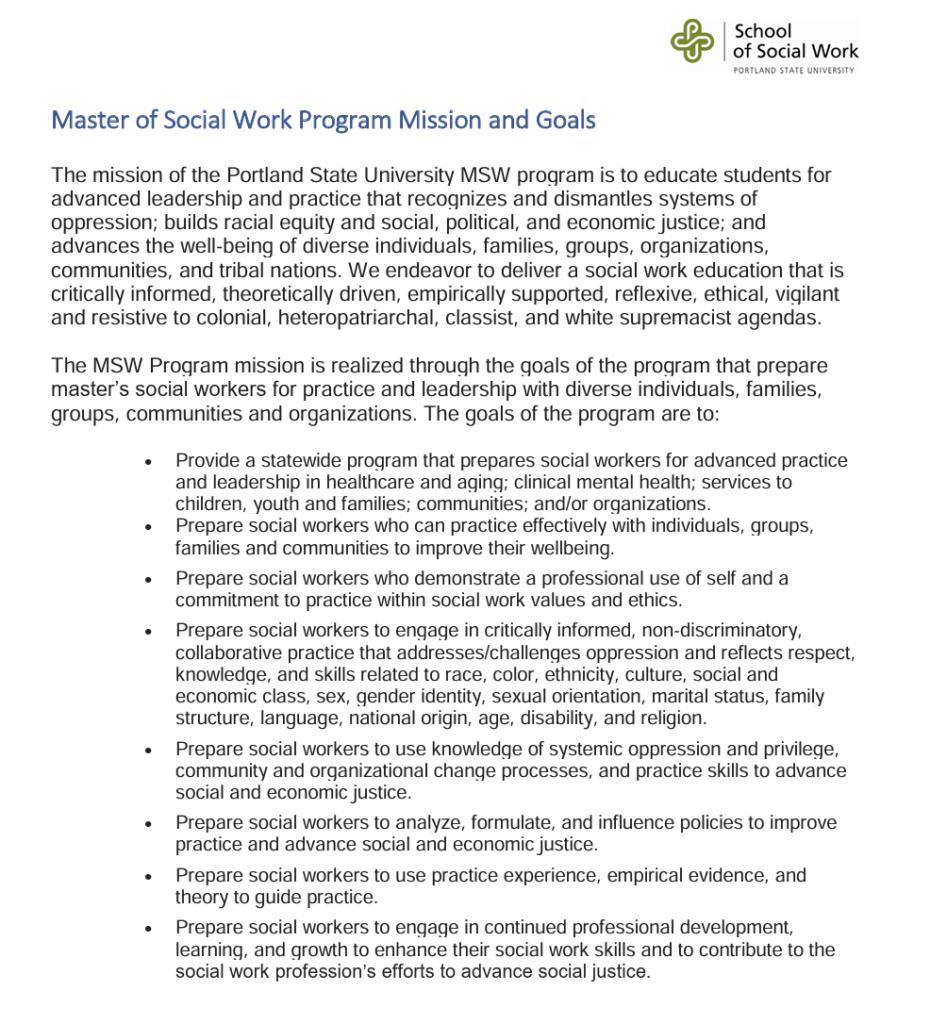
Portland State University’s School of Social Work states that its mission is to “educate students for advanced leadership and practice that recognizes and dismantles systems of oppression; builds racial equity and social, political, and economic justice; and advances the well-being of diverse individuals, families, groups, organizations, communities, and tribal nations.” It also aims to “deliver a social work education that is critically informed, theoretically driven, empirically supported, reflexive, ethical, vigilant and resistive to colonial, heteropatriarchal, classist, and white supremacist agendas.”
School goals include preparing social workers to “use knowledge of systemic oppression and privilege, community and organizational change processes, and practice skills to advance social and economic justice” and “to engage in continued professional development, learning, and growth to enhance their social work skills and to contribute to the social work profession’s efforts to advance social justice.”
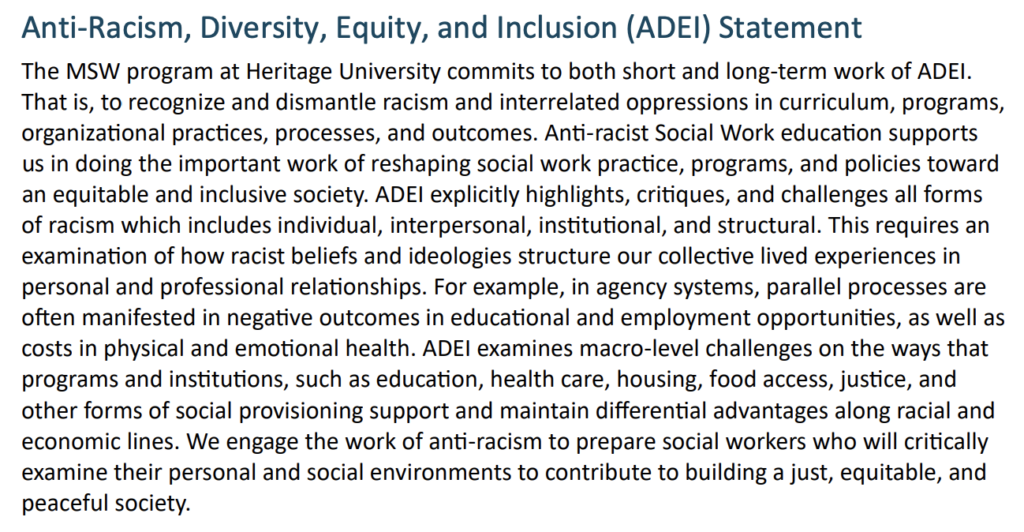
Heritage University’s Social Work program focuses on advancing anti-racism, diversity, equity, and inclusion, as well as social justice.
The school’s Student Handbook states that it commits to “both short and long-term work” of Anti-racism, Diversity, Equity, and Inclusion. The program works to “recognize and dismantle racism and interrelated oppressions in curriculum, programs, organizational practices, processes, and outcomes” and is “doing the important work of reshaping social work practice, programs, and policies toward an equitable and inclusive society.”
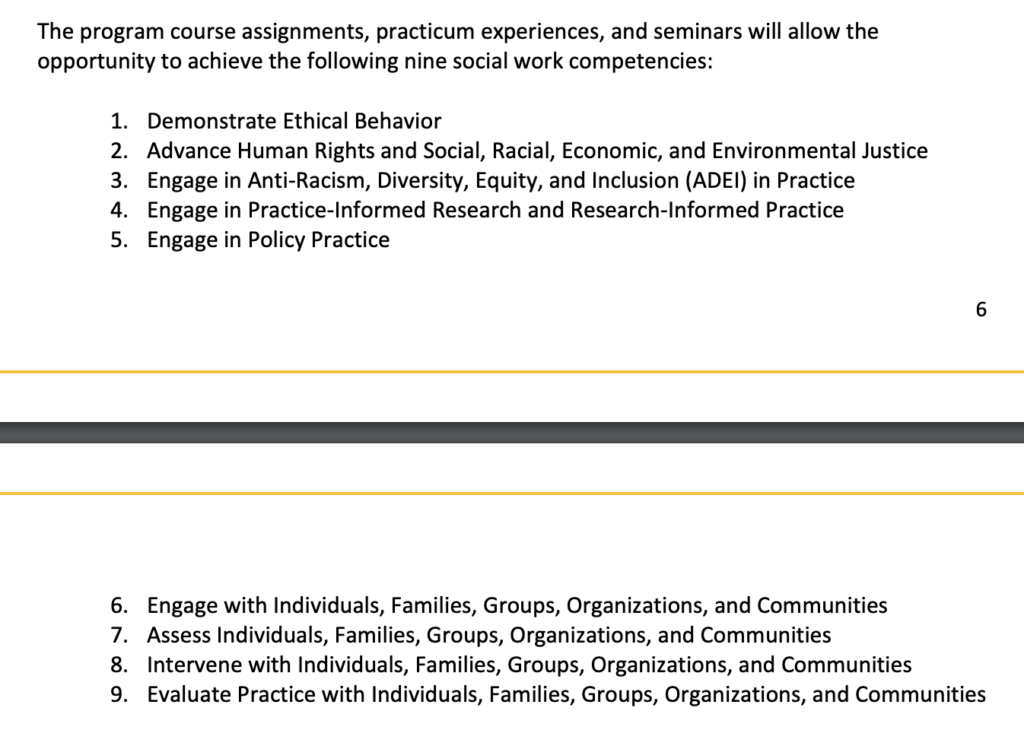
The document lists “nine social work competencies” students are to achieve including advancing “Human Rights and Social, Racial, Economic, and Environmental Justice” and engaging in “Anti-Racism, Diversity, Equity, and Inclusion (ADEI) in Practice.”
The department’s Practicum Manual includes a “Learning Contract” or rubric by which program students are to be evaluated. Competencies and behaviors include demonstrating “anti-racist and anti-oppressive social work practice at the individual, family, group, organizational, community, research, and policy levels,” identifying “ethical, culturally informed, antiracist, and anti-oppressive strategies that address inherent biases for use in quantitative and qualitative research methods to advance the purposes of social work,” and using “social justice, anti-racist, and anti-oppressive lenses to assess how social welfare policies affect the delivery of and access to social services.”


UNIVERSITY COUNSELING PROGRAMS/COURSES
How to read this section: The colleges and universities listed below include links to university program sites that offer social work as a Master’s degree/concentration. Courses are listed underneath the respective school with a link to a syllabus or course catalog.
If a university does not have a course syllabus, there will be no link attached to that course.
- University of Alaska Anchorage
- ED Grant – $1,200,000
- SWK A643 – Engaging Diversity through Justice and Anti-Oppressive Social Work Practice
- Cal Polytechnic University Humboldt
- California State University, Fresno
- SWK 213 – Theories of Diversity and Oppression (Spring 2020)
- California State University Monterey Bay
- University of the Pacific
- ED Grant – $1,082,192
- SOCW 207 – Diversity & Social Justice
- Florida International University
- ED Grant – $6,000,000
- ED Grant – see University of Iowa
- SOW 5629 – Social Work Practice with Diverse Populations
- University of South Florida
- ED Grant – $758,219
- SOW 6348 – Diversity and Social Justice
- Georgia State University
- ED Grant – $8,000,000
- SW 7500 – Diversity and Social Justice
- Kennesaw State University
- ED Grant – counted in the GrantED report
- SW 7700 – Social Work Foundations: Diversity, Social Justice and Ethics
- Dominican University
- ED Grant – $3,800,000
- SWK 623 – Race and Ethnicity in U.S. Social Policy
- SWK 625 – Race, Gender, and Human Rights in the Guatemalan Context
- University of Iowa
- ED Grant – $10,400,000 (in collaboration with the University of Wisconsin-Madison, the University of California-Santa Barbara, and the University of South Florida)
- SSW 1022 – Social Justice and Social Welfare in the United States
- Boston University
- ED Grant – $5,800,000 (in collaboration with University of Massachusetts, Boston)
- Long Island University
- Nazareth University
- ED Grant – $2,600,000
- SWK 524 – Cultural Diversity and Social Work
- Binghamton University
- ED Grant – $4,500,000
- SW 503 – Diversity and Oppression
- University at Buffalo
- Portland State University
- ED Grant – $1,600,000
- SW 539 – Social Justice in Social Work
- Baylor University
- ED Grant – $2,529,544
- 5320 Human Diversity & Social Justice
- Prairie View A&M University
- SOWK 3321 – Human & Cultural Diversity Social Work (Spring 2024)
- Texas A&M University – Central Texas
- SOWK 3303 – Social Work with Diverse Populations (Summer 2023)
- University of Texas at Austin
- University of Texas Rio Grande Valley
- ED Grant – $2,200,000
- SOCW 6315 – Social Work with Diverse Populations
- Heritage University
- ED Grant – $5,544,925
- SOWK 537 – Social Work Practice in a Diverse Society
- University of Washington
- University of Wisconsin-Madison
- ED Grant – see University of Iowa
- SW 710 – Diversity, Oppression, and Social Justice in Social Work
- University of Wisconsin – Stevens Point
- SW 365 – Social Work Practice with Diverse Populations (Spring 2021)