


CAIR New Jersey’s ‘Educator’s Guide’ and ‘Muslim Studies Curriculum’ teach 9/11 through lens of Islamophobia and claim that ‘Israel is committing an ethnic cleansing and military occupation against Palestine.’
Investigations
SUMMARY
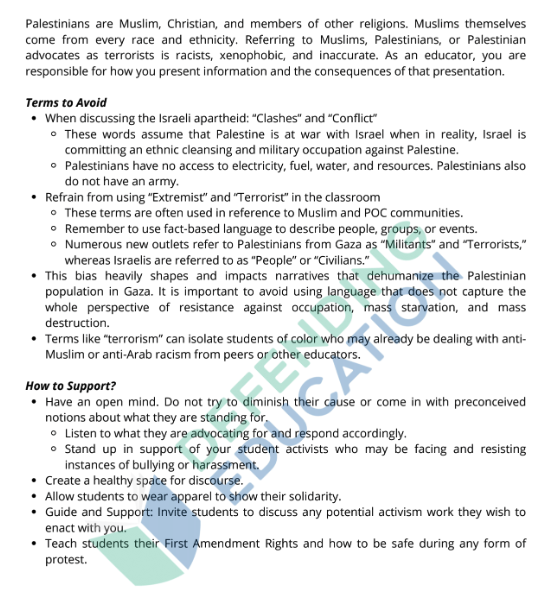
The Council on American-Islamic Relations (CAIR) New Jersey’s “Educator’s Guide” and “Muslim Studies Curriculum” include topics such as Islamophobia, imperialism, and suggest that teachers avoid terms such as “‘clashes’ and ‘conflict'” because these words “assume that Palestine is at war with Israel when in reality, Israel is committing an ethnic cleansing and military occupation against Palestine.”
KEY TAKEAWAYS
- The “Muslim Studies Curriculum” includes topics such as Islamophobia, imperialism, and terrorism.
- The curriculum also promotes the Southern Poverty Law Center’s Learning for Justice lesson plan on “Countering Islamophobia.”
- CAIR-NJ’s 2024 “Educator’s Guide” states that when it comes to 9/11 and Islamophobia,”news media often describes Muslims as terrorists, effectively ignoring groups including white supremacists and anti-abortionists who carry out violent acts.”
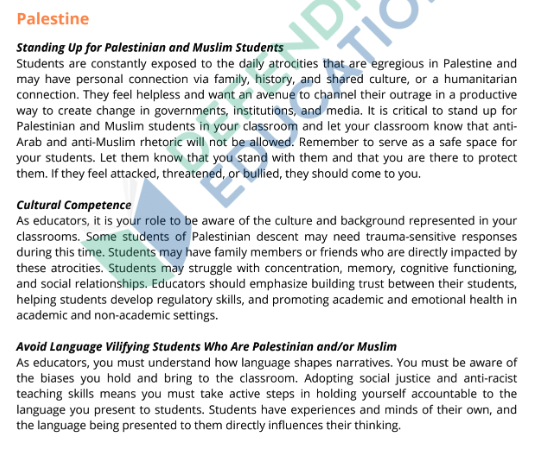
- A section in the 2024 “Educator’s Guide” titled “Palestine” states that people often “assume that Palestine is at war with Israel when in reality, Israel is committing an ethnic cleansing and military occupation against Palestine.”
- The same section tells teachers that it is “important to avoid using language that does not capture the whole perspective of resistance against occupation, mass starvation, and mass destruction.”
CURRICULUMS AND GUIDES
Muslim Studies Curriculum
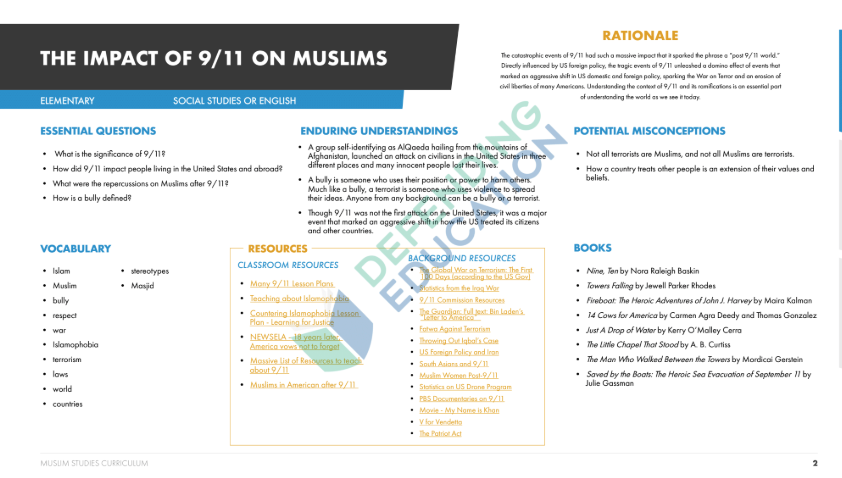
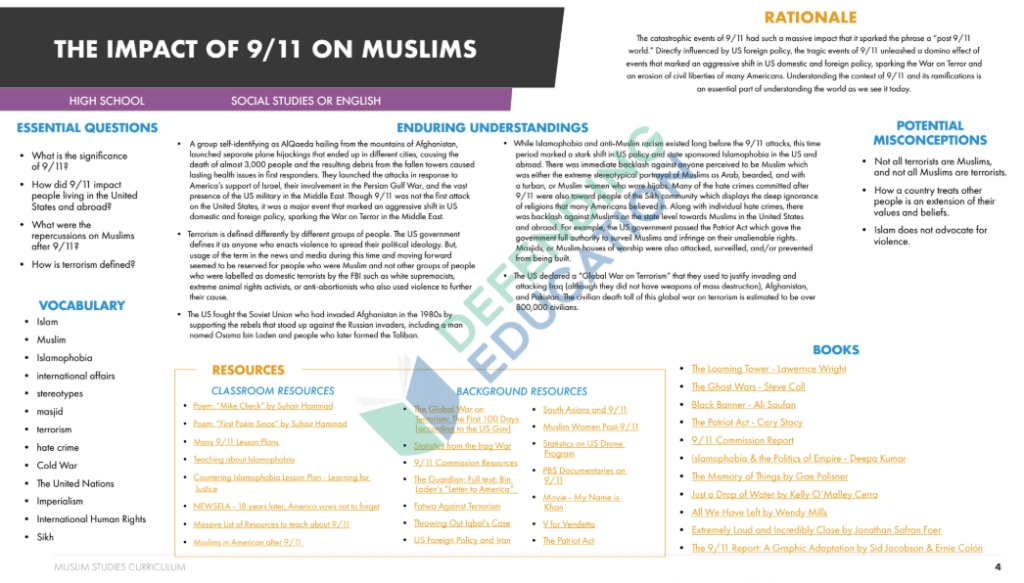
CAIR-NJ’s “Muslim Studies Curriculum” for elementary through high school students includes topics such as Islamophobia, imperialism, and terrorism. Curriculum resources include a lesson from Southern Poverty Law Center’s Learning for Justice lesson plan on “Countering Islamophobia,” Osama bin Laden’s “Letter to America,” and the movie “V for Vendetta.”
The high school curriculum states that “while Islamophobia and anti-Muslim racism existed long before the 9/11 attacks, this time period marked a stark shift in US policy and state sponsored Islamophobia in the US and abroad.”
An Educator’s Guide to Islamic Religious Practices (2024)
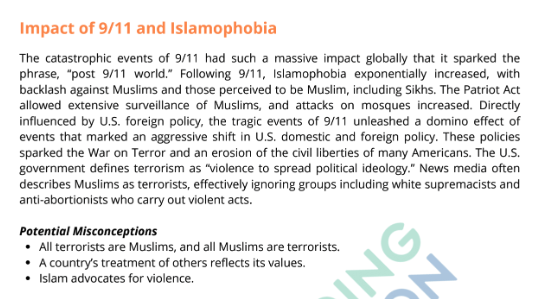
CAIR New Jersey’s 2024 “An Educator’s Guide to Islamic Religious Practices includes a section titled “Impact of 9/11 and Islamophobia” which states that after 9/11, “Islamophobia exponentially increased, with backlash against Muslims and those perceived to be Muslim.”
The document also claims that “news media often describes Muslims as terrorists, effectively ignoring groups including white supremacists and anti-abortionists who carry out violent acts.”
A section in the document titled “Palestine” states that it is “critical to stand up for Palestinian and Muslim students in your classroom and let your classroom know that anti-Arab and anti-Muslim rhetoric will not be allowed.” It calls upon educators to avoid “language vilifying students who are Palestinian and/or Muslim,” be aware of biases, and to adopt “social justice and anti-racist teaching skills” to take “active steps in holding yourself accountable to the language you present to students.”
The document provides a list of “terms to avoid” such as “‘clashes’ and ‘conflict'” because these words “assume that Palestine is at war with Israel when in reality, Israel is committing an ethnic cleansing and military occupation against Palestine.” It also suggests refraining from using “‘extremist’ and ‘terrorist'” because the “terms are often used in reference to Muslim and POC communities” and also because “numerous news outlets refer to Palestinians from Gaza as ‘Militants’ and ‘Terrorists,’ whereas Israelis are referred to as ‘People’ and ‘Civilians.'”
The section concludes by stating that it is “important to avoid using language that does not capture the whole perspective of resistance against occupation, mass starvation, and mass destruction” and that “terms like ‘terrorism’ can isolate students of color who may already be dealing with anti-Muslim or anti-Arab racism from peers or other educators.”
2026-2027 BACK TO SCHOOL RESOURCE GUIDE
Stay Informed