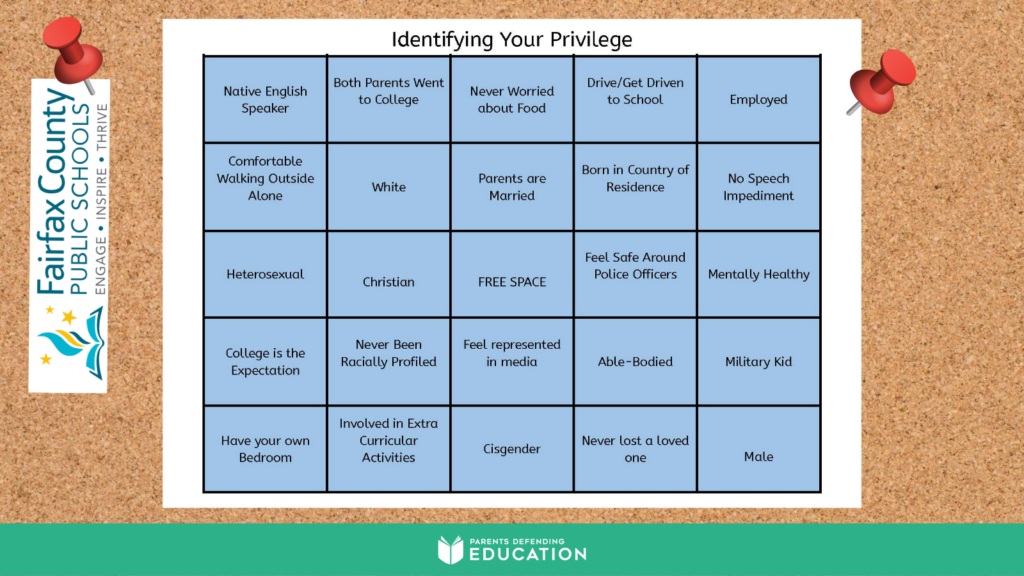
In response to a public records request from Parents Defending Education, Fairfax County Public Schools provided four documents that identify that the controversial “Privilege Bingo” game, establishing “Military Kid” as a privilege,” is a 20-minute exercise in a wider “Lesson 4,” in which students are instructed to watch a Beyoncé music video, do a “Privilege Walk” and deconstruct the “privilege” and “disadvantages” in their lives, compared to others.
“Privilege Bingo” is “Station 2” on slide No. 4 of “Lesson 4.” Student are instructed: “Identify areas of privilege in your life. Reflect on how it has/can shape perspective and bias.” The lesson also includes graphics from controversial posters from the University of Ontario, Canada, telling students to “CHECK THEIR PRIVILEGE.”
Amid controversy over the exercise, a school district official previously said that “Privilege Bingo” is part of English curriculum approved by the school district. On the school district’s official Twitter account @FCPS_News, the school district’s communications staff posted a message that the “Privilege Bingo” card was “revised.”
Two important questions remain unanswered:
- What is the actual source of the lesson? A company, organization, university or something else?
- When was this class first taught, where and how widespread is this lesson in the school district?
- What is the new “revised” bingo card?
The documents provided by the school district are (with the file names provided by the school district):
- “Original, Archived Lesson 4 – How and why do different people perceive the same event in different ways.” — 13-slide lesson on “privilege,” with a Beyoncé music video discussion, a video with the “Privilege Walk” and a 20-minute “Privilege Bingo” exercise.”
- “Original, Archived Lesson 4 – Privilege Bingo Assignment” — Includes the “Privilege Bingo” card.
- “Perspectives Journal – ‘Quey’” — A writing assignment to reflect on privilege.
- “half-caste” — A two-page reading from a book, Homecoming
“Original Archived Lesson 4 – Privilege Bingo Assignment’
The “Privilege Bingo” card is part of a wider 13-slide lesson (below) that includes a discussion of “privilege.”
- Page 1: “Identifying Your Privilege.”
- Page 2: “Use the bingo card (linked) or mark the squares that apply to you by highlighting.” The link takes students to this link: https://mfbc.us/m/v4mqy4 with a bingo card with “Military Kid” on it.
- Students are asked two questions. The first question: “Reflect on one of the elements that applies to you.” They are further asked: “How has this part of your life made things easier for you?” And they are asked: “Can you identify an opinion you have that is related to the element you chose?”
- The second question: “Reflect on one of the elements that does not apply to you.” They are also asked: “How has this part of your life made things more difficult for you?” And also: “Can you identify an opinion you have that is related to the element you chose?”
“Original Archived Lesson 4”
“How and why do different people perceive the same event in different ways”
- Slide 1: “How and why do different people perceive the same event in different ways?”
- Slide 2: In the unit, “Perspectives,” the “Essential Questions” include, “How do our personal biases impact our perspectives,” and “What role does privilege play in the formation of bias?” The “Warm Up: Quick Write” included asking, “How can you connec the reading from last class to our discussion of bias?” It further asked: “Explain an assumption made about someone based on bias.” It also asked: “How is Esi’s perspective impacted by her experiences?”
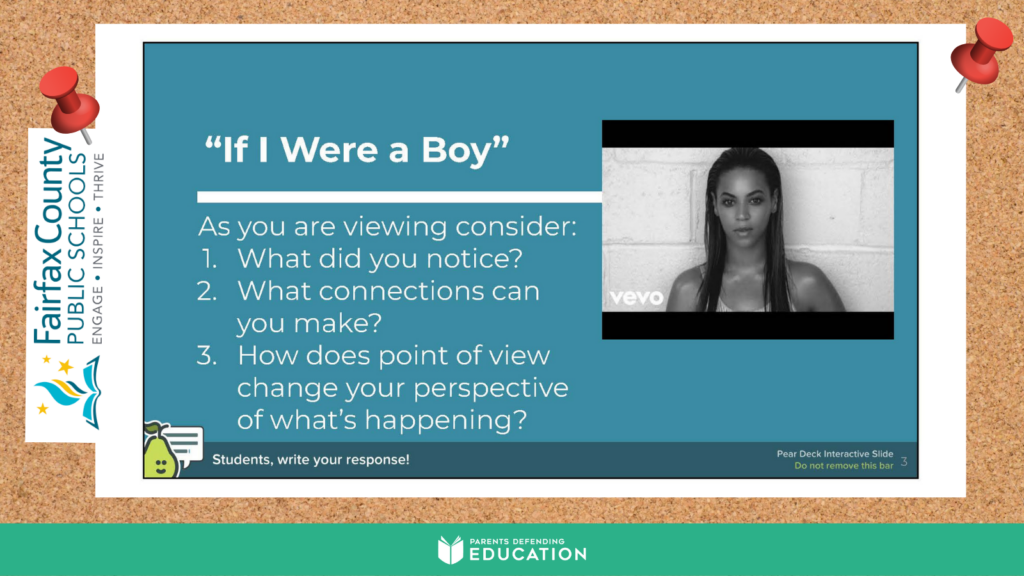
- Slide 3: “If I Were a Boy” — The slide had a music video embedded in the slide for a 2009 music video of the song by that name by pop star Beyoncé. The video tells the story of a woman who ponders questions about gender identity, as she visualizes herself as a police officer and her boyfriend in the office, both dealing with flirtations. The slide includes an image from the music video of Beyoncé standing against a white wall. The slide asked: “How does point of view change your perspective of what’s happening?”
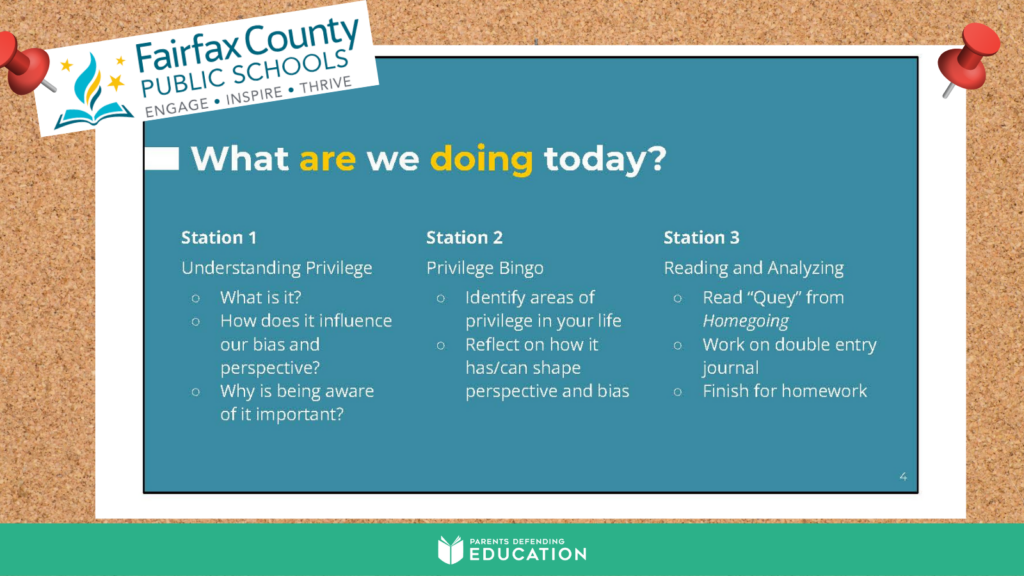
- Slide 4: “What are we doing today?” — The slide covers three stations. Station 1 includes “Understanding Privilege.” Station 2 includes “Privilege Bingo,” with the instructions: “Identify areas of privilege in your life. Reflect on how it has/can shape perspective and bias.” Station 3 includes reading a passage, entitled, “Quey,” (below) from a book, Homecoming, and writing in a “double entry journal,” that is the “Perspectives Journal” (below).
- Slide 5: “Becoming aware of privilege should not be viewed as a burned or source of guilt, but rather, an opportunity to learn and be responsible so that we may work toward a more just and inclusive world,” quoting the University of Ontario Office of Student Life.
- Slide 6: “Understanding Privilege?” with a link to a 3:59 minute video by the liberal media outlet BuzzFeed on the YouTube channel of As/Is. It chronicles the “Privilege Walk,” and explains that a list of “35 social privileges or disadvantages” were read to 10 people, who took a step forward if they had a “privilege” or backward if they had a “disadvantage.” An Asian American man said he “wasn’t sure” where he fell in privilege. The lesson’s notes say: “This lesson is very important to guide the class through. It should be done in-person or face to face online if possible. Students MUST feel supported in discussions of privilege…” The notes then included questions with the warning: “These are the questions used in the video if students feel comfortable doing the activity.” It then lists 35 questions (see below).
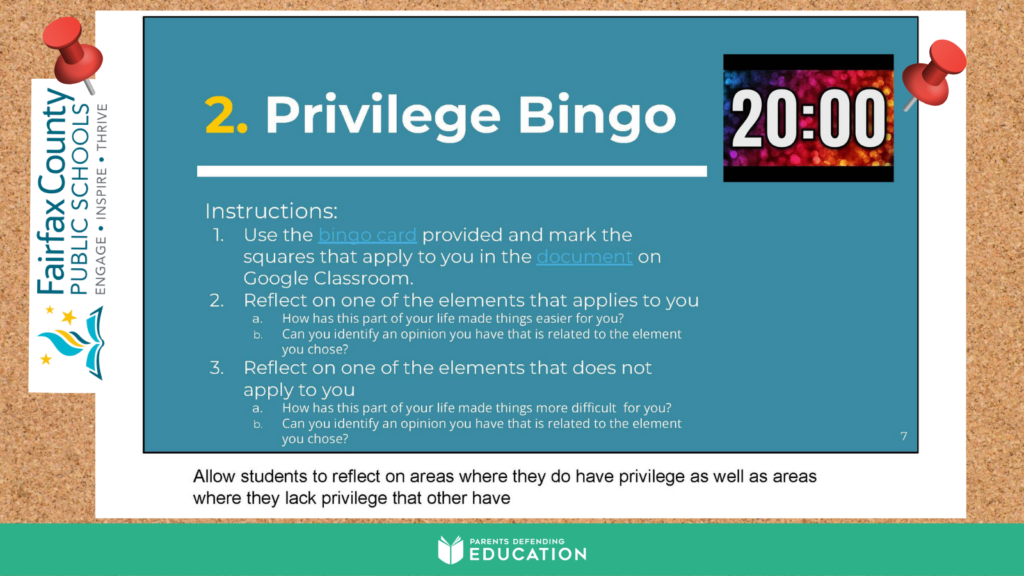
- Slide 7: “Privilege Bingo” with 20-minute timer — The instructions say to use a bingo card provided and link to a bingo card on a website to make free bingo cards. It includes the bingo card with “Military Kid” on it. There is a link to a document in Google Classroom that could not be opened. The slide asks students to “reflect” on “the elements that applies to you” and asked, “How has this part of your life made things easier for you?” The teacher instructions say: “Allow students to reflect on areas where they do have privilege as well as areas where they lack privilege that others have.”

- Slide 8: “Perspective” — The slide includes a poster credited to the University of Ontario Institute of Technology Student Engagement and Equity, with the message: “CHECK YOUR PRIVILEGE,” and a list of privileges, including: “Able-bodied,” “Access to education,” “Christian,” “Cisgender,” “Heterosexual,” “Male,” “Native English speaker” and “White.” It offered a perspective that the poster represents “hate speech” because it “defines certain groups of people and blames them for the ills of society” or “acknowledging our privilege isn’t saying that we did not work for our accomplishments…”
The University of Ontario posters sparked wide controversy in 2018, drawing media attention, after the university’s Office of Student Life put the posters around campus, leading to the posters being quickly removed.
- Slide 9: “Check IN” — This slide asks, “What can we do with the privilege we find in ourselves?”
- Slide 10: “Reading and Analyzing” with 20-minute timer — The slide instructs students to read “Quey” from a book, Homecoming. It says, “Consider our discussion of privilege and perspectives as you read.” It says to work on the “double entry journal.” The link provided doesn’t give access to a document.
- Slide 11: “Debrief” — This slide asks several questions, including: “How do our personal biases impact our perspective,” and “What role does privilege play in the formation of bias?”
- Slide 12: “Homework” — Finish reading “Quey” and answering the questions from the last slide.
“Perspectives Journal – ‘Quey’”
The “Perspectives Journal” gives students two reading assignments in a worksheet. In the novel Homecoming, published in 2016 by Yan Gyasi, a Ghanaian-American author. Each chapter follows the stories of the descendents of a woman, Maame, from the Asante tribe of Ghana. One of her daughters is Effia, a black woman who marries a white slave trader, James Collins. Their son is “Quey” and lives conflicted because of his biracial identity and sexual attraction to a boy.
- It tells students to read a chapter, “Esi,” and asked: “In this chapter, what privilege does Quey have? What are the reasons that he has this privilege?”
- It tells students to read another article, “related to the term ‘half-caste,” and asked: “What is the author’s main point?”
- The worksheet also asks “how do the ideas behind the antiquated term still remain?”
“Half Caste”
A two-page reading includes these passages:
- The page begins with a discussion of the term “Paki,” the author writing: “They say it as a shortening of Pakistan, like Brit or Aussie. But then, they’d never had it snarled int emir face with rage and spittle.”
- “As I get older, and the country threatens to tip back into its old, intolerant ways, it breaks my heart to think of how my parents might have been treated. My dad, the immigrant, and my mum, the white woman who married him.”
- “Political correctness is often ridiculed…But the sort of people who decry it are usually the ones throwing out the sharpest barbs. To me, political correctness is just kindness by another name.”
- “And, please, do explain to me quite what the harm is in being correct?”
“Privilege Walk”
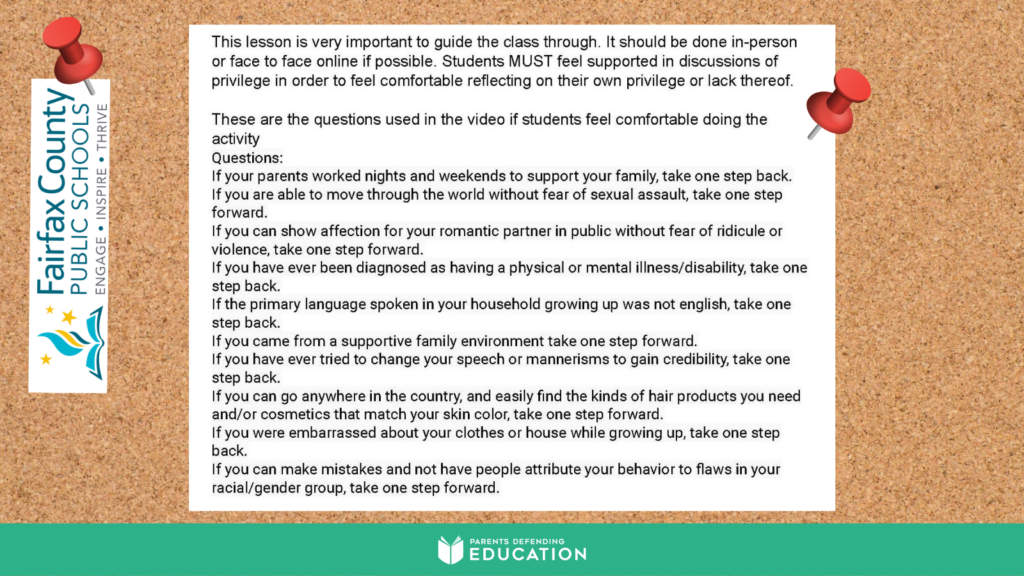
The “Privilege Walk” from the lesson include 35 questions.
- If your parents worked nights and weekends to support your family, take one step back.
- If you are able to move through the world without fear of sexual assault, take one step forward.
- If you can show affection for your romantic partner in public without fear of ridicule or violence, take one step forward.
- If you have ever been diagnosed as having a physical or mental illness/disability, take one step back.
- If the primary language spoken in your household growing up was not english, take one step back.
- If you came from a supportive family environment take one step forward.
- If you have ever tried to change your speech or mannerisms to gain credibility, take one step back.
- If you can go anywhere in the country, and easily find the kinds of hair products you need and/or cosmetics that match your skin color, take one step forward.
- If you were embarrassed about your clothes or house while growing up, take one step back.
- If you can make mistakes and not have people attribute your behavior to flaws in your racial/gender group, take one step forward.
- If you can legally marry the person you love, regardless of where you live, take one step forward.
- If you were born in the United States, take one step forward.
- If you or your parents have ever gone through a divorce, take one step back.
- If you felt like you had adequate access to healthy food growing up, take one step forward
- If you are reasonably sure you would be hired for a job based on your ability and qualifications, take one step forward.
- If you would never think twice about calling the police when trouble occurs, take one step forward.
- If you can see a doctor whenever you feel the need, take one step forward.
- If you feel comfortable being emotionally expressive/open, take one step forward.
- If you have ever been the only person of your race/gender/socio-economic status/ sexual orientation in a classroom or workplace setting, please take one step back.
- If you took out loans for your education take one step backward.
- If you get time off for your religious holidays, take one step forward.
- If you had a job during your high school and college years, take one step back.
- If you feel comfortable walking home alone at night, take one step forward.
- If you have ever traveled outside the United States, take one step forward.
- If you have ever felt like there was NOT adequate or accurate representation of your racial group, sexual orientation group, gender group, and/or disability group in the media, take one step back.
- If you feel confident that your parents would be able to financially help/support you if you were going through a financial hardship, take one step forward.
- If you have ever been bullied or made fun of based on something that you can’t change, take one step back.
- If there were more than 50 books in your house growing up, take one step forward.
- If you studied the culture or the history of your ancestors in elementary school take one step forward.
- If your parents or guardians attended college, take one step forward.
- If you ever went on a family vacation, take one step forward.
- If you can buy new clothes or go out to dinner when you want to, take one step forward.
- If you were ever offered a job because of your association with a friend or family member, take one step forward.
- If one of your parents was ever laid off or unemployed not by choice, take one step back.
- If you were ever uncomfortable about a joke or a statement you overheard related to your race, ethnicity, gender, appearance, or sexual orientation but felt unsafe to confront the situation, take one step back.