Executive Summary
Internal documents from the National Education Association (NEA)—and shared with Defending Education—note the following:
- that unions may “spend unlimited amounts from their general treasuries on ballot measures”
- the organization is providing “strategic and financial assistance” to defeat unfriendly ballot measures
- is engaging in litigation to thwart anti-union legislation
- is tracking ‘attacks’ from right-wing and education reform groups.
Also included in this report are also examples of the NEA, its state-level affiliates, and its political action committees’ (PACs) financial influence on state-level ballot initiatives/ measures. A deeper dive into national, state, and local teachers unions’ spending on leftwing political organizations and far-left activist groups are in our federal DivertED and state-level DivertED reports.
Key Takeaways
- A NEA document titled “Financial & Operational Standards of the National Education Association and Its Affiliates” states that “unions may spend unlimited amounts from their general treasuries on ballot measures in any state, subject to any state affiliate agreements to address specific state laws.”
- A “confidential” document titled “Affiliate Vulnerability Framework” calls for the maintaining of “payroll deduction arrangements in anticipation of legislative rollback to provide affiliates with a financial cushion while they flip to autopay” and notes that “risk is mitigated” through “litigation challenging the repeal of payroll dues deduction has successfully blocked the repeal in several states.”
- A subsection titled “Tracking Right Wing & Ed Reform Activity as it Pertains to Union Threats” calls for partnering with “others to develop or access information needed to anticipate right-wing attacks” from groups such as “ALEC, SPN (State Policy Network), and Right-to-Work.” The subsection also calls for connecting “state affiliates to the Disinformation Defense Federation,” a project of the State Leadership Project and receives funding from The Genesis Prize.
- Another subsection states that the NEA is to “provide strategic and financial assistance through the Ballot Measure grant program” which will mitigate risk by “engaging politically to defeat these measures” to protect “our members, students, and communities.”
- In 2026, the NEA, its Advocacy Fund, as well as state and local affiliates contributed $7,791,929.95 to groups and PACs opposing school choice and ballot measures in just three states (AK, AZ, WA). [See “Financial Takeaways” for a breakdown.]
Financial & Operational Standards of the NEA and Its Affiliates
A September 2026 NEA and National Council of State Education Associations (NCSEA) document titled “Financial & Operational Standards of the National Education Association and Its Affiliates” provides state and local affiliates with updated guidance and policy templates. The document includes various sample policies, best practices, and union oversight.
Campaign Finance and Lobbying
Elections for Federal Office
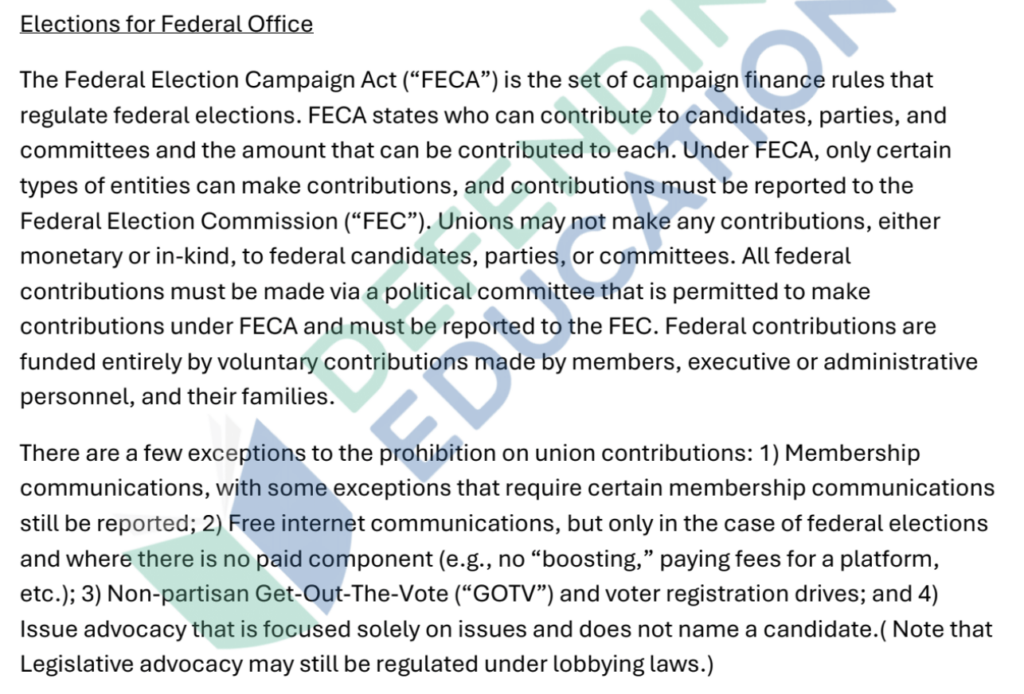
In the section titled “Campaign Finance and Lobbying,” the document notes that “unions may not make any contributions, either monetary or in-kind, to federal candidates, parties, or committees” and that “all federal contributions must be made via a political committee that is permitted to make contributions” under the Federal Election Campaign Act (FECA).
The document also states that there are a “few exceptions to the prohibition on union contributions” such as:
- “Membership communications, with some exceptions that require certain membership communications still be reported”
- “Free internet communications, but only in the case of federal elections and where there is no paid component (e.g.,no “boosting,” paying fees for a platform, etc)”
- “Non-partisan Get-Out-The-Vote (“GOTV”) and voter registration drives”
- “Issue advocacy that is focused solely on issues and does not name a candidate”
Elections for State/Local Office
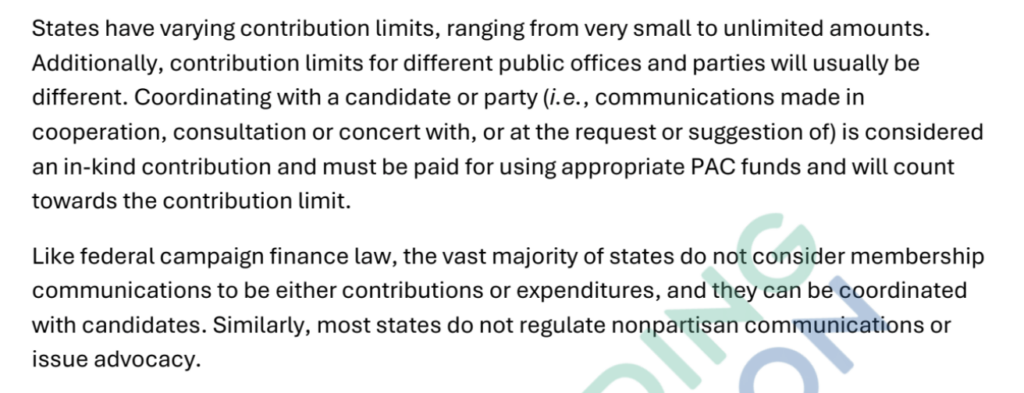
The document notes that “State and local elections are regulated by state campaign finance laws” and that “most, but not all, , state campaign finance laws prohibit union contributions, including monetary and in kind, to candidates and parties.” It also states that “like federal campaign finance law, the vast majority of states do not consider membership communications to be either contributions or expenditures, and they can be coordinated with candidates” and “most states do not regulate nonpartisan communications or issue advocacy.”
Ballot Measures
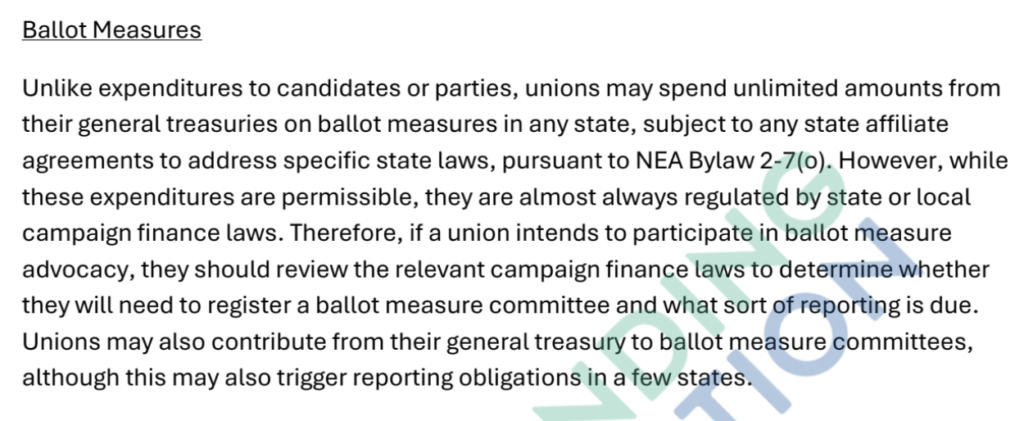
The document states that “unions may spend unlimited amounts from their general treasuries on ballot measures in any state, subject to any state affiliate agreements to address specific state laws.” It also states that “unions may also contribute from their general treasury to ballot measure committees, although this may also trigger reporting obligations in a few states.”
Affiliate Vulnerability Framework
A “confidential” document titled “Affiliate Vulnerability Framework” includes a number of organizational “strategic outcomes” and risk mitigation actions including the maintaining of “payroll deduction arrangements in anticipation of legislative rollback,” push back on and/or litigate challenges to “voucher schemes,” tracking “Right Wing & Ed Reform Activity,” and “defeating harmful measures at the ballot.”
Significant Legal Affiliate Support
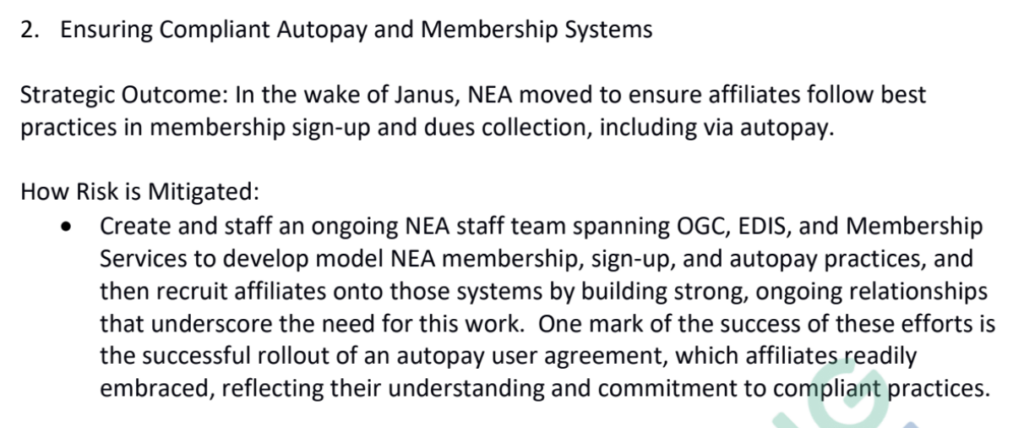
Ensuring Compliant Autopay and Membership Systems
The document states that “in the wake of Janus, NEA moved to ensure affiliates follow best practices in membership sign-up and dues collection, including via autopay.”
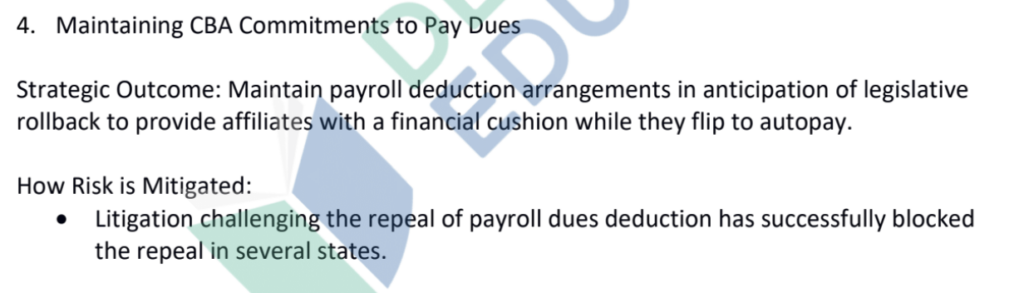
Maintaining CBA Commitments to Pay Dues
The “strategic outcome” calls for the maintaining of “payroll deduction arrangements in anticipation of legislative rollback to provide affiliates with a financial cushion while they flip to autopay.” The section notes that “risk is mitigated” through “litigation challenging the repeal of payroll dues deduction has successfully blocked the repeal in several states.”
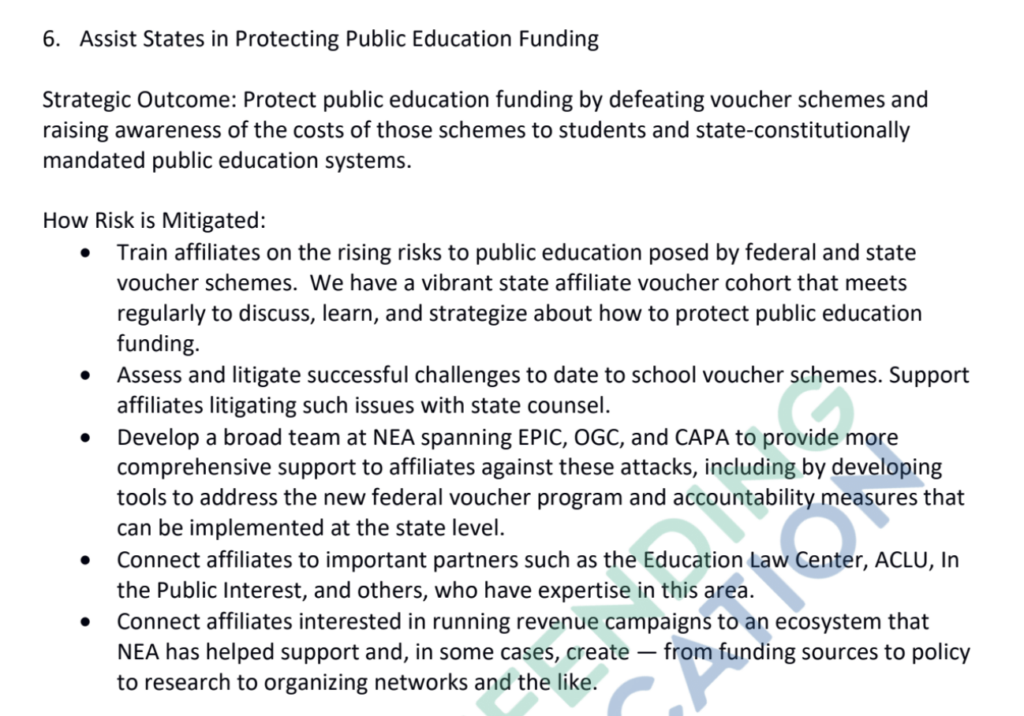
Assist States in Protecting Public Education Funding
This subsection calls for protecting “public education funding by defeating voucher schemes and raising awareness of the costs of those schemes to students and state-constitutionally mandated public education systems.”
Risk mitigation efforts include:
- Training “affiliates on the rising risks to public education posed by federal and state voucher schemes.”
- “Assess and litigate successful challenges to date to school voucher schemes” and “support affiliates litigating such issues with state counsel.”
- “Develop a broad team at NEA spanning EPIC, OGC, and CAPA to provide more comprehensive support to affiliates against these attacks, including by developing tools to address the new federal voucher program and accountability measures that can be implemented at the state level.”
- “Connect affiliates to important partners such as the Education Law Center, ACLU, In the Public Interest, and others, who have expertise in this area.”
Significant Legislative Crisis Affiliate Support
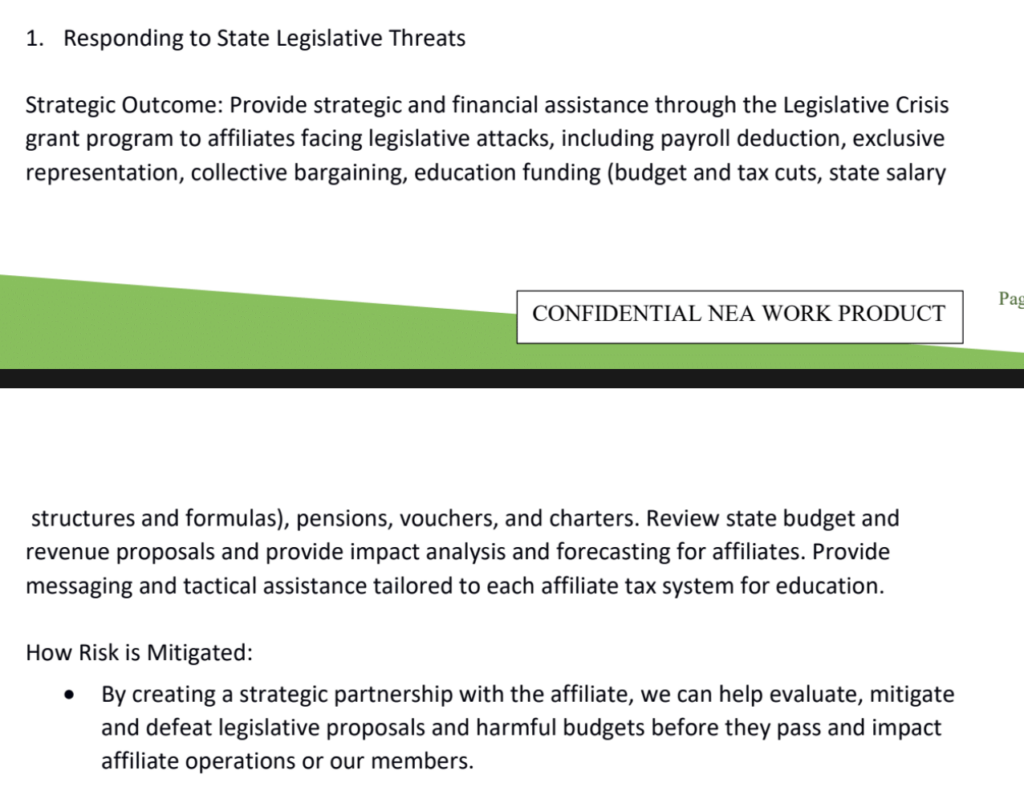
Responding to State Legislative Threats
This subsection states that the NEA will “provide strategic and financial assistance through the Legislative Crisis grant program to affiliates facing legislative attacks, including payroll deduction, exclusive representation, collective bargaining, education funding (budget and tax cuts, state salary structures and formulas), pensions, vouchers, and charters.” The organization will also “review state budget and revenue proposals and provide impact analysis and forecasting for affiliates” and “provide messaging and tactical assistance tailored to each affiliate tax system for education.”
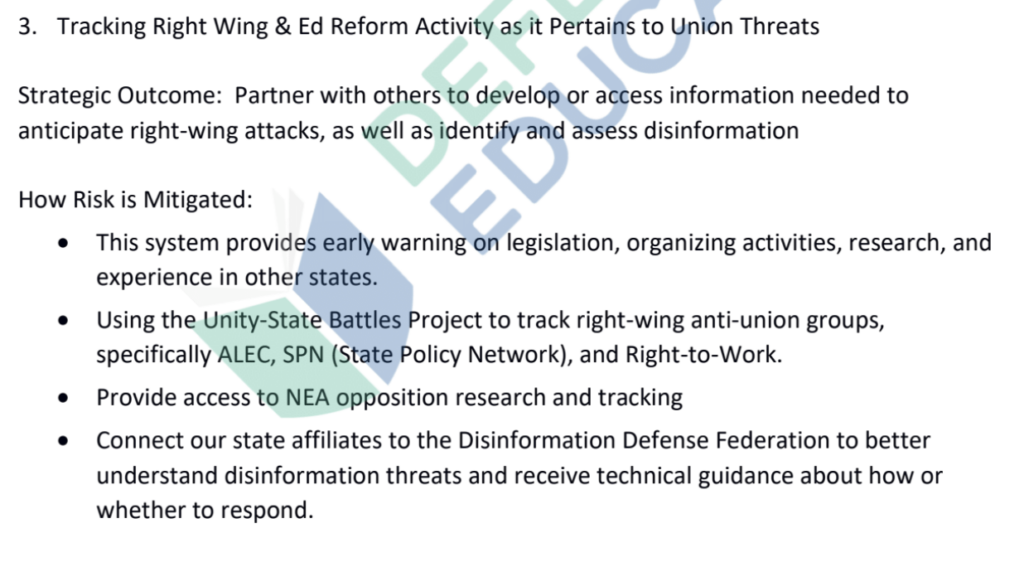
Tracking Right Wing & Ed Reform Activity as it Pertains to Union Threats
The document calls for partnering with “others to develop or access information needed to anticipate right-wing attacks, as well as identify and assess disinformation.” It notes how risk will be mitigated because the “system provides early warning on legislation, organizing activities, research, and experience in other states,” it uses the “Unity-State Battles Project to track right-wing anti-union groups, specifically ALEC, SPN (State Policy Network), and Right-to-Work,” “provide access to NEA opposition research and tracking,” and “connect our state affiliates to the Disinformation Defense Federation to better understand disinformation threats and receive technical guidance about how or whether to respond.”
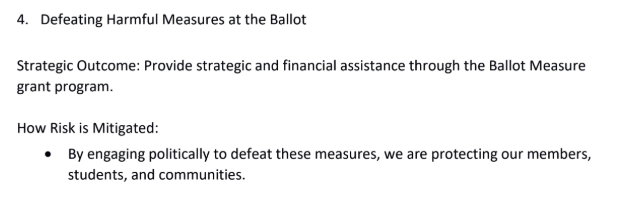
Defeating Harmful Measures at the Ballot
This subsection states that its “strategic outcome” is to “provide strategic and financial assistance through the Ballot Measure grant program” which will mitigate risk by “engaging politically to defeat these measures” to protect “our members, students, and communities.”
AutoPay Playbook
Another NEA document titled “AutoPay Playbook” claims that the “goal of payroll deduction bans” is to “force affiliates into all-consuming conversion campaigns that prevent our union from building the power we need to protect public eduction.” It also states that “proactively converting our membership is the only way to neutralize this threat and protect our power.”
The goal for the NEA is to convert their members over to their “AutoPay” program, which draws member dues via recurring electronic funds transfers (EFT). Because of state legislatures passing laws that prohibit public school districts from deducting dues from employee’s paychecks, the union aim is to secure direct, independent access to member funds, ensuring the NEA maintains its revenue and membership numbers.
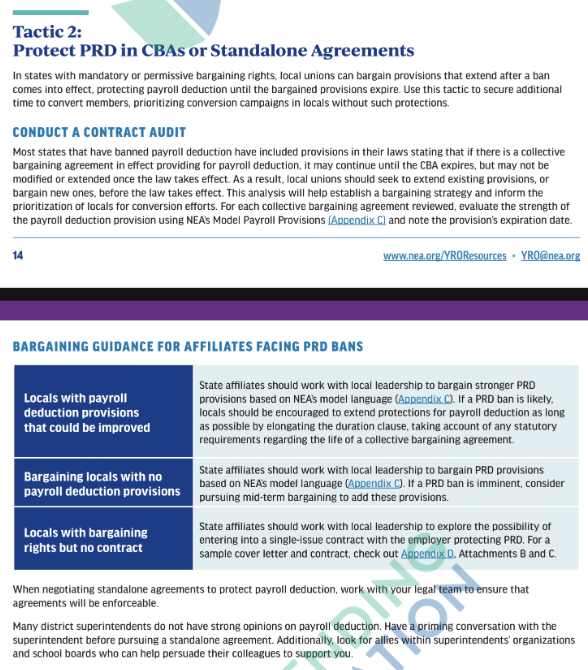
Key Strategy 2: Prepare Your Leaders Locals, and Allies
The subsection titled “Tactic 2: Protect PRD in CBAs or Standalone Agreements” states that “local unions can bargain provisions that extend after a ban comes into effect, protecting payroll deduction until the bargained provisions expire.” The document promotes the use of this tactic to “secure additional time to convert members, prioritizing conversion campaigns in locals without such protections.”
Key Strategy 4: Reach Every Member Multiple Times
The document promotes several different tactics to get members to convert to AutoPay, including making home visits to members.

Financial Takeaways
- On September 22, 2026, the NEA Advocacy Fund contributed $250,000 to the group “No on 2” which opposes Alaska’s Ballot Measure No. 2 – which repeals/ eliminates the state’s top-four ranked-choice voting system and replaces it with the a primary winner to general election format.
- In the first two quarters of 2026, the Protect Education, Accountability Now PAC received a total of $7,075,438.33 from the Arizona Education Association and National Education Association to run an anti-school choice campaign. The PAC appears to be run and operated by the president of an NEA local affiliate – Kyrene Education Association.
- In Arizona, Will Of The People PAC, which opposes Proposition 318, received $75,000 from the Arizona Education Association on September 30, 2026.
- In Washington state, the committee No Hate in WA State, which has spent over $4M in 2026 attempting to defeat Ballot Measures IL26-001 and IL26-638, received $391,491.62 in contributions from the Washington Education Association (WEA).
- Between 2023 and 2024, Support Our Schools Nebraska, which led a campaign to repeal school choice legislation, received $4,298,076 from the NEA. [from DivertED: National teachers’ unions report]
- Protect Our Schools KY received $7.2M from the NEA in 2024. The organization advocates against school choice and voucher legislation. [from DivertED: National teachers’ unions report]
- In 2024, the NEA gave $4,037,500 to Colorado based Public Schools Strong to campaign against Amendment 80 and school choice. [from DivertED: National teachers’ unions report]
- In 2020, the NEA affiliate California Teachers Association Political Action Committees (PACs), spent $20M+ in support of “Yes on 15,” a ballot measure to change the tax assessment on commercial and industrial property to raise more funds for public schools, community colleges, and other government services. [from DivertED: state and local report]