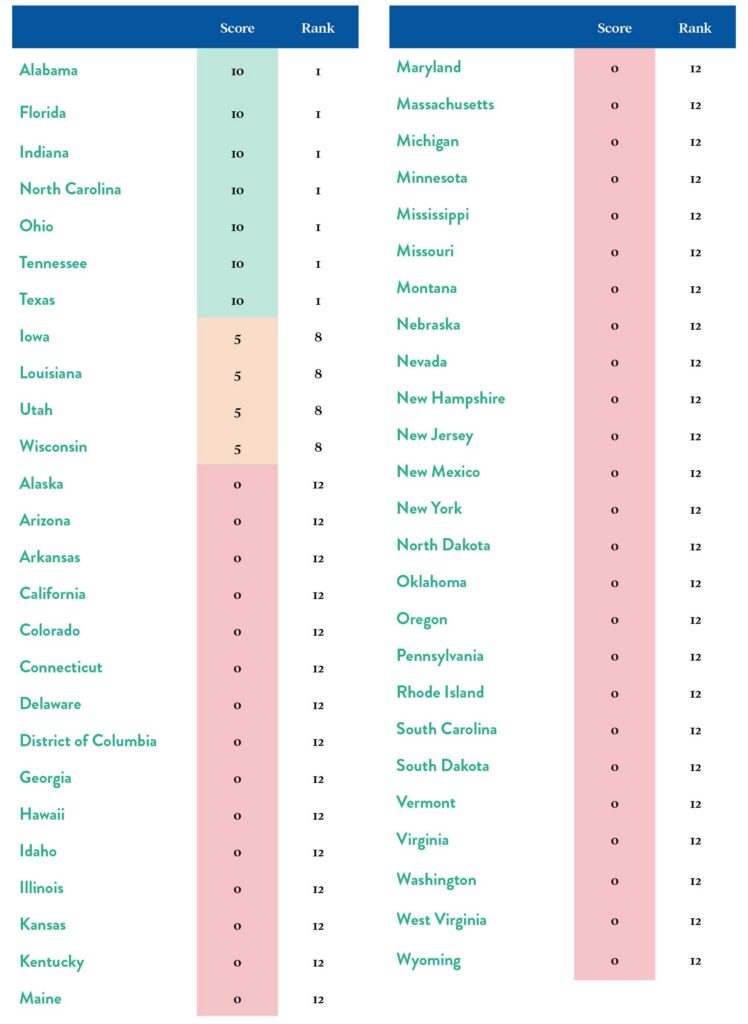

Introduction
American students and parents face a wide variety of challenges in today’s society: gender ideology introduced for the youngest students, elements of anti-racism and critical race theory embedded into curricula and standards, union influence on teachers, foreign funding undermining learning, and more. Defending Education’s Rankings on Integrity in State Education (RISE) compares how state governments are handling these issues and what they are doing to protect students and families, and keep public education in the best interest of students.
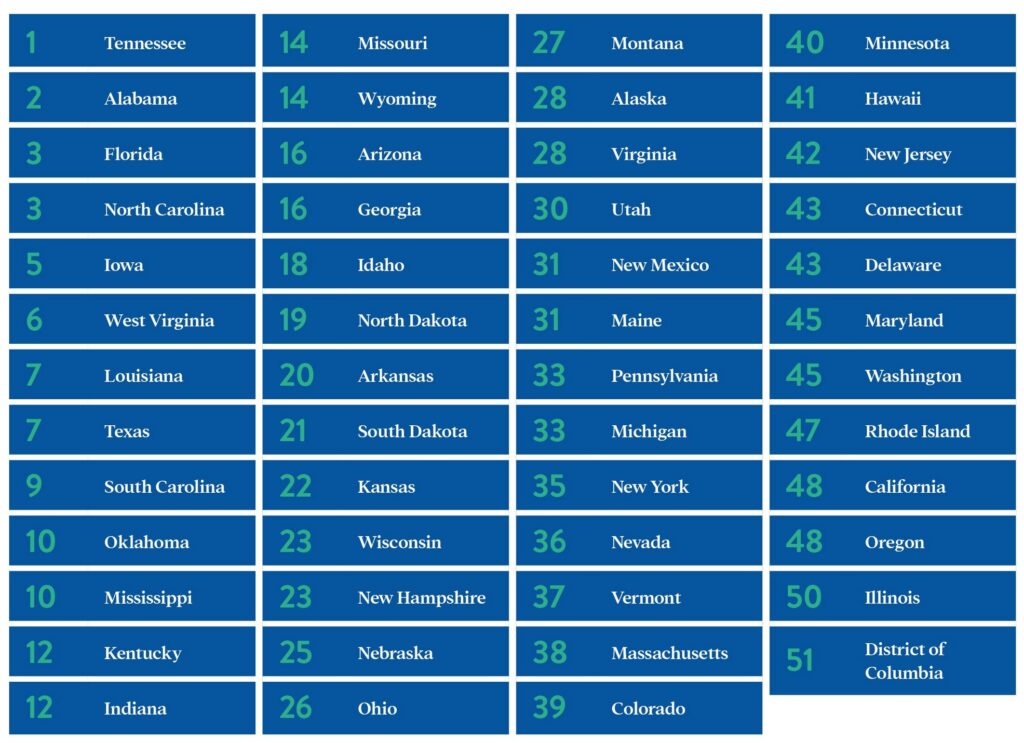
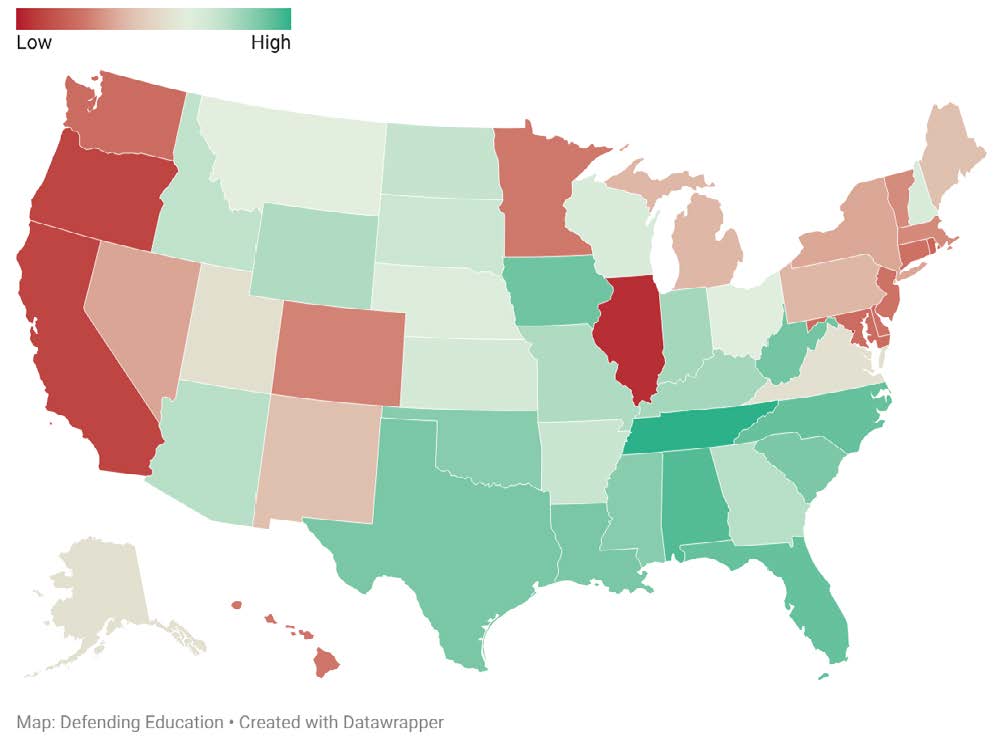
We scored all 50 U.S. states and the District of Columbia on five major education categories (gender and sexuality, “diversity, equity, and inclusion”, parental rights, teacher policies, and foreign influence), and ranked them based on their performance. Tennessee earns the top score in 2026, while Illinois ranks the worst, only over the District of Columbia which takes the 51st spot.
Our 2026 RISE Rankings
Ranking School Integrity By State
SECTION I. Gender and Sexuality Policy
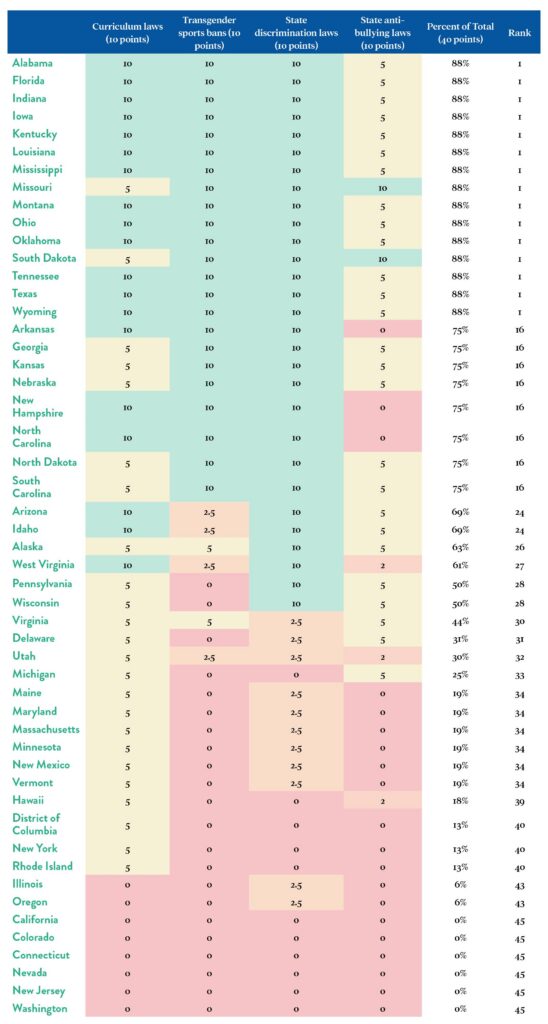
To estimate state regulation of gender and sexuality ideology in schools, we ranked states on the following metrics: gender and sexuality ideology included in school curricula, policies on transgender students in sports, and inclusion of sexual orientation and/or gender identity in state discrimination and anti-bullying laws.
GENDER AND SEXUALITY TOPICS IN CURRICULA
Scores in this metric estimated how states regulate inclusion of gender and sexuality topics in subjects such as history, civics, or social studies. It also measures whether states mandate certain inclusion requirements for representation based on gender and sexuality and other demographic characteristics. The scoring was based on information published by the Movement Advancement Project in 2026.
| Scores Criteria | |
|---|---|
| 10 Points | State restricts LGBTQ-specific content in school curricula. |
| 5 Points | State has no LGBTQ-specific curriculum laws. |
| 0 Points | State has an LGBTQ-inclusive curriculum requirement. |
POLICY ON TRANSGENDER STUDENTS IN SPORTS
Scores in this metric reflect whether anti-bullying policies include gender identity as a protected class. The scoring was based on information published by the Movement Advancement Project in 2026.
| Scoring Criteria | |
|---|---|
| 10 Points | State law bans transgender students from joining sports teams according to their assumed gender identity. |
| 5 Points | State regulation or agency bans transgender student participation. |
| 2.5 Points | State law or regulation bans transgender student participation, but it is blocked by a court decision. |
| 0 Points | State does not ban transgender student participation. |
GENDER IDENTITY INCLUDED IN DISCRIMINATION LAWS
Scores in this metric reflect whether or not state discrimination laws (which apply generally to employment and housing applications) include gender identity as a specified protected class. The scoring was based on information published in 2026.
| Scoring Criteria | |
|---|---|
| 10 Points | State does not include gender identity in nondiscrimination laws. |
| 2.5 Points | State includes gender identity only. |
| 0 Points | State includes gender identity and expression. |
GENDER IDENTITY INCLUDED IN ANTI-BULLYING LAWS
Scores in this metric reflect whether anti-bullying policies include gender identity as a protected class. The scoring was based on information published by the Movement Advancement Project in 2026.
| Scoring Criteria | |
|---|---|
| 10 Points | State law or regulation prevents adding gender identity to anti-bullying laws. |
| 5 Points | No state law includes bullying based on gender identity. |
| 2 Points | School regulations or teacher code may include gender identity in bullying definition. |
| 0 Points | State anti-bullying law includes gender identity. |
Gender And Sexuality Policy Scores and Rankings By State
Section II. Diversity, Equity, And Inclusion (“DEI”) Content
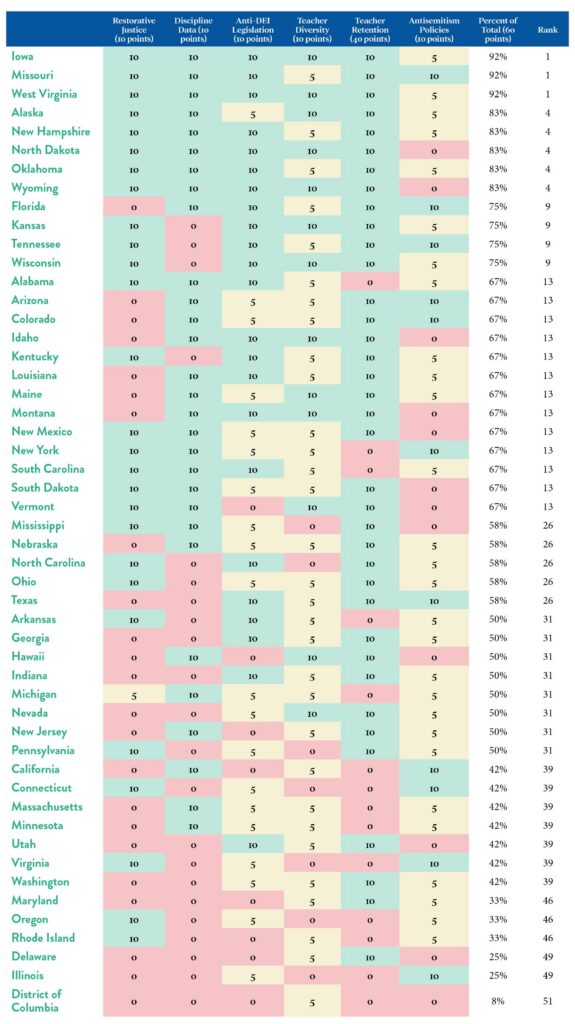
This section analyzes how states regulate use of critical race theory and other “diversity, equity, and inclusion” concepts that emphasize the United States as a racist, white supremacist society in school settings. To do this, we tracked six metrics including: restorative justice ideology as a race- and ethnic-based alternative to discipline, reporting discipline data by race, requiring a variety of “diversity, equity, and inclusion” concepts in schools, race- or ethnic-based metrics to teacher hiring and retention, and antisemitism policy.
RESTORATIVE JUSTICE
The restorative justice metric evaluated the extent to which each state has incorporated restorative justice practices into statewide education policy. “Restorative justice” refers generally to policies that replace traditional discipline with alternatives based on social-emotional learning, which can be tied to racial or ethnic diversity concepts.
States were scored on a 10-point scale, with lower scores assigned to states that have more progressive restorative justice policies and higher scores assigned to states with little or no statewide involvement. The scoring was based on information published by the Association of State and Territorial Health Officials, published in 2021.
| Scoring Criteria | |
|---|---|
| 10 Points | No statewide restorative justice policy. |
| 5 Points | A restorative justice policy was adopted through an administrative rule or action by the state executive branch. |
| 2.5 Points | A restorative justice policy was passed by the state legislature but does not require executive approval. |
| 0 Points | Restorative justice policy was passed by the state legislature and approved by the governor. |
RACIAL DISAGGREGATION OF DISCIPLINE DATA
This metric evaluated whether a state requires student discipline records, including suspensions and expulsions, to be disaggregated by race.
States received a score of 10 if they did not require racial disaggregation of discipline records and a score of 0 if they did require it. The scoring was based on information published by the Education Commission of the States 50-State Comparison Report, updated as of May 2021.
| Scoring Criteria | |
|---|---|
| 10 Points | State doesn’t have regulations about reporting discipline records by race. |
| 0 Points | State does have regulations about reporting discipline records by race. |
ANTI-DEI LEGISLATION
This metric evaluated whether a state had introduced or enacted legislation restricting or prohibiting “diversity, equity, and inclusion” (DEI) initiatives across public educational institutions.
States received a score of 10 if they had enacted at least one anti-DEI law, a score of 5 if they had introduced at least one anti-DEI bill but had not enacted one, and a score of 0 if they had not introduced any anti-DEI legislation. This scoring is based on the Movement Advancement Project’s Dismantling DEI: A Coordinated Attack on American Values report and accompanying state policy map, which tracks anti-DEI legislation across all levels of education.
| Scoring Criteria | |
|---|---|
| 10 Points | State has enacted at least one anti-DEI law as of 2024. |
| 5 Points | State has introduced at least one anti-DEI bill as of 2024 but has not enacted one. |
| 0 Points | State has not introduced any anti-DEI legislation as of 2024. |
TEACHER DIVERSITY GOALS AND DATA COLLECTION
This metric evaluated whether a state publicly set goals to increase teacher workforce diversity and collected teacher diversity data to measure progress.
States received a score of 10 if they neither set teacher diversity goals nor collected teacher diversity data, a score of 5 if they collected teacher diversity data but did not set public diversity goals, and a score of 0 if they both set teacher diversity goals and collect teacher diversity data. The scoring was based on the National Council on Teacher Quality’s State of the States 2023: Policies to Increase Teacher Diversity.
| Scoring Criteria | |
|---|---|
| 10 Points | State neither sets teacher diversity goals nor collects teacher diversity data. |
| 5 Points | State collects teacher diversity data but does not set public teacher diversity goals. |
| 0 Points | State sets public teacher diversity goals and collects teacher diversity data. |
STATE-FUNDED TEACHER RETENTION INITIATIVES
This metric evaluated whether state funded teacher retention initiatives and whether those initiatives included a specific focus on increasing teacher workforce diversity.
States received a score of 10 if they did not fund teacher retention initiatives that require certain diversity benchmarks like race or gender, and a score of 0 if they funded teacher retention initiatives that specifically focused on these diversity requirements. The scoring was based on the National Council on Teacher Quality’s State of the States 2023: Policies to Increase Teacher Diversity.
| Scoring Criteria | |
|---|---|
| 10 Points | State does not fund teacher retention initiatives that require race, ethnicity, gender, or other “diversity” benchmarks. |
| 0 Points | State funds teacher retention initiatives with a specific focus on increasing teacher workforce diversity. |
ANTISEMITISM POLICIES
This metric evaluated the extent to which states have adopted policies to protect Jewish communities,
educate about the Jewish experience, and prioritize efforts to combat antisemitism.
The scoring was based on the Anti-Defamation League’s U.S. Jewish Policy Index, which assesses
state policies related to combating antisemitism across three major policy areas detailed below.
| Scoring Criteria | |
|---|---|
| 10 Points | State has laws and initiatives protecting Jewish communities, educating about the Jewish experience, and prioritizing efforts to combat antisemitism. |
| 5 Points | State has some laws or initiatives protecting Jewish communities, educating about the Jewish experience, or prioritizing efforts to combat antisemitism. |
| 0 Points | State has no laws or initiatives protecting Jewish communities, educating about the Jewish experience, or prioritizing efforts to combat antisemitism. |
DEI Scores and Rankings by State
SECTION III. Parental Rights
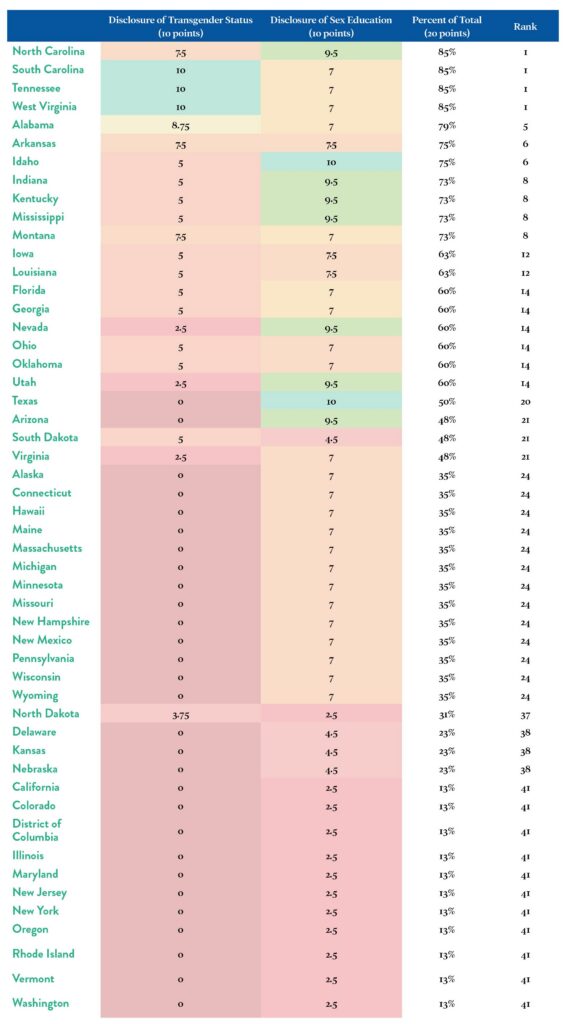
To understand how states empower parents’ rights to know and navigate content in their children’s schools, we reviewed state policies on disclosing student transgender status as well as disclosure of sex education content and participation.
Our criteria for ranking states on these metrics follows, with a full table of assigned scores and resulting rankings in this category.
DISCLOSURE OF TRANSGENDER STATUS OF STUDENTS
This metric analyzes how state law informs policy on if and how a school is required to tell parents about their student using alternate pronouns or other indications that the student is transgender. This is based on information published at the school-district level by Defending Education (updated 2026) and at the state law level by the Movement Advancement Project (2026).
| Scoring Criteria | Points awarded for both school districts and state laws were averaged to generate a single score in this metric. |
|---|---|
| School-district Level | |
| 10 Points | No school districts have specific policies allowing school staff to hide students’ gender pronouns or transgender status from parents. |
| 0 Points | Some school districts allow school staff to hide pronouns or transgender status |
| State-law Level | |
| 10 Points | State law requires disclosure to parents. |
| 7.5 Points | State law requires disclosure if parents ask. |
| 5 Points | State law requires disclosure before using changed pronouns, but not upon initial request of new pronouns from student. |
| 0 Points | No state law on parental disclosure. |
DISCLOSURE OF SEX EDUCATION CONTENT AND PARTICIPATION
This metric analyzes how states regulate transparency around sex education topics particularly around gender and sexuality for school children, and whether parents are able to know, inform, or remove their child from participation in this content. This is based on information published by the Sexuality Information and Education Council of the United States (SIECUS) in 2025.
| Scoring Criteria | Points awarded for participation and topics were averaged to generate a single score for this metric. |
|---|---|
| Participation | |
| 10 Points | Parents are required to consent (“opt-in”) for children to participate in sex education curricula. |
| 5 Points | Parents may opt out of child participation in sex education content. |
| 0 Points | No notification to parents required. |
| Topics | |
| 10 Points | State law prohibits sexual orientation and gender identity content in sex education up to a certain age. |
| 9 Points | State law does not explicitly include sexual orientation and gender identity in sex education. |
| 5 Points | No state law on including sexual orientation and gender identity in sex education, but state guidelines offer some recommendations on how to include these topics. |
| 0 Points | State law requires including sexual orientation and gender identity in sex education. |
Parental Rights Scores and Rankings By State
SECTION IV. Teacher Policies
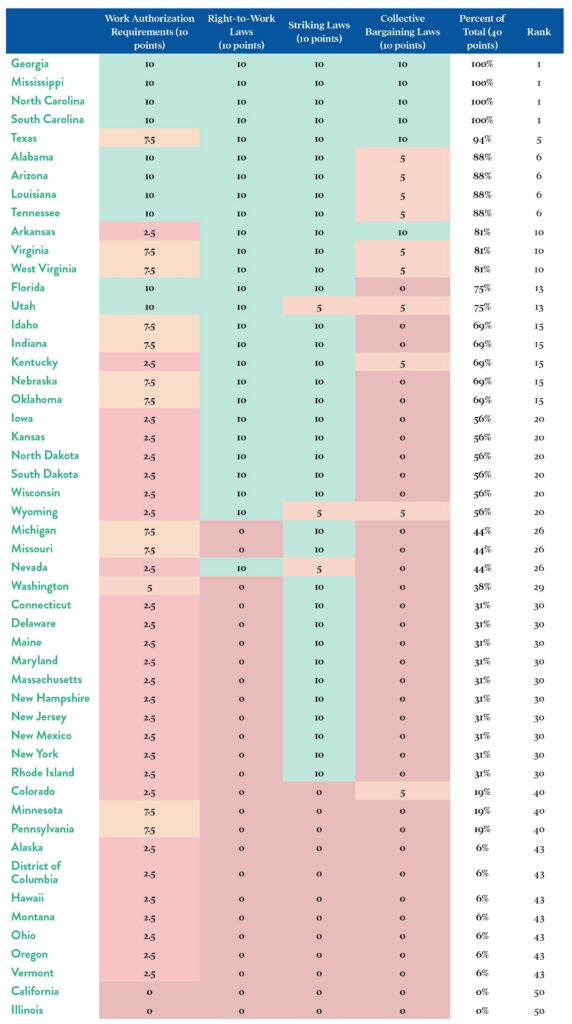
This section analyzed how state laws regulate teachers, safety, and union activities. We looked at the following metrics: requirements to check teachers’ work authorization status using E-Verify, requirements for background checks, right-to-work laws that allow teachers to freely choose or not choose to join a union, strike laws, and collective bargaining laws.
Our criteria for ranking states on these metrics follows, with a full table of assigned scores and resulting rankings in this category.
WORK AUTHORIZATION REQUIREMENTS
This metric reflects whether states require schools to verify teachers’ authorization to work legally in the United States, specifically using the federal E-Verify web system. This is based on information published by Equifax in 2025.
| Scoring Criteria | |
|---|---|
| 10 Points | States require all or most employers to use E-Verify. |
| 7.5 Points | States require public employers and/or contractors to use E-Verify. |
| 5 Points | Some localities require employers to use E-Verify. |
| 2.5 Points | No E-Verify requirement, voluntary only. |
| 0 Points | State restricts E-Verify use. |
RIGHT-TO-WORK LAWS
This metric looks at whether a state protects school employees’ (including teachers’) rights to freely choose whether to join a union. These laws are called right to work laws, and prohibit the practice of requiring employees to become dues-paying members of unions as a condition of employment. This information is based on data published by the National Right to Work Legal Defense Foundation through 2024.
| Scoring Criteria | |
|---|---|
| 10 Points | State has a right-to-work law. |
| 0 Points | State restricts E-Verify use. |
STRIKING LAWS
This metric focuses on how the state regulates teachers going on strike, which when left unregulated can result in interruptions to instruction of students. This is based on information on public sector strike laws published by the National Education Association. Federal laws still generally allow private sector employees to strike regarding collective bargaining or unfair labor practices.
| Scoring Criteria | |
|---|---|
| 10 Points | Public sector striking is illegal. |
| 5 Points | State has no legislation regarding public sector striking or certain groups can strike. |
| 0 Points | Public sector striking is allowed. |
COLLECTIVE BARGAINING LAWS
This metric analyzes whether states regulate collective bargaining, or require employers to negotiate with union demands. This metric analyses whether states regulate collective bargaining, or require employers to negotiate with union demands. This is based on information published by the National Education Association (2026).
| Scoring Criteria | |
|---|---|
| 10 Points | Collective bargaining is prohibited for both K–12 teachers and education support professionals. |
| 5 Points | Collective bargaining is limited for K–12 teachers and is either prohibited or limited for education support professionals. |
| 0 Points | Collective bargaining is permitted for K–12 teachers and is either permitted or limited for education support professionals. |
Teacher Policies Scores and Rankings by State
Section V. Foreign Influence and Funding in Education
This section focuses on state policies addressing foreign government influence in education. While federal law regulates certain aspects of foreign funding and influence, states have also adopted their own approaches to restricting or overseeing these activities.
CHINESE INFLUENCE IN EDUCATION
This metric evaluated whether states had enacted laws restricting or prohibiting Chinese government
influence in education, including policies addressing Confucius Institutes or other forms of Chinese
government involvement in educational institutions.
The scoring was based on an individual review of each state’s statutes and enacted legislation, as no
comprehensive national dataset was available for this topic.
| Scoring Criteria | |
|---|---|
| 10 Points | State has enforceable legislation restricting or prohibiting Confucius Institutes or other forms of Chinese government educational funding or influence. |
| 5 Points | State has enacted narrower restrictions addressing specific aspects of Chinese government influence in educational institutions. |
| 0 Points | State has no relevant statewide policy restricting Chinese government influence in education. |
Foreign Influence Scores and Rankings By State