



California State University, East Bay’s (CSUEB) ‘Ethnic Studies’ General Education requirement only offers far-left content such colonialism, social justice, and white supremacy; trains future teachers in “critical theories and practices that lead to liberatory forms of education.”
Investigations
SUMMARY
California State University, East Bay’s (CSUEB) Ethnic Studies General Education requirement only offers courses that focus exclusively on far-left content such as black gender and sexuality, Asian-American political tensions, Filipino sexuality culture, colonialism, social justice, and white supremacy. Future teachers are taught “critical theories and practices that lead to liberatory forms of education.”
The course is a graduation requirement for students beginning with the class of 2026.
KEY TAKEAWAYS
- A course for future teachers focuses on “institutional challenges, educational policies, social problems, and solutions in and through K-12 education as it relates to the intersections of race, class, gender, sexual orientation, and ability” and includes an “opportunity to learn critical theories and practices that lead to liberatory forms of education.”
- CSUEB offers a course that “explores the identities and experiences of LGBTQ+ Filipina/x/o Americans” and examines “how colonialism and other systems continue to impact Filipina/x/os on personal, familial, local, and global levels.”
- The GE course Hip Hop Nation “explores the diasporic origins and the national, and international evolution of hip hop as a transformative cultural and political force.”
- The course The Black Fantastic specifically discusses African “gender and sexuality.”
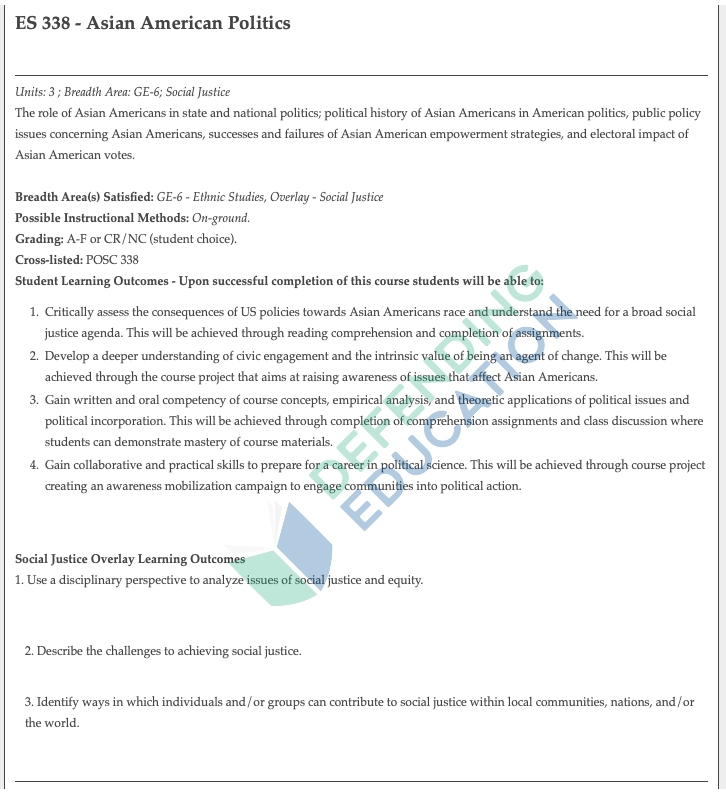
- CSUEB offers an Asian American Politics course that intends to “assess the consequences of US policies towards Asian Americans race and understand the need for a broad social justice agenda”
INTRODUCTION TO ETHNIC STUDIES COURSES
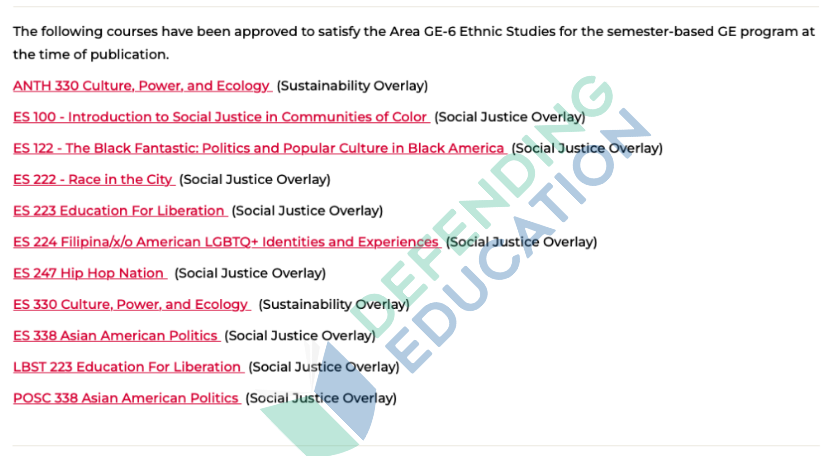
The list of 8 course options that would fulfill the core requirement is as follows: Culture, Power, and Ecology, Introduction to Social Justice in Communities of Color, The Black Fantastic: Politics and Popular Culture in Black America, Race in the City, Education For Liberation, Filipina/x/o American LGBTQ+ Identities and Experiences, Hip Hop Nation, and Asian American Politics.
Even though it lists 11 different courses that can fulfill the requirement, there are only 8 (since many repeat themselves) and they uphold a narrow narrative of systemic racism.
COURSE DESCRIPTIONS
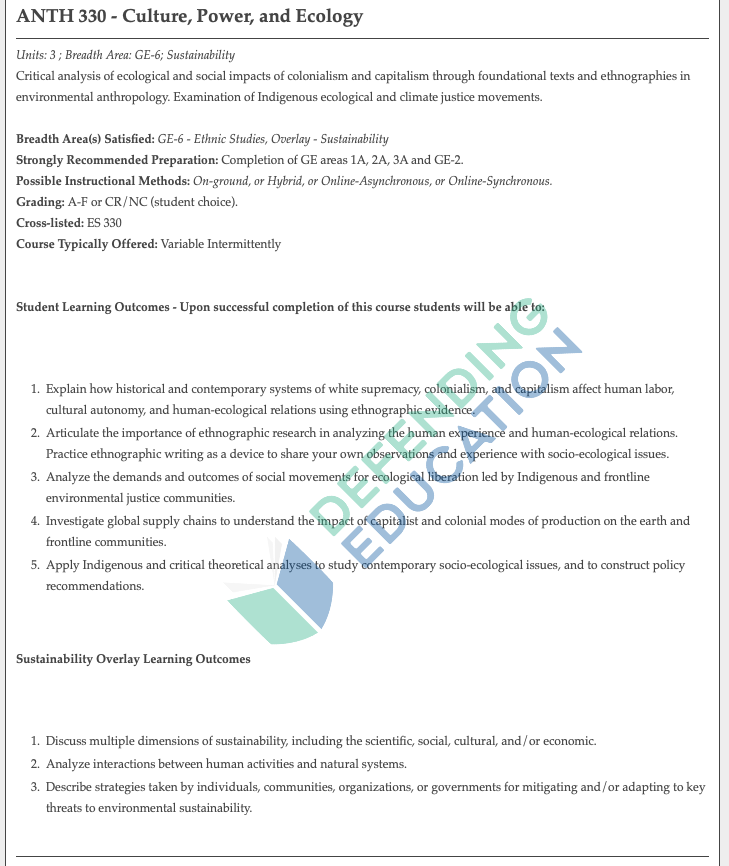
Course 1: ANTH 330 Culture, Power, and Ecology / ES 330 Culture, Power, and Ecology
The purpose of this course is to provide a “critical analysis of ecological and social impacts of colonialism and capitalism through foundational texts and ethnographies in environmental anthropology.” It also gives an “examination of Indigenous ecological and climate justice movements.”
It does so by focusing on “white supremacy, colonialism, and capitalism.”
The course’s intent to denounce capitalism. One goal of the class is to empower students to “investigate global supply chains to understand the impact of capitalist and colonial modes of production on the earth and frontline communities.”
Course 2: ES 100 – Introduction to Social Justice in Communities of Color
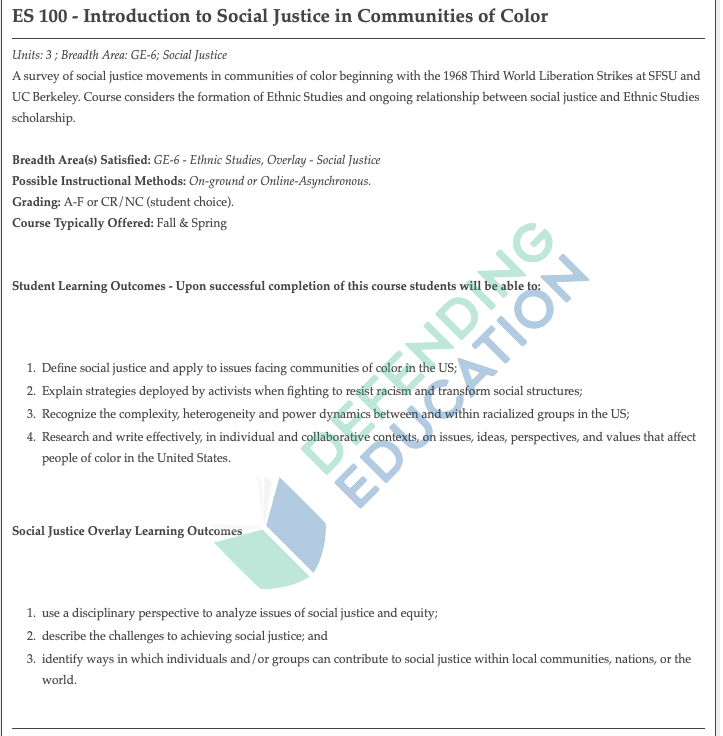
The second course provides “a survey of social justice movements in communities of color beginning with the 1968 Third World Liberation Strikes at SFSU and UC Berkeley. The course considers the formation of Ethnic Studies and ongoing relationship between social justice and Ethnic Studies scholarship.”
It explicitly and intentionally weaves “social justice” into the course. Moreover, it instructs students in “strategies deployed by activists when fighting to resist racism and transform social structures.”
Finally, it examines the tensions between racial groups.
Course 3: ES 122 – The Black Fantastic: Politics and Popular Culture in Black America
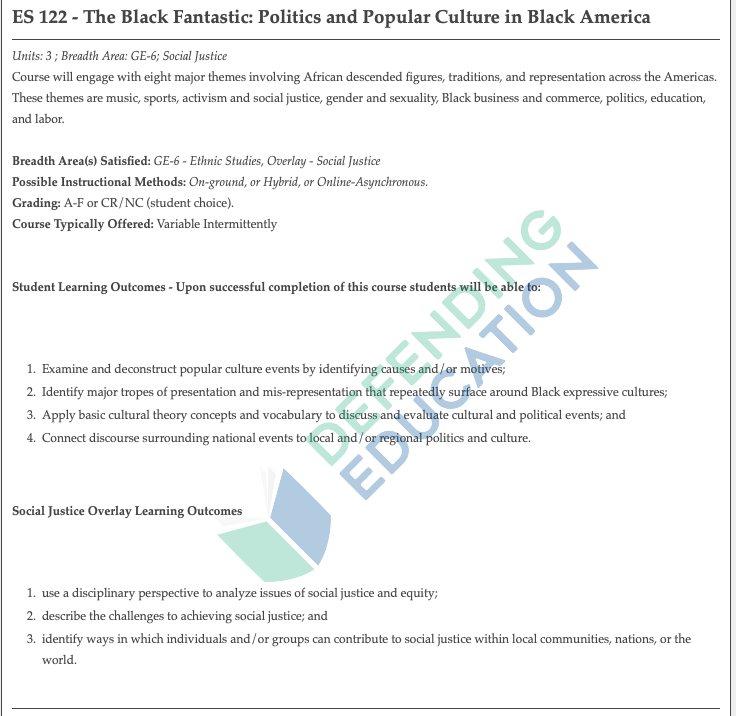
As laid out in the syllabus, “the course will engage with eight major themes involving African descended figures, traditions, and representation across the Americas. These themes are music, sports, activism and social justice, gender and sexuality, Black business and commerce, politics, education, and labor.”
The course intends to teach students about black involvement in pop culture. Inherently, the course claims that this course is necessary for the student to become a well-formed individual based on the goal of GE.
Finally, it includes a section on black sexuality. The class ties contemporary sexuality theories to black historical figures and their historical narrative.
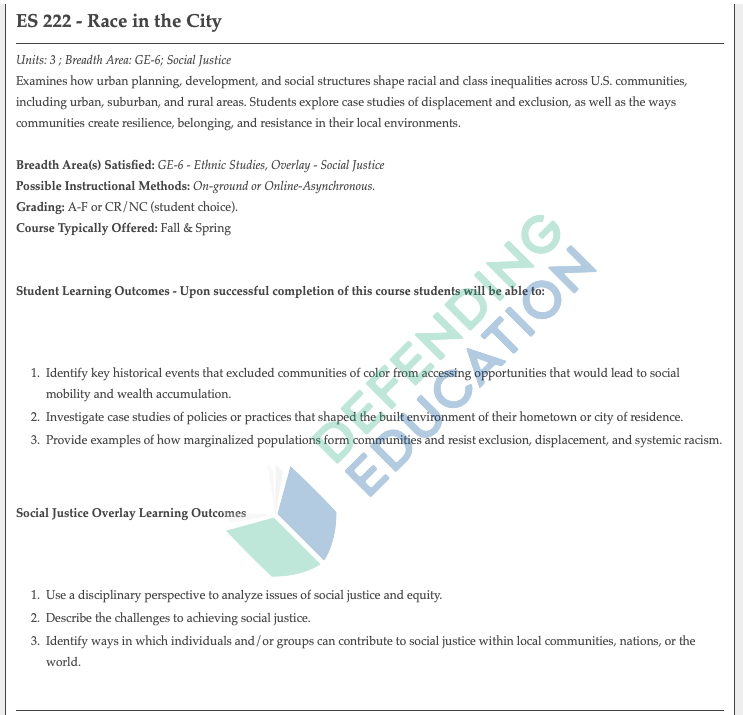
Course 4: ES 222 – Race in the City
The course “Race in the City” specifically “examines how urban planning, development, and social structures shape racial and class inequalities across U.S. communities, including urban, suburban, and rural areas. Students explore case studies of displacement and exclusion, as well as the ways communities create resilience, belonging, and resistance in their local environments.”
It focuses on how urban structure is racist and encourages class inequalities and systemic racism.
Finally, the course denounces “wealth accumulation” as systemically racist.
Course 5: ES 223 Education For Liberation / LBST 223 Education For Liberation
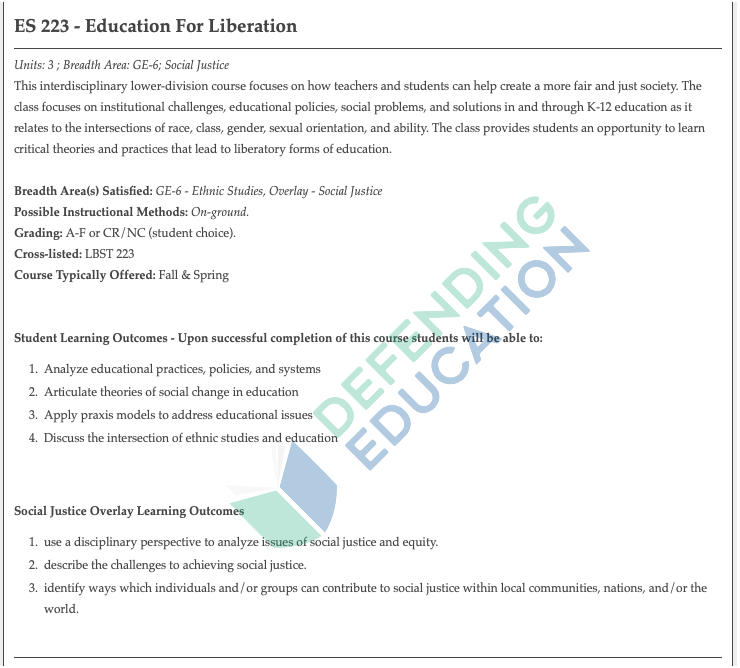
This course entails an education on “how teachers and students can help create a more fair and just society. The class focuses on institutional challenges, educational policies, social problems, and solutions in and through K-12 education as it relates to the intersections of race, class, gender, sexual orientation, and ability. The class provides students an opportunity to learn critical theories and practices that lead to liberatory forms of education.”
It involves a focus on education in race, class, gender, sexual orientation, and ability.
Of course, it also discusses the intersection of ethnic studies and education.
Course 6: ES 224 Filipina/x/o American LGBTQ+ Identities and Experiences
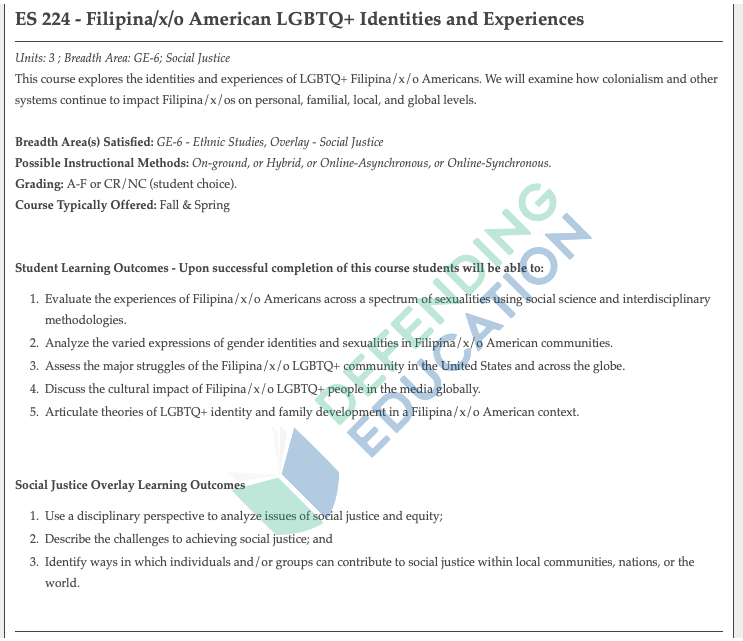
The syllabus outlines the course saying it “explores the identities and experiences of LGBTQ+ Filipina/x/o Americans. We will examine how colonialism and other systems continue to impact Filipina/x/os on personal, familial, local, and global levels.”
It provides a study on Filipino’s sexuality and its history
Inherently blames “colonization” as a source of struggle for all Filipinos.
Course 7: ES 247 Hip Hop Nation
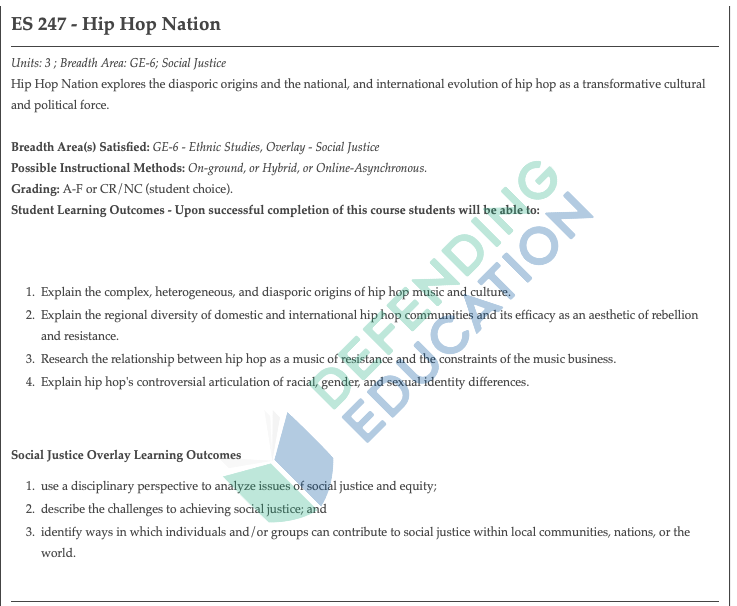
The course “Hip Hop Nation” “explores the diasporic origins and the national, and international evolution of hip hop as a transformative cultural and political force.”
It studies the narrative of hip hop as a transformative cultural and political force and it discusses how to use culture to change politics.
Also, it outlines Hip hop’s “controversial articulation of racial, gender, and sexual identity differences.”
Course 8: ES 338 Asian American Politics / POSC 338 Asian American Politics
As the syllabus states, this class educates students on “the role of Asian Americans in state and national politics; political history of Asian Americans in American politics, public policy issues concerning Asian Americans, successes and failures of Asian American empowerment strategies, and electoral impact of Asian American votes.”
The course intentionally vilifies American policies and reactions to China’s actions and responses.
Finally, it encourages students to be an “agent of change” and trains them in running campaigns. It does not simply teach them a narrow narrative of Asian-American relations, but requires students to learn to make change based on the class.
Stay Informed