



Stockton Unified School District ethnic studies curriculum focuses on intersectionality, power, oppression and student activism
Incidents
Stockton Unified School District’s Ethnic Studies program features learning outcomes such as critiquing “empire-building in history and its relationship to white supremacy, racism and other forms of power and oppression.” The document further clarifies that this outcome includes, but is not limited to, “patriarchy, cisheteropatriarchy, exploitative economic systems, ableism, ageism, anthropocentrism, xenophobia, misogyny, antisemitism, anti-blackness, anti-indigeneity, Islamophobia, and transphobia.”
The learning outcomes also include students challenging “racist, bigoted, discriminatory, imperialist/colonial beliefs and practices on multiple levels” and “conceptualize, imagine, and build new possibilities for a post-racist, post-systemic racism society that promotes collective narratives of transformative resistance, critical hope, and radical healing.”
The district’s framework states that it “analyzes the intersectionality of identity, including race, ethnicity, gender, class, sexuality, and belief systems, amongst others.” Ethnic studies “empowers students to become ethical, effective, and empathetic social justice artist-activist-scholars and leaders who speak truth to power.”
Stockton Unified states that it centers “equity and social justice in the curriculum and pedagogy.” The pedagogy also utilizes “Social Emotional Learning (SEL) tools to support the whole student” and utilizes “Trauma Informed Practices to support all students.”
Units to be covered in the ethnic studies curriculum include “Identity & Counter Narratives,” in which students “analyze how race has been socially constructed and contested in the United States, in an ongoing struggle for power in society.”
The second unit titled “Systems & Power” has students examine the “origins, perpetuation, impact, intersectionality, and levels (ideological, institutional, interpersonal, internalized) of systemic and structural oppression (racism/white supremacy, classism, sexism, heterosexism, and xenophobia, among others), and how people and groups have resisted and transformed them.” The unit also requires students to identify and describe the “hegemonic structures, institutions, and practices that further social injustice, inequities, and oppression and how people and groups have resisted and transformed them.”
In the “Movements For Liberation” unit, students “Analyze the strategies and impacts of historical and contemporary individuals and groups to address oppression and inequality” and “design, implement, and evaluate Youth Participatory Action Research Projects (YPAR) to address diverse community needs.”
The district “Sample Scope and Sequence” from 2020 includes more details to the district’s framework. Key concepts for the ethnic studies course involve “intersectionality” and “Counter Narrative,” “4 I’s of Oppression,” “Hegemony/Counter Hegemony” and “Trauma and Healing.”
Key content to be covered in the district’s ethnic studies program includes “Introductions To White Supremacy/Racism & Ethnic Studies Movement,” “Race & Wealth, Racial Wealth Gap,” “Universal Basic Income” and “Redlining & Housing Discrimination,” “Transgender, Cisgender, Non-Binary, Gender Queer, Gender Fluid” and “Introduction To Police Violence & Murders of Black & Brown Peoples.”
Additional key content includes “Institutional Racism in: schools, media, police, government, business, families, religion, military,” “Racism & Whiteness” and “White Supremacy in: media, police, courts, schools, government, sports,” “ISMS: (Sexism (Patriarchy) / Patriarchy, Heterosexism / Homophobia, Classism)” and “Democratic Socialism.”
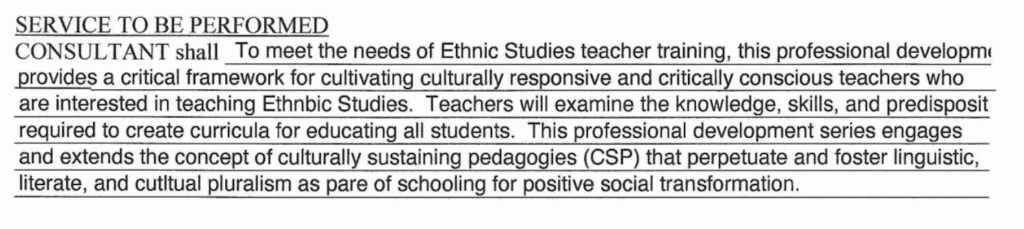
Stockton Unified signed a November 2020 contract with consultant Ehecatl Wind Philosophies, LLC., (EWP) to “meet the needs of Ethnic Studies teacher training, this professional development provides a critical framework for cultivating culturally responsive and critically conscious teachers who are interested in teaching Ethbnic Studies.”
“Teachers will examine the knowledge, skills, and predisposit required to create curricula for educating all students,” the contract states. “This professional development series engages and extends the concept of culturally sustaining pedagogies (CSP) that perpetuate and foster linguistic, literate, and cutltual pluralism as pare of schooling for positive social transformation.”
EWP was paid $200 per hour with total compensation “not to exceed $56,400.”
Stay Informed