
Summary
Documents obtained by Defending Education show that the National Education Association’s Leaders for Just Schools (LJS) Year One Training instructs participants on concepts of “white privilege,” “systemic oppression,” and race-based power dynamics through guided activities and discussion prompts.
The curriculum includes a “Privilege Walk,” defined as an exercise in which participants step forward or backward based on how privilege-related statements apply to them. The goal of this activity is to have participants “confront the ways in which society privileges some individuals over others.”
Other sections examine different ways that “white people” are said to “silence” dialogue related to race, in contrast to “marginalized people.” The training further defines oppression as the “one-way systemic mistreatment of a defined group of people” and directs participants to apply these frameworks when developing action plans to advance “equitable and just” schools.
Background
The National Education Association (NEA) is a powerful teacher’s union with affiliate organizations in every state. Comprised of 3 million educators and allies, the organization boasts its commitment to justice and excellence in public education. As part of the NEA’s push towards excellence, under a division of the organization titled “Just & Equitable Schools,” they push for causes such as: racial justice, violence prevention, gender equity, LGBTQ support, and more.
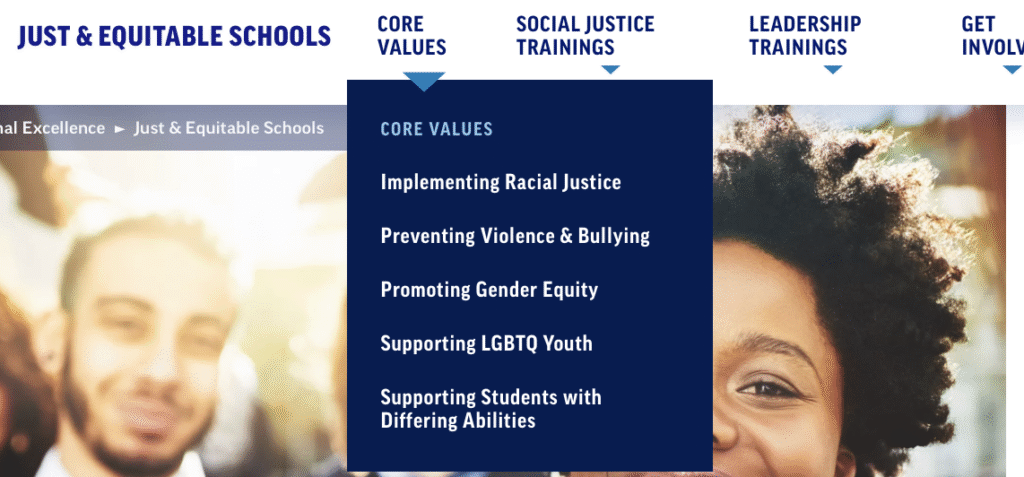
As stated on the NEA’s website, “years of systemic racism and unconscious bias have limited opportunities for many students and contributed to a growing education gap.” Under this website page, viewers can find NEA-specific tools including “NEA and Racial Justice in Education,” “FAQs When Talking About Race,” and “Developing a Culturally Responsive Classroom,” among others.
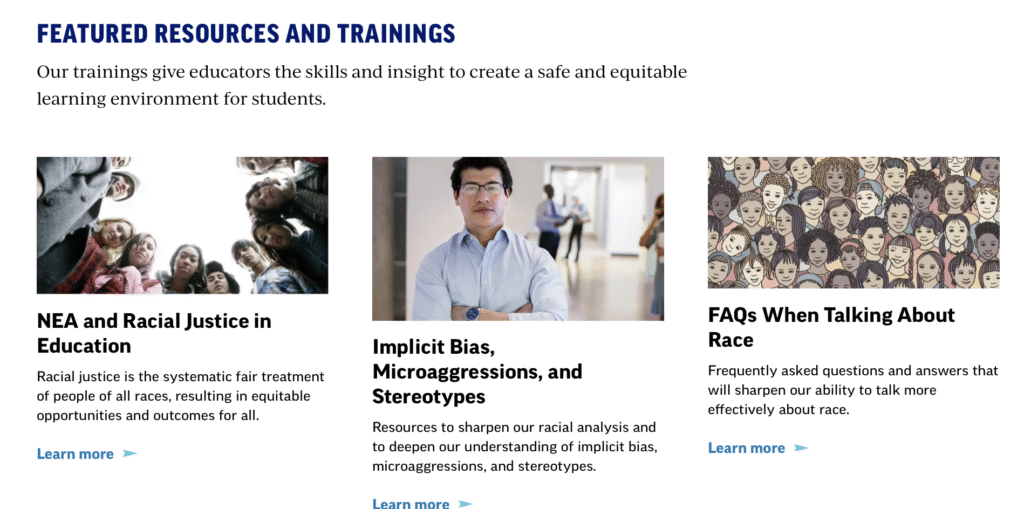
Leaders for Just Schools (LJS) is a three-year program that “gives participants the historical, legal, and educational tools to transform policy and practice at the local, state, and national levels.” Through LJS, the NEA hopes to create a “nationwide network of educators who cultivate equitable, safe, and just learning environments…”
A 2024 report on the program by the NEA president stated, “As attacks against public education continue to escalate—from attempts to whitewash and then rewrite the nation’s history and eliminate the contributions and lived experiences of Indigenous, Black, and other communities of color, to the maligning and marginalization of LGBTQ+ students and educators—the work of LJS is more important than ever.”

LJS Year One Training

The following documents–all obtained by Defending Education–span the first year of the LJS program, specifically examining handouts, slides, and the curriculum guide. All of the handouts and slides are from a four-day training series, in which the days are labeled:
“DAY 1: DEVELOPING OUR ‘WHY’”
“DAY 2: UNDERSTANDING PRIVILEGE AND BIAS”
“DAY 3: CREATING INCLUSIVE ACTION PLANS FOR JUST LEARNING ENVIRONMENTS”
“DAY 4: DEEPENING OUR LEARNING THROUGH EQUITY AUDITS AND REFLECTION”
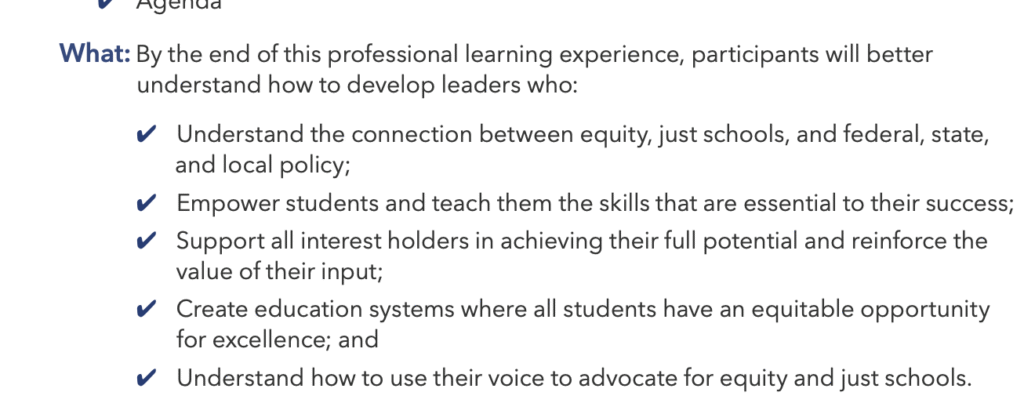
The ultimate goals for participants following the training, as shown below, are to understand equity’s connection to policy, employer students, support all stakeholders, and create equity-based equity systems.
The first section involves an exploration of the NEA’s resolutions, found in the NEA handbook, which has been publicly taken down from the organization’s website. However, Defending Education archived this document here.

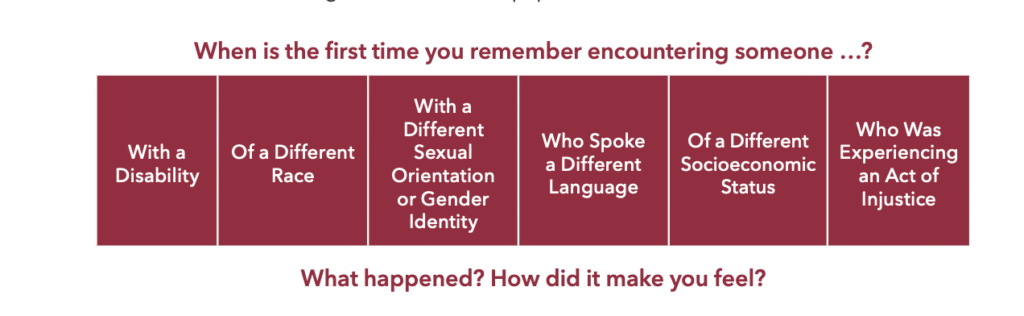
The following introductory sections explore equity and bias. In the third introductory module titled “Beginning the Conversation with Self” asks participants to recall the first time they interacted with someone with a disability, with a different sexual orientation or gender identity, who spoke a different language, someone of a different socioeconomic status, or someone who was experiencing an act of injustice. Participants are asked to think about how this experience made them feel.
Section 1.6 discusses “ISMs.” The “why” behind this activity reads, “The history of white supremacy and inequitable power have led to the -isms that can plague learning environments in systemic ways. It is easy for people to pick out their oppression, but it can be difficult for educators to identify their privilege, and this activity will explore the impact of such social justice issues.”

In this section, “ISMS” are defined as, “When one group experiences privileges and advantages over another group or groups.”

Some of the terms mentioned here include:
“Heterosexism: of a different sexual orientation (e.g., lesbian, gay, or bisexual persons)”
“Racism: of a different race”
“Cissexism: of a different gender identity (e.g., transgender)”
“Sizeism: of a different size or weight”
“Classism: from different social or economic classes
Colorism: with a dark skin tone, typically among people of the same ethnic or racial group”
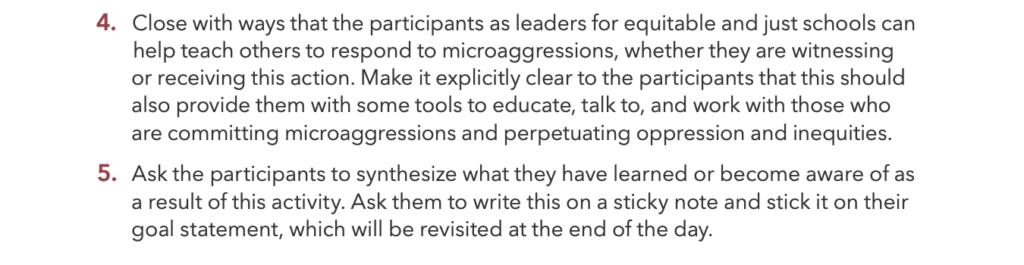
The following section–timed at 40 minutes–deals with “microaggressions.” The learning video included in this section is titled “If Microaggressions Happened to White People.”

After watching the video, participants are asked to explore ways they can respond to microaggressions, because these offenses perpetuate “oppression and inequities.” Participants then are asked to write down what they learned so they can add it to their goal statement.
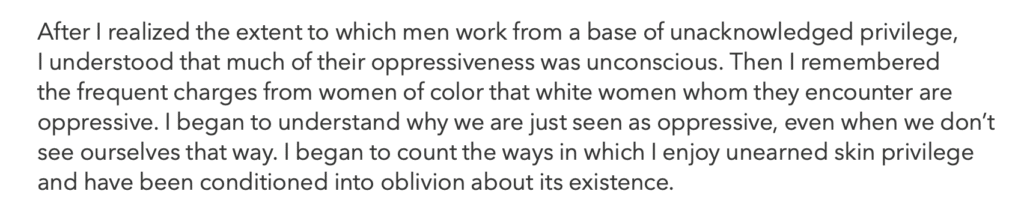
The next section 1.8–”White Privilege: Unpacking the Invisible Knapsack”–opens with a discussion of how men express an unwillingness to acknowledge their privilege. The author of this paper, Peggy McIntosh, shares that men are guilty of “unconscious” “oppressiveness.” From this point, the author believes that this oppressive privilege relates to white privilege, which is “similarly denied and protected.”


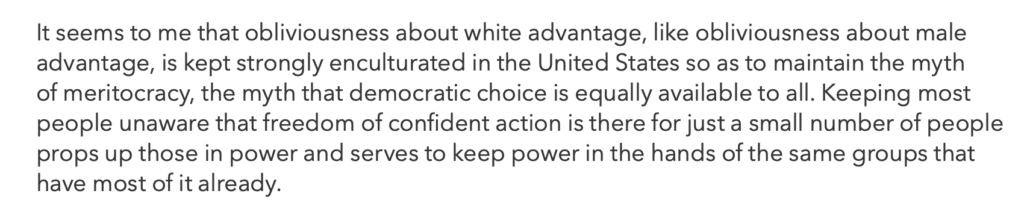
McIntosh concludes this paper by discussing the myth that meritocracy exists as well as the structural privilege of white males: “It seems to me that obliviousness about white advantage, like obliviousness about male advantage, is kept strongly enculturated in the United States so as to maintain the myth of meritocracy, the myth that democratic choice is equally available to all.”
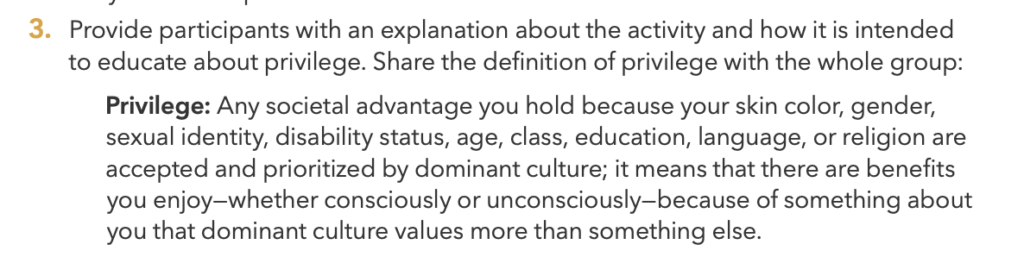
The following portion of the curriculum includes a “Privilege Walk.” According to the training, privilege is defined as, “Any societal advantage you hold because your skin color, gender, sexual identity, disability status, age, class, education, language, or religion are accepted and prioritized by dominant culture; it means that there are benefits you enjoy—whether consciously or unconsciously—because of something about you that dominant culture values more than something else.”
According to the handout: “‘Throughout the privilege walk, the following statements are read by the facilitator, and the participants are asked to take a step forward or backward based on their responses. This activity forces participants to confront the ways in which society privileges some individuals over others. It is designed to get participants to reflect on the different areas in their lives where they have privilege as well as the areas where they don’t.’”
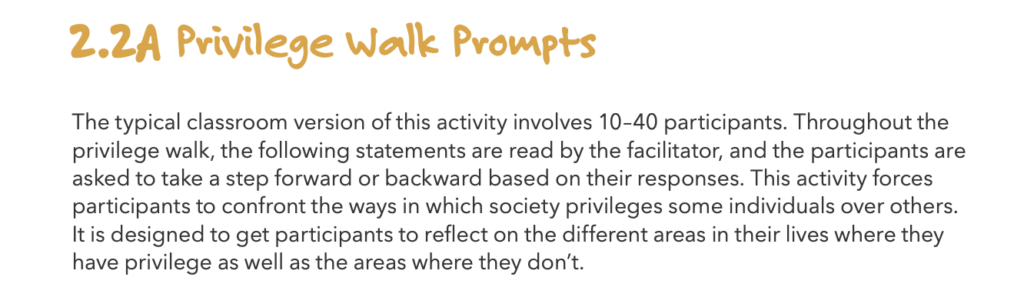
The “classroom version” of this activity includes statements such as:
“If your primary ethnic identity is “American, take one step forward.”
“If you studied the culture of your ancestors in elementary school, take one step forward.”
“If you were ever discouraged from academics or jobs because of race, class, ethnicity, disability status, gender, or sexual orientation, take one step back.”
“If you’re in a position of power that has traditionally been held by people with dominant identity and social location markers, take one step forward.”
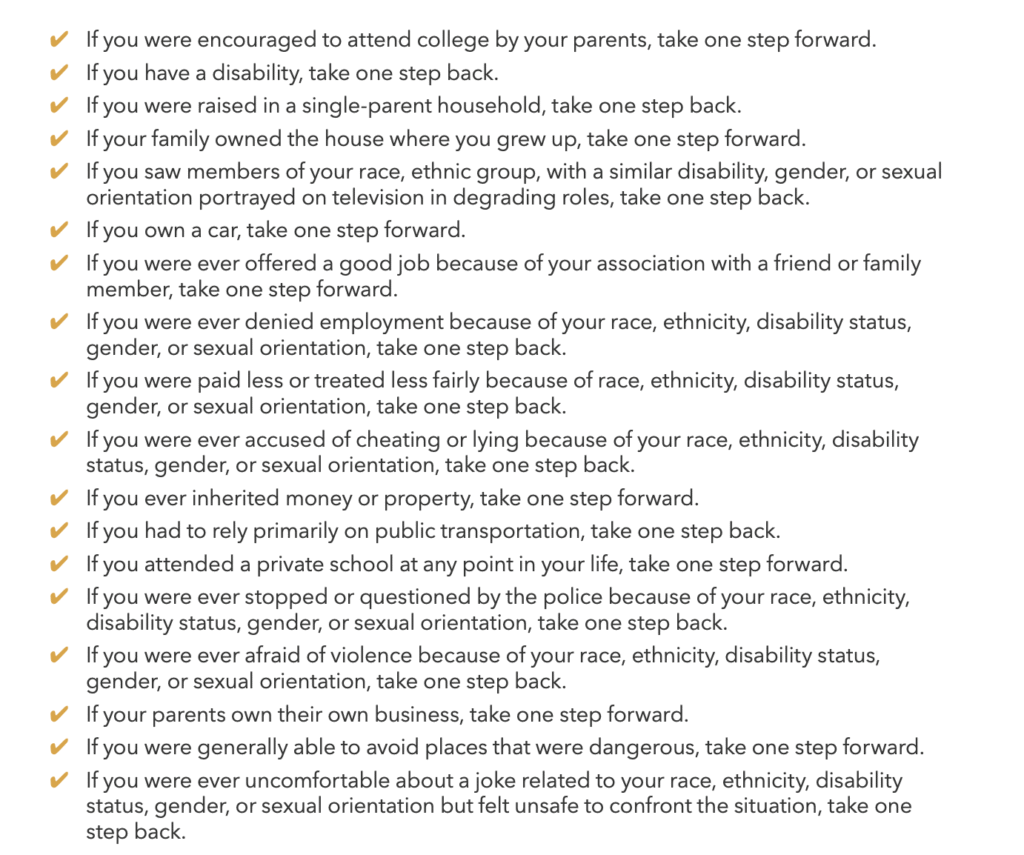
Other statements from this exercise are pictured below. The full document is found at the bottom of this page.

After statements are read for the activity, participants are posed a series of questions, including: “‘One person’s privilege is another person’s oppression. How does this activity reinforce this statement?’”
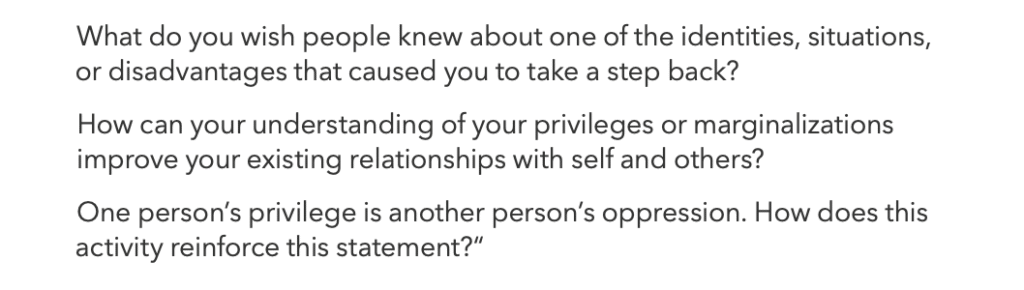
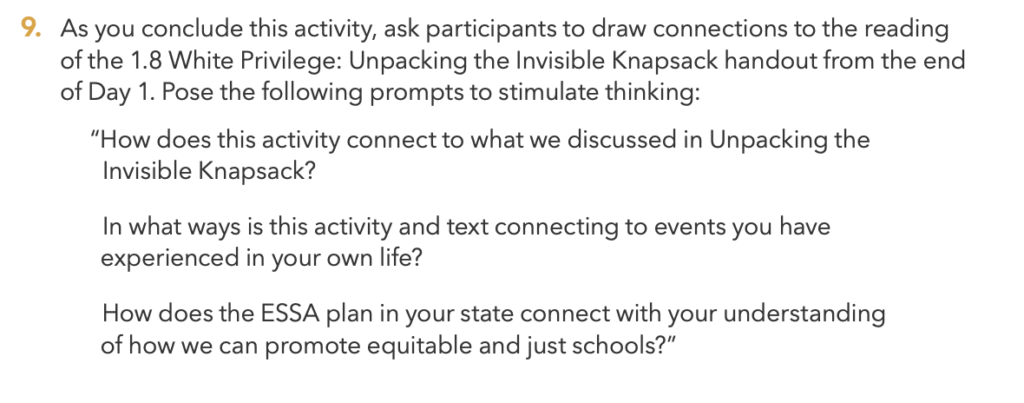
At the conclusion of this activity, participants are asked to connect privilege to whiteness. Specifically, the training calls for asking participants to relate the discussion of privilege back to activity 1.8 and the handout “White Privilege: Unpacking the Invisible Knapsack.”
Participants are asked, “‘How does this activity connect to what we discussed in Unpacking the Invisible Knapsack?’” as well as, “‘How does the ESSA plan in your state connect with your understanding of how we can promote equitable and just schools?’”
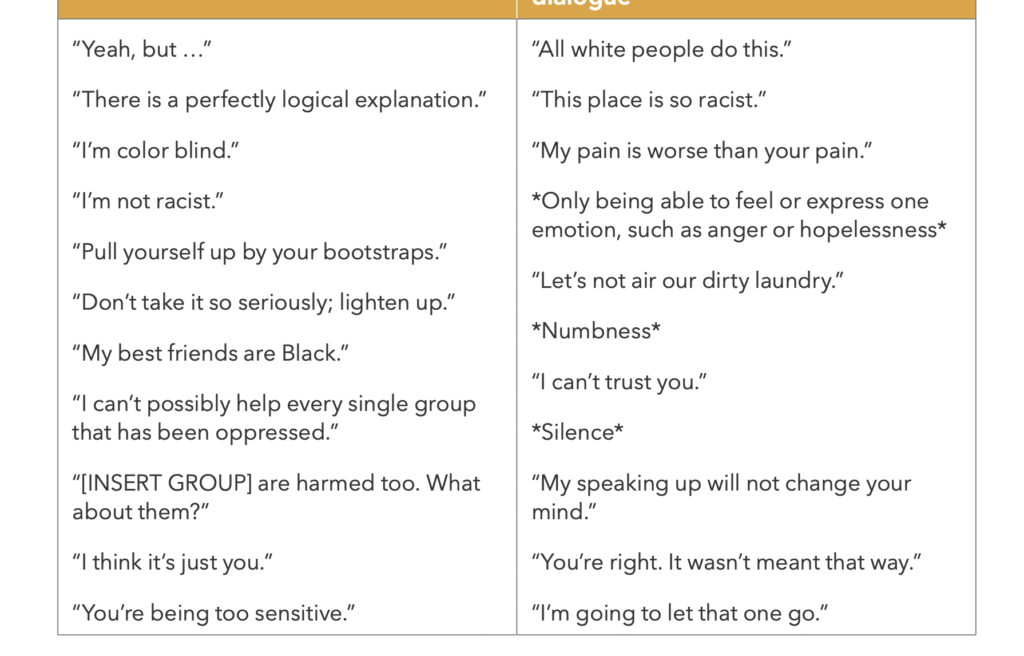
Another section in the training series details “Statements That Silence the Dialogue.” The statements are divided between statements that “white people say or do” and statements by “people from a marginalized group.”
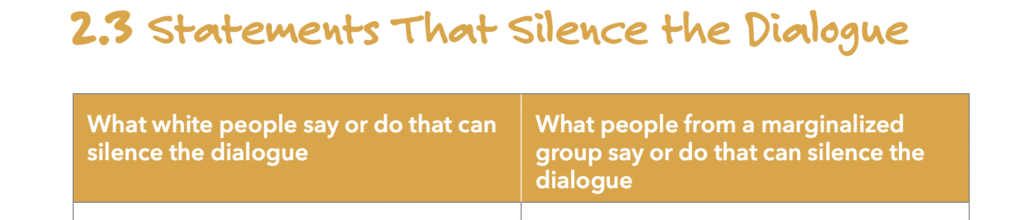
According to the training, “white people” can silence the dialogue by saying phrases such as: “‘I’m not racist,’” “‘I’m color blind,’” and “‘There is a perfectly logical explanation,’” among other phrases.
The following section–2.4–is titled “Systemic Oppression.” In this 45-minute activity, participants “examine internalized and transferred oppression” and walk through historical examples that explain how “systemic oppression” is still in schools and classrooms.

According to the curriculum guide, oppression is defined as the “Oppression: The one-way systemic mistreatment of a defined group of people, with that mistreatment reinforced and supported by society where one group systematically enjoys privileges while the other group or groups systematically experience disadvantage.”

After defining three forms of oppression, participants are asked to connect the Privilege Walk to this activity, specifically through the learning question, “‘In what ways did the historical connections to the Privilege Walk prompts shift your thinking or expand your knowledge about privilege and oppression?’“

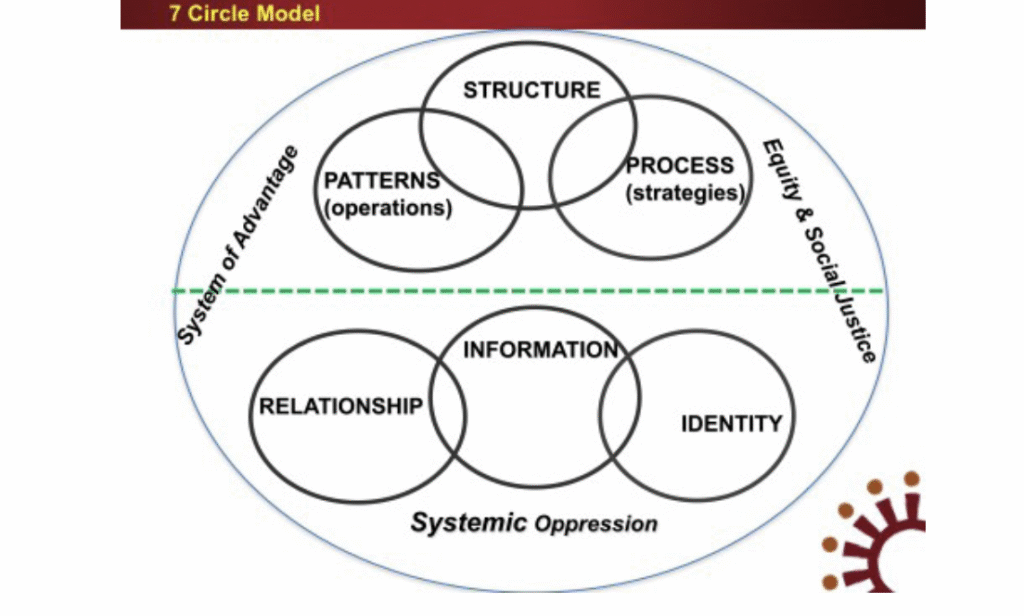
The training also discusses “Wheatley’s Six Circles: Leading for Equity.” In this framework, six areas are essential for leaders to create equity-based solutions. These circles include: patterns, structure, and process above the green line and relationship, information, and identity below.

The green line analogy functions similarly to an iceberg, where everything below the green line includes less explored ideas related to organizational success and equity. In this example, what is below the green line includes: ” beliefs and values, both individual and organizational, that evolve from assumptions, feelings, and emotions; individual roles, ambitions, and aspirations; organizational visions; and the psychological histories of individuals and organizations.”
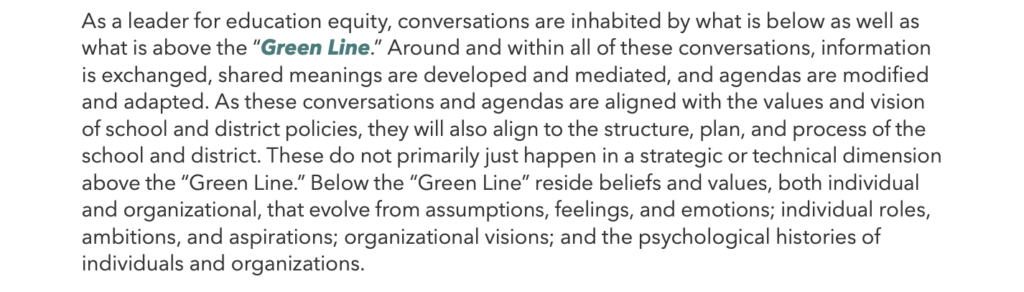
Here, participants are asked to think about what they learned in the previous material on biases and isms. The NEA then asks participants to look at the seven-circle model, which includes the same six ideas but includes three more concepts: “System of Advantage,” “Systemic Oppression,” and “Equity & Social Justice.” Pulled from the National Equity Project, the training suggests, “This model recognizes that systemic oppression exists and negatively affects the dynamic interplay of people working above and below the green line.”

According to the document, this model expands on systems that “may be reproducing inequity.”
Conclusion
At the end of the training, participants are asked, “What are the factors of equitable and just learning environments that we need to stay keenly aware of?” Thereafter, participants have time to construct an action for plan creating more equitable and just schools.
Most recently, Defending Education covered the NEA’s “Advancing LGBTQ+ Justice,” which included material “aimed at unlearning our own internal oppression” and advancing race, class, and gender justice. This training included employee transition guides as well as a section on how “opponents” utilize “strategic racism.”