



LiberatED: K-12 Liberated Ethnic Studies Industrial Complex
Investigations
The Money and Influence of Ethnic Studies
Total school districts: 55
Total spent by districts on ethnic studies: $17,520,788.51
Total federal funds (ESSER/ Title funds) used: $10,127,660.72
SUMMARY
The purpose of this report is to expose the K-12 Liberated Ethnic Studies (LES) Industrial Complex and the various actors and pieces that are involved. The goal is to not only show how much money is being spent by school districts on far-left ethnic studies curriculum, textbooks, and professional development, but to also reveal how a small network of “experts” and professors influence the creation of lessons and curriculums for large education content providers.
Liberated ethnic studies pushes divisive, anti-American and anti-Western ideologies into K-12 schools hiding behind seemingly noble missions, pleasant sounding language, and academic jargon. Lessons and units often center around racial identities (intersectionality), an oppressor versus oppressed view of the world (critical consciousness), who has privilege (i.e. “white privilege”) and who does not, historical examples of “resistance” to Western culture (Black Lives Matter), and engagement in social justice activism.
For example, the University of California Berkeley’s The Puente Project promotes its mission as assistance for underrepresented students in enrolling in two and four-year colleges. However, a review of the curriculum reveals it is steeped in far-left, radical ideologies such as critical race theory, decolonization, liberation, queer theory, and racial justice.
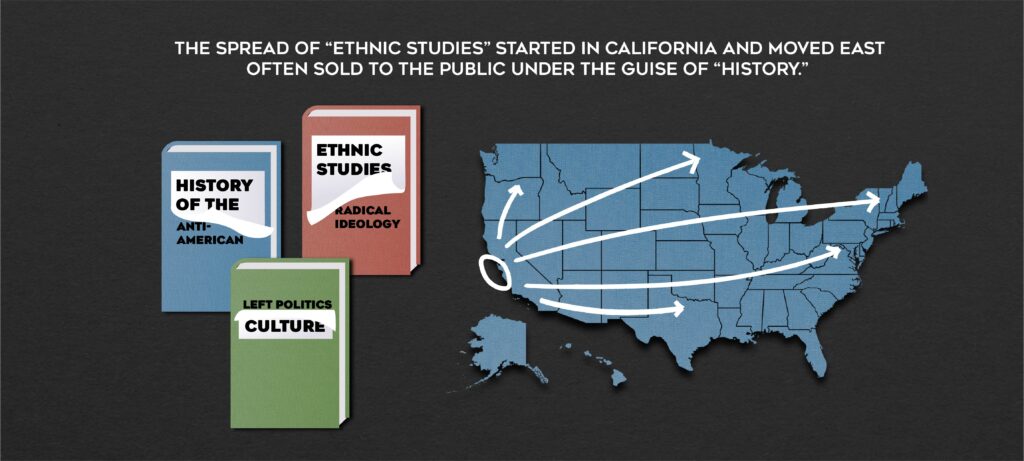
This is not a comprehensive report due to the ever growing and changing landscape of [liberated] ethnic studies. While this report includes some examples of consultants and content providers, it does not capture curriculum, lessons, or content created by school district staff and teachers internally.
To view district curriculums, go here.
KEY TAKEAWAYS
- K-12 school districts have spent $17,520,788.51 on ethnic studies professional development, curriculums, textbooks, and programming.
- Gibbs Smith Education’s Voices: An Ethnic Studies Survey textbook includes content such as antiracism, climate justice and activism, decolonization, intersectionality, oppression, power, privilege, white fragility, and whiteness. One lesson features a subsection comparing parents in 2021 protesting at school board meetings to past protests over school desegregation (1960s) and the teaching of sexual education (1990s).
- Imagine Learning’s ethnic studies course focuses on “deconstructing systems of power that perpetuate inequality” and includes content such as “white privilege,” being “White in the US,” and “Women and Femmes of Color in Oppressive Systems.”
- Newsela’s California Ethnic Studies Collection Guide, created by Community Responsive Education, features content such as colorism, environmental racism, implicit bias, intersectionality, patriarchy, and white supremacy. Lessons range from questioning national borders and citizenship to promoting movements and groups such as the Black Panther Party, Black Lives Matter, reparations, “land back,” and environmental justice.
- According to board documents, Lynwood Unified School District contracted with 5M Legacy to provide a “Black History Matters 2U History Course” which included several “ethnic studies” workshops for male students only. The district has spent over $160,000 on the consultant.
- Riverside Unified School District (CA) spent $114,625 to send fourteen educators on a cross-country trip as ethnic studies professional development.
- San Diego Unified School District (CA) allocated $9,400,000 in ESSER III funds towards developing its ethnic studies curriculum. In 2024, the district also signed a $286,600 agreement with a university professor for an audit of the district’s ethnic studies program and curriculums.
- University of California Berkeley’s The Puente Project curriculum includes teaching middle and high school students critical race theory, decolonization, tenets of queer theory, white supremacy culture, and other far-left social justice ideologies. School districts have paid $625,400 to the program.
- Pittsburgh Public Schools (PA) approved $780,000 for Gibbs Smith Education’s Voices: An Ethnic Studies Survey and Scholarus (now Education Elements) curriculums and instructional materials.
FUNDING, CONSULTANTS, AND PROGRAMS
The following includes brief overviews of funding and grants, consultants, companies, and university programs engaged in providing ethnic studies content and training to K-12 school districts.
State Funding and Grants
Some states offer, or have offered, K-12 school districts access to state funding and/or grants to help districts offset the costs of starting up ethnic studies programs or curriculums. In the past, California allotted state funding to help districts establish and implement ethnic studies. In May 2025, the Governor of California withheld funding set aside for the ethnic studies mandate, rendering the course requirement potentially not in effect.
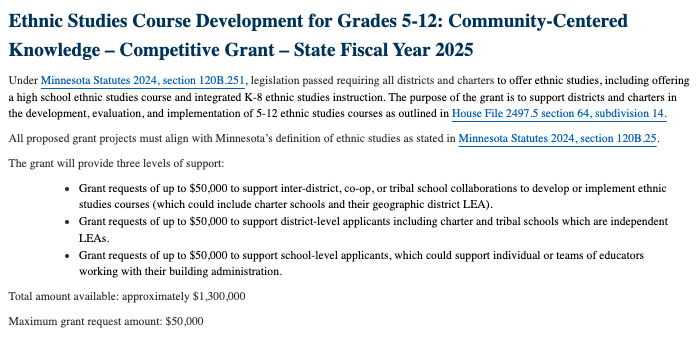
In spring 2025, the Minnesota Department of Education released a grant application for “Ethnic Studies Course Development for Grades 5-12: Community-Centered Knowledge” with the expressed purpose of supporting “districts and charters in the development, evaluation, and implementation of 5-12 ethnic studies courses.” The state set aside $1,300,000 for the grant program, allowing requests of up to $50,000 in support of “inter-district, co-op, or tribal school collaborations to develop or implement ethnic studies courses” or “to support school-level applicants, which could support individual or teams of educators working with their building administration.”
Gibbs Smith Education
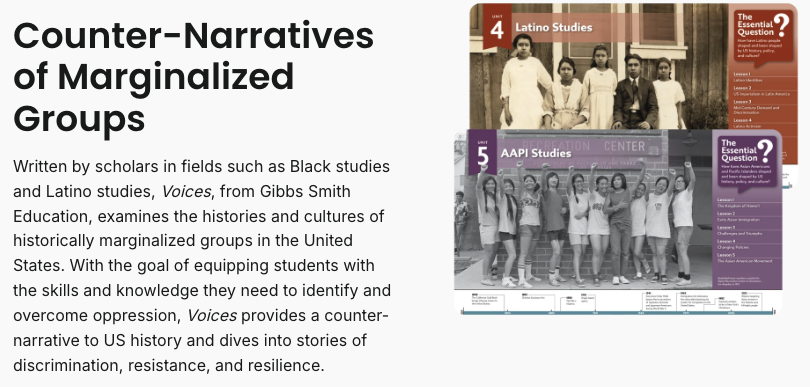
Gibbs Smith Education’s “Voices: An Ethnic Studies Survey” states that it “examines the experiences and contributions of Indigenous, Black, Latino, Pacific Islander, and Asian Americans. Students will learn the terms and tools they need to analyze the impacts of race and ethnicity in US history and the present day.”
The textbook includes “counter-narratives of marginalized groups” and equips “students with the skills and knowledge they need to identify and overcome oppression.”
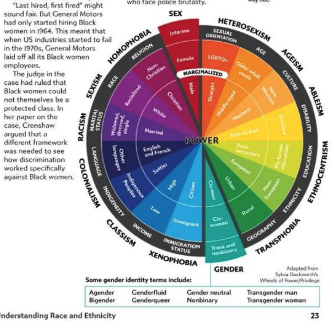
The unit “Understanding Race and Ethnicity” includes lessons on “Intersectionality,” “Understanding Bias,” and “Forms of Discrimination.”
The timeline and images available online also feature Paulo Freire, author of Pedagogy of the Oppressed.
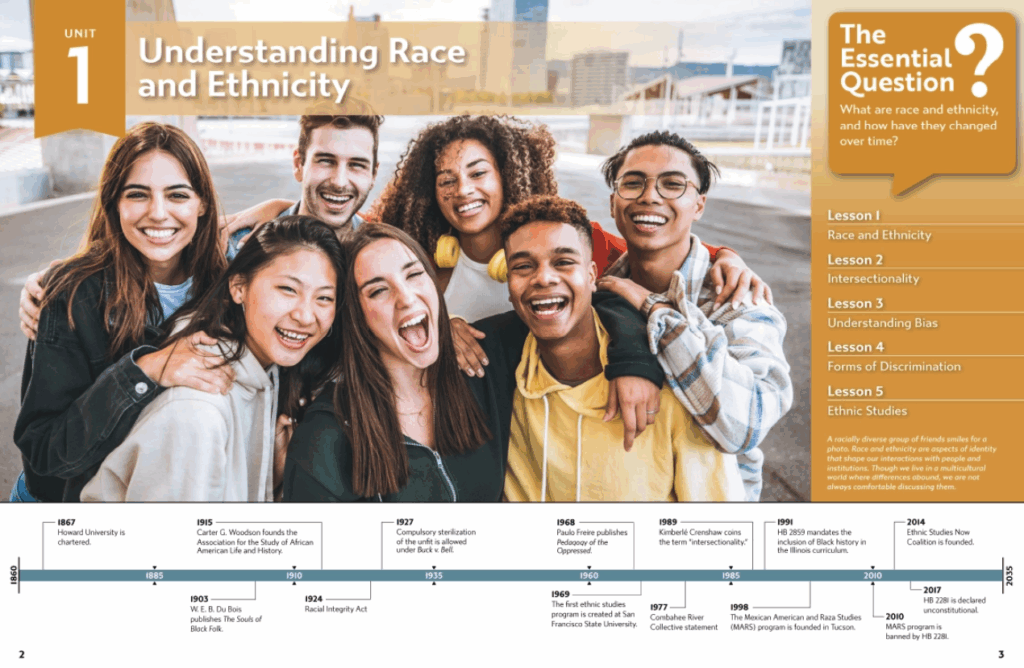
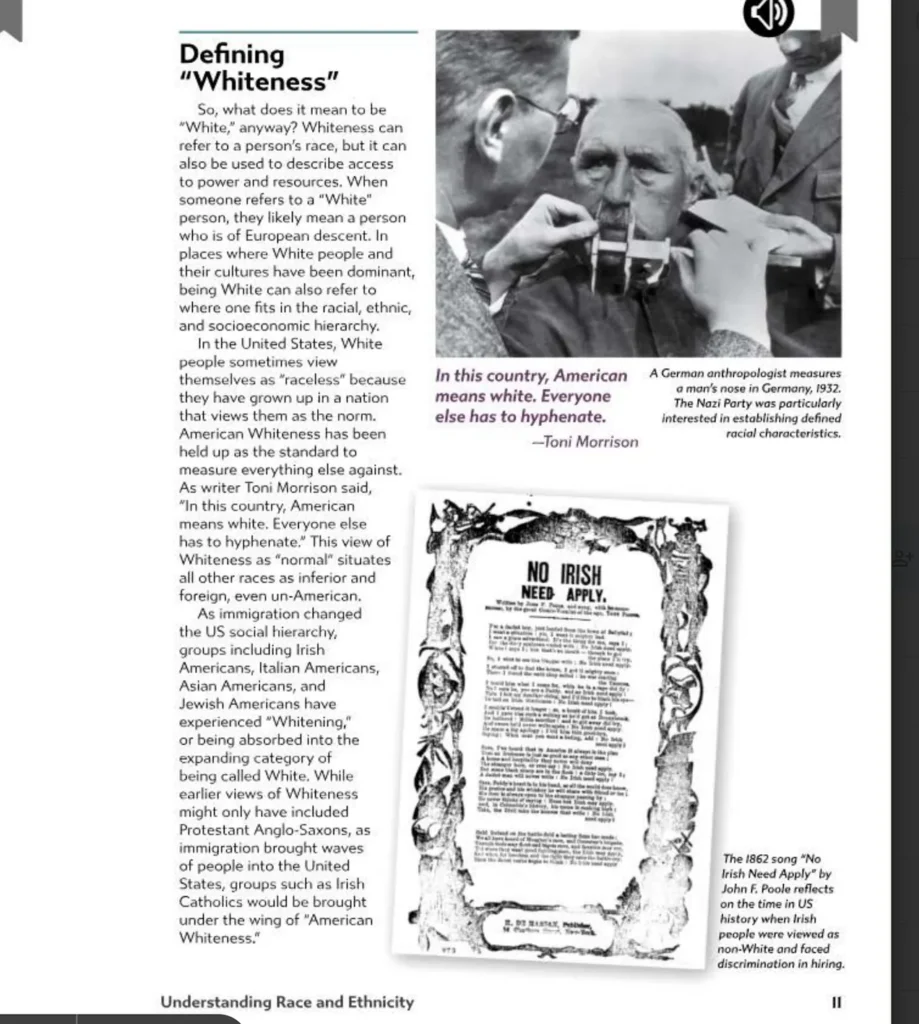
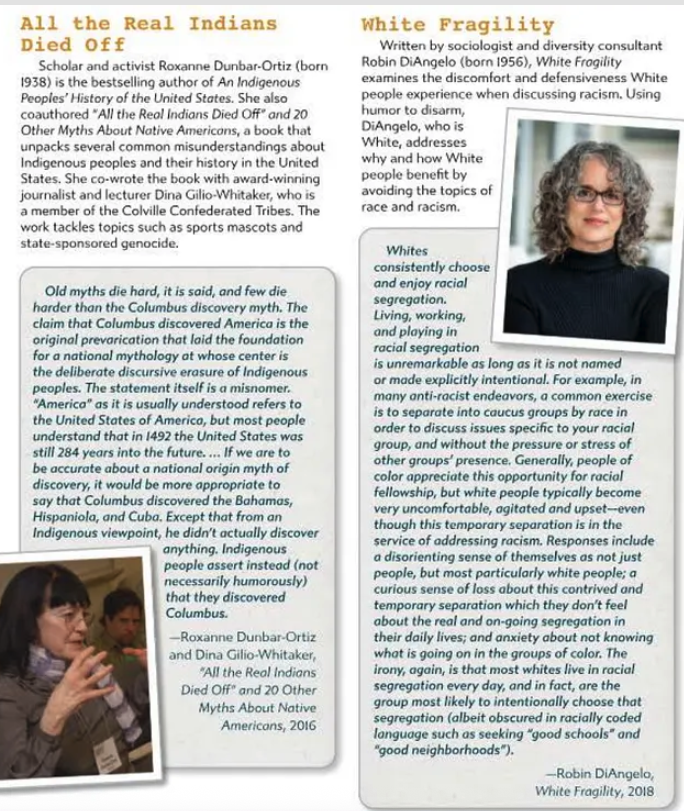
According to excerpts and images obtained by K12 Extremism Tracker, the Voices textbook includes lessons and content such as antiracism, climate justice and activism, decolonization, intersectionality, oppression, power, privilege, white fragility, and whiteness.
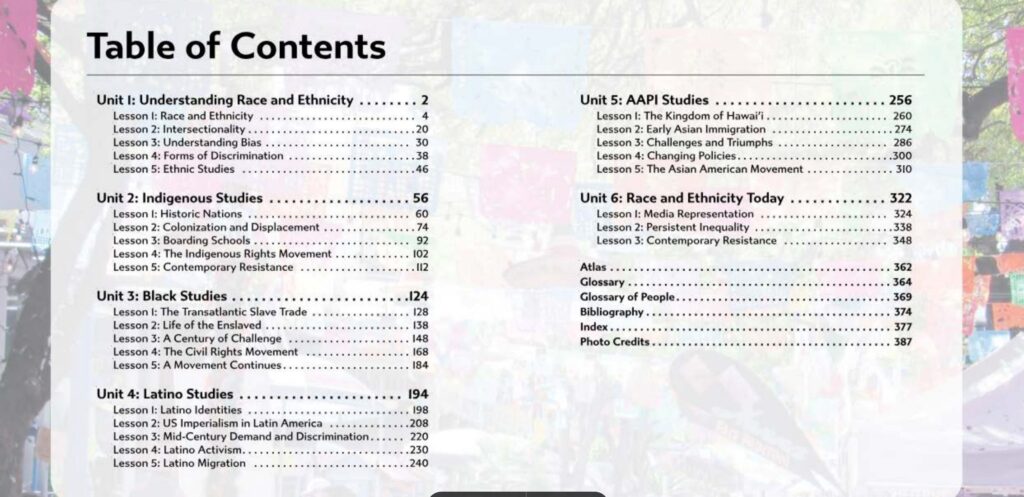
The unit titled “Understanding Race and Ethnicity” includes “luminaries” such as Ibram X. Kendi and Robin DiAngelo. An “Analyze & Answer” question asks students “How does DiAngelo’s description of White self-isolation reflect Kendi’s ideas about the complexity of racism and antiracism?”
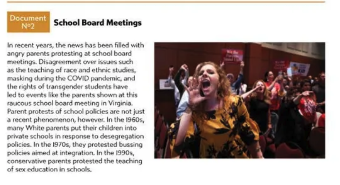
The Unit 1 lesson “Forms of Discrimination” includes a page titled “Forms of Protest” which features a subsection titled “School Board Meetings” and states “Disagreement over issues such as the teaching of race and ethnic studies, masking during the COVID pandemic, and the rights of transgender students have led to events like the parents shown at this raucous school board meeting in Virginia.”
The subsection goes on to state that parent protests of school policies are “not just a recent phenomenon,” but are akin to the 1960s when “many White parents put their children into private schools in response to desegregation policies” and to the 1990s when “conservative parents protested the teaching of sex education in schools.”
Imagine Learning, LLC (Edgenuity)
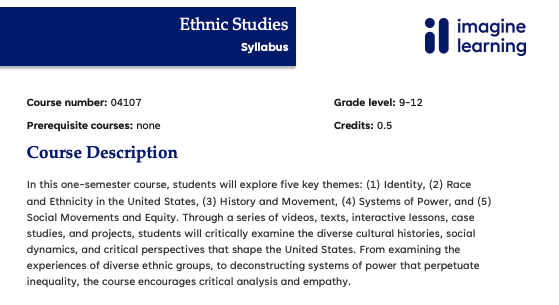
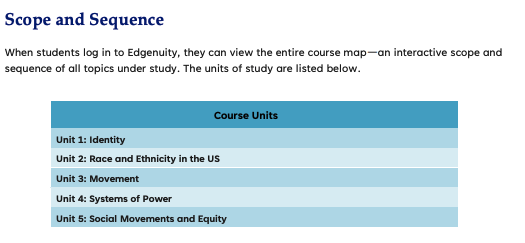
Imagine Learning’s (parent company of Edgenuity) ethnic studies course for grades 9-12 states that it will “explore five key themes: (1) Identity, (2) Race and Ethnicity in the United States, (3) History and Movement, (4) Systems of Power, and (5) Social Movements and Equity” and will “critically examine the diverse cultural histories, social
dynamics, and critical perspectives that shape the United States.”
The course will examine the “experiences of diverse ethnic groups, to deconstructing systems of power that perpetuate inequality, the course encourages critical analysis and empathy.”
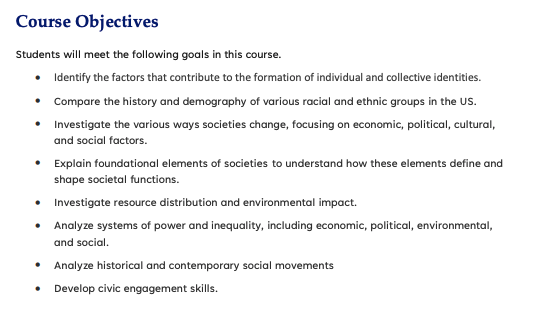
Course objectives include a focus on the “formation of individual and collective identities,” investigating “resource distribution and environmental impact,” and analyzing “systems of power and inequality, including economic, political, environmental, and social.”
The course scope and sequence includes unites on “identity,” “race and ethnicity in the US,” “systems of power,” and “social movements and equity.”
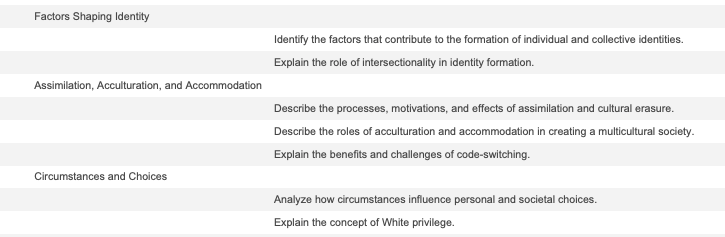
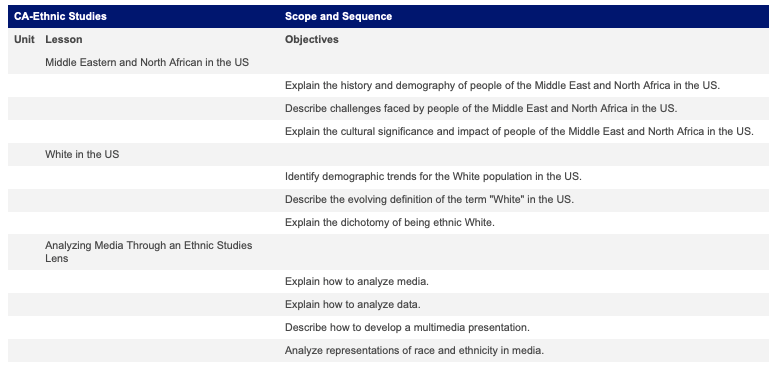
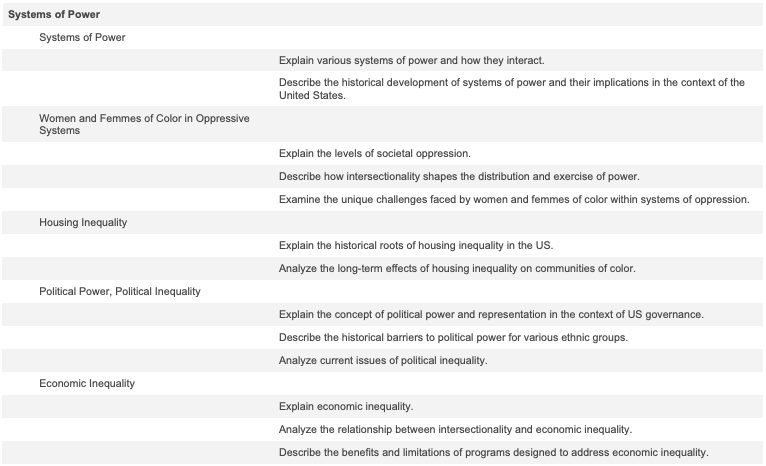
A more thorough review of Imagine Learning’s “CA-Ethnic Studies” scope and sequence includes topics such as “cultural erasure,” “white privilege,” being “White in the US,” “Women and Femmes of Color in Oppressive Systems,” “housing” and “economic” inequality, “environmental justice,” resistance movements, and activism.
Newsela
California Ethnic Studies Collection Guide
The Newsela California Ethnic Studies Collection was created in “collaboration with Community Responsive Education” and is aligned to the organization’s curricular framework. Content featured in the collection include “colorism”, “environmental racism”, “implicit bias”, “intersectionality”, “patriarchy”, and “white supremacy”.
Additionally, many of the questions provided in the document appear leading and biased towards a far-left social justice view of the world.
The collection units are “organized around four core themes of Ethnic Studies: Identity, systems and power, community stories and narratives, and movements and solidarity.”
The document states that it is also a “living resources” and they will be “adding more content as we are able to source it: more diverse stories and histories, more voices of communities of color, more local California connections.”
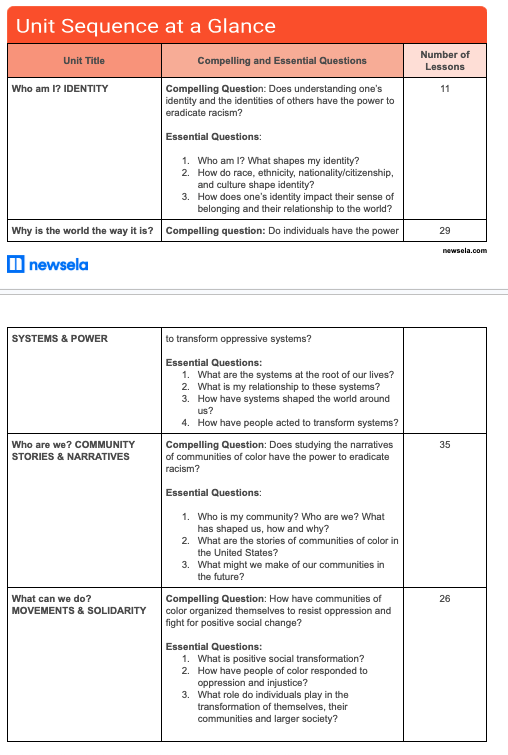
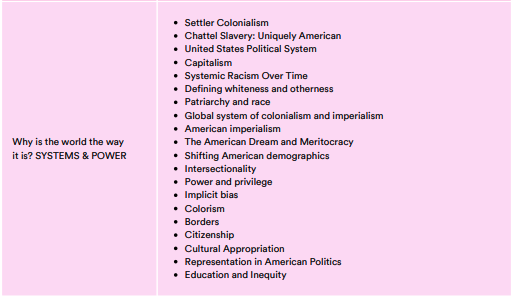
The unit focused on “Systems & Power” includes having students “examine the role of racism in the founding of the U.S. system of government,” “trace the development of white identity and white supremacy in the United States,” and “examine the effect of patriarchal systems on American society, particularly women of color.”
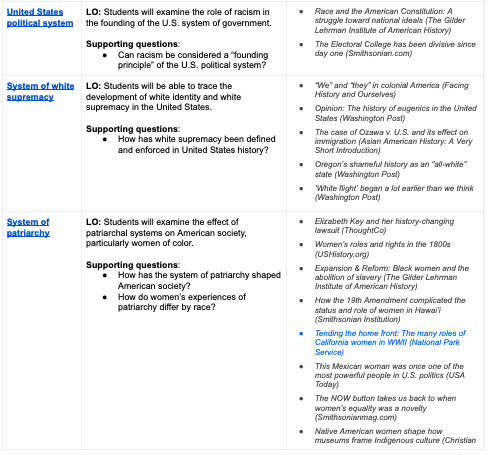
The unit also teaches students about intersectionality, implicit bias, and colorism. Learning objectives include students being able to “define intersectionality, and examine how it shapes their own and others’ experiences of systems,” “examine the idea of implicit bias, and connect it to larger systems of power,” and “define colorism and its relationship to systems such as imperialism and white supremacy.”
Another section in the unit focused on “borders” states that students will “analyze the development of national borders through the lens of systems of power.” Listed “supporting questions” include “What is the purpose of borders?” and “What is the relationship between borders and systems of power?”
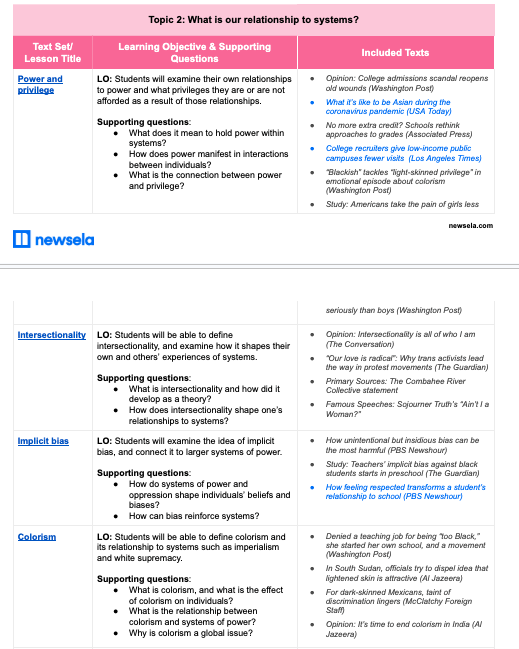
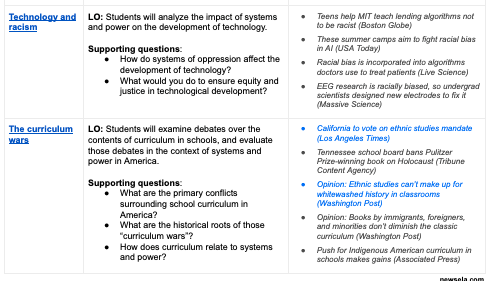
Other unit topics include “police brutality,” “environmental racism,” “technology and racism,” and “curriculum” as it relates to “systems of power.” Support texts for these sections include a piece from Angela Davis, articles on “racial bias” in algorithms and artificial intelligence, and a collection of leftwing biased articles on curriculum matters.
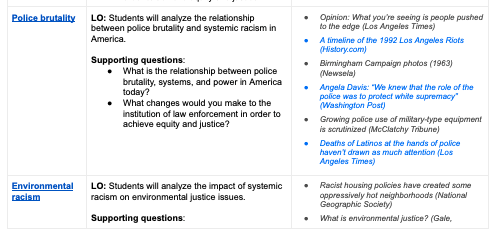
The unit titled “Narratives & Community Stories” introduces students to “counter narratives” and how “racism and oppression” have impacted various ethnic groups throughout United States history.
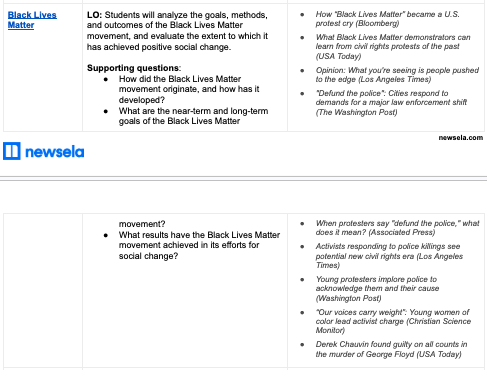
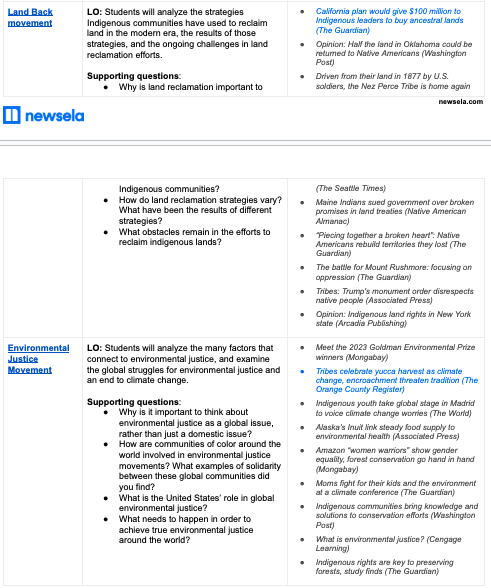
The final unit on “Movements & Solidarity” includes topics and lessons focused on “social change,” “resistance,” and societal transformation. Movements and groups highlighted in this unit include the “Abolition movement,” “Black Power and Black Panthers,” “People of color in the LGBTQ+ Rights Movement,” “Black Lives Matter,” the “Movement for Reparations,” the “Land Back Movement,” and the “Environmental Justice Movement.”

Washington Ethnic Studies Collection
The Washington state Ethnic Studies Collection overview features a lot of the same content as California but also includes “defining whiteness and otherness,” “Queer and Trans POC activism,” and media literacy.
University of California Berkeley
The University of California Berkeley offers K-12 school districts several different opportunities for engagement related to ethnic studies. This includes:
UC Berkeley History-Social Science Project – K-12 Ethnic Studies
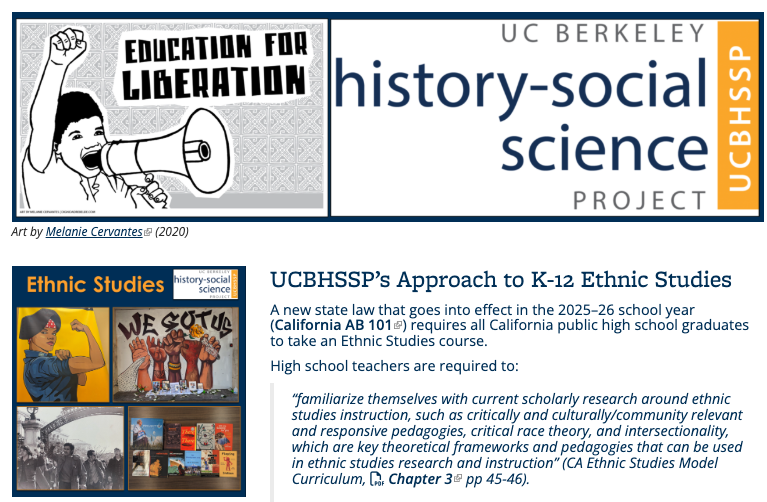
The University of California Berkeley’s History-Social Science Project – Ethnic Studies “provides guidance to high school teachers and school districts to assist them in developing Ethnic Studies courses.”
According to the website, California AB 101 – the state law requiring ethnic studies as a high school graduation requirement – states that “high school teachers are required to:”
“familiarize themselves with current scholarly research around ethnic studies instruction, such as critically and culturally/community relevant and responsive pedagogies, critical race theory, and intersectionality, which are key theoretical frameworks and pedagogies that can be used in ethnic studies research and instruction” (CA Ethnic Studies Model Curriculum, Chapter 3(PDF file)(link is external) pp 45-46).
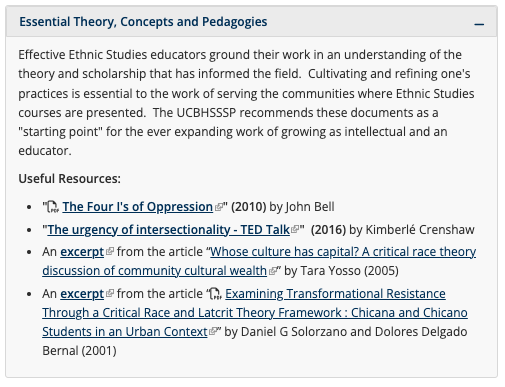
Under “Essential Theory, Concepts and Pedagogies,” the program includes “useful resources” on topics such as “The Four I’s of Oppression,” intersectionality, and critical race theory.
The project website also includes links to various other UC Berkeley resources for educators, including its High School Ethnic Studies Initiative Website and High School Ethnic Studies Initiative Resource Hub.
More information on this can be found in an accompanying LiberatED report on university ethnic studies here.
The Puente Project
While the overall stated purpose of The Puente Project seems noble, the program prioritizes the integration of critical race theory and far-left social justice ideologies into its curriculum.
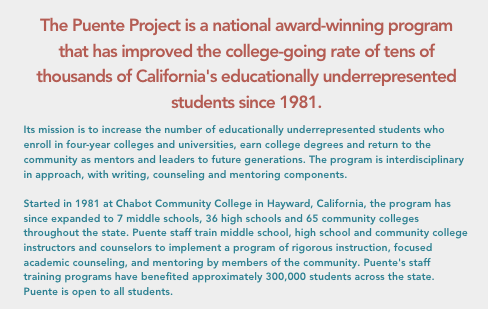
The program’s mission is “to increase the number of underrepresented students who enroll in four-year colleges and universities, earn college degrees and return to the community as mentors and leaders to future generations.”
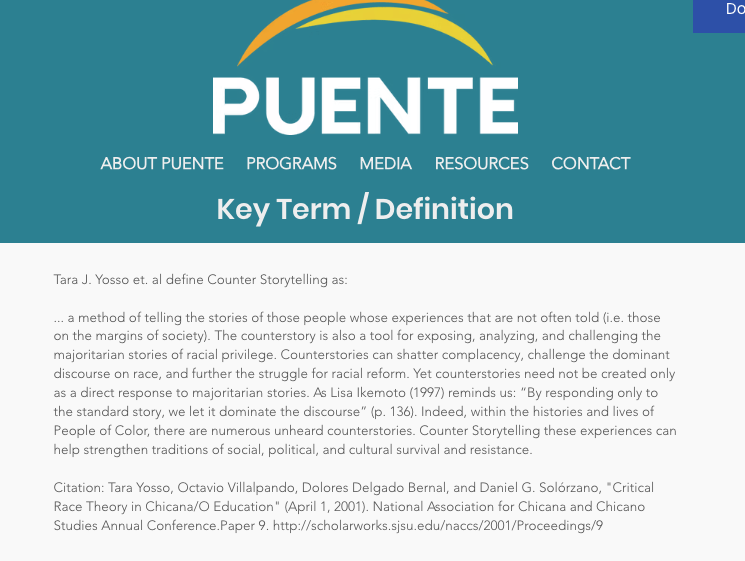
The program curriculum includes various units, topics, and readings focusing on far-left ideologies such as “critical consciousness,” critical race theory, decolonization, environmental justice, liberation, linguistic justice, queer theory, and racial justice.
The first chapter of the curriculum, Racial Justice – Our Future History and Future, includes a note to the educator which states that an “essential concept to understand, and to help students understand and be able to analyze, is white supremacist capitalist patriarchy.” It continues by claiming that it is “crucial because as Black Feminist Theory reminds us, systems of oppression are often interlocking.”

The chapter also includes “suggested activities” for middle school (MS), high school (HS), and community college (CC) students such as “Foundations: White Supremacy & How it Works.” The site links to a document titled “Heteropatriarchy and the Three Pillars of White Supremacy.”
The activity includes discussion questions such as “What is the relationship between capitalism and slavery?,” “What is the relationship between genocide and colonialism?,” and “Why does Andrea Smith argue we cannot disregard the “black/white binary” when organizing against systems of oppression?”

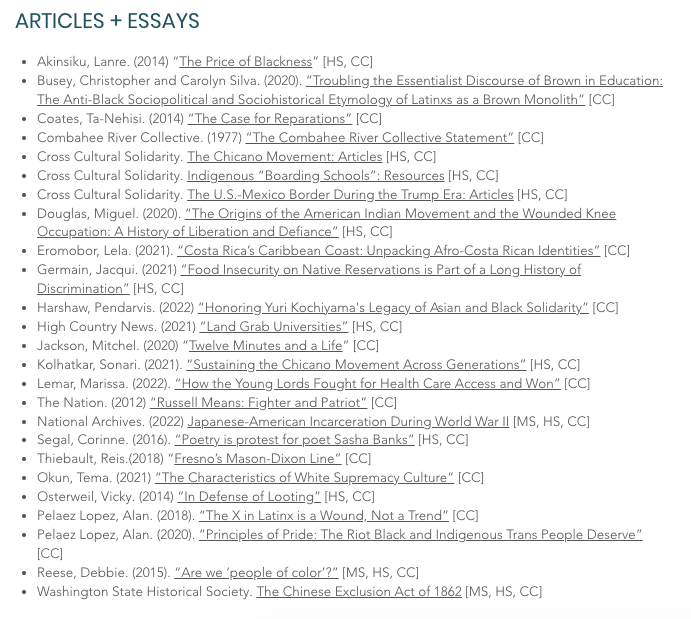
The chapter also includes “Articles + Essays” such as “The Combahee River Collective Statement,” Tema Okun’s “The Characteristics of White Supremacy Culture,” and “In Defense of Looting.”
Puente Anthology
Chapter 1: Racial Justice
Chapter: Liberated Students
Chapter: Gender and Sexuality
Chapter 4: Linguistic Justice
Chapter 5: Trusting Indigenous Knowledge
Chapter 8: Mind, Body, Spirit
Chapter 9: Environmental Justice
Go to Defending Education’s “Groups Pushing Liberated Ethnic Studies in Schools” page to review additional organizations engaged in consulting on and promoting liberated ethnic studies in K-12 schools.
K-12 SCHOOL DISTRICT CONTRACTS
Listed below are links to school district contracts for ethnic studies professional development and training, curriculum and instructional materials, or involvement in programming.
This is not a comprehensive collection of district spending, but will be updated as new information is gathered.
TOP GROSSING CONSULTANTS
Universities: $1,374,272 (UC Berkeley: $783,040)
Newsela: $1,360,727.18*
Community Responsive Education Corp: $1,066,502
Gibbs Smith Education: $904,413.39
Acosta Latino Leadership Partnership: $852,900
Ehecatl Wind Philosophy LLC: $543,700
Liberated Ethnic Studies Model Curriculum Consortium: $292,320
An * denotes that Newsela’s ethnic studies curriculum was part of a product package and did not include an itemized cost.
CALIFORNIA
Alvord Unified School District
- 2023 – The Puente Project, University of California Berkeley (two-year contract) – $24,000
- 2025 – The Puente Project, University of California Berkeley (two-year contract) – $24,000
- 2025 – Gibbs Smith Education – $241,934.29
Antioch Unified School District
- 2021 – Title II – Milton Reynolds Consulting – $36,300
- 2022 – Title II – Kingmakers of Oakland – $108,000
- 2022 – Title II – University of California, Berkeley History-Social Science Project – $13,200
- 2023 – Title II – University of California, Berkeley History-Social Science Project – $28,000
- 2023 – University of California, Berkeley History-Social Science Project – $36,000
- 2025 – Khepera Curriculum Group – $25,000
Baldwin Park Unified School District
- 2023 – Ehecatl Wind Philosophy, LLC – $51,300
- 2024 – Ehecatl Wind Philosophy, LLC – $7,300
- 2024 – Ehecatl Wind Philosophy, LLC – $37,000
- 2024 – Newsela ethnic studies curriculum – $12,742.63
- 2025 – Newsela ethnic studies professional development – $1,500
- 2025 – Gibbs Smith Education – $52,000
Bassett Unified School District
Berkeley Unified School District
- 2023 – Liberated Ethnic Studies Model Curriculum Consortium – $111,120
- 2024 – Liberated Ethnic Studies Model Curriculum Consortium – $9,840
- 2024 – The Puente Project – $20,000
Burton School District
- 2024 – Newsela ethnic studies curriculum – $5,885.70
- 2025 – Newsela ethnic studies curriculum – $22,277.99
Campbell Union High School District
- 2021 – Newsela ethnic studies curriculum* – $98,127
- 2022 – Newsela ethnic studies curriculum* – $113,945.88
- 2023 – Title IV – Newsela ethnic studies curriculum* – $133,580.72
- 2024 – Title III – Newsela ethnic studies curriculum* – $135,580
- 2025 – Newsela ethnic studies curriculum* – $121,349.01
- 2025 – Dr. Luis Poza – Ethnic Studies Summer Institute – $300
Corona-Norco Unified School District
- 2021 – The Puente Project – $60,000
- 2024 – Ehecatl Wind Philosophy, LLC – $59,400
- 2025 – The Puente Project – $42,000
- 2025 – Ehecatl Wind Philosophy, LLC – $27,000
Davis Joint Unified School District
- 2022 – Acosta Latino Learning Partnership – $86,000
- 2023 – Acosta Latino Learning Partnership – $63,000
- 2023 – Irina Nunez – YPAR PD – $7,000
Duarte Unified School District
Elk Grove Unified School District
- 2024 – Los Rios Community College – $15,117
- 2025 – UC Davis History-Social Science Project – $18,000
El Rancho Unified School District
- 2022 – UCLA Center X – $23,980
- 2023 – California State University, Los Angeles – $8,000
- 2023 – UCLA Center X – $23,040
- 2024 – California State University, Los Angeles – $8,000
- 2024 – UCLA Center X – $19,050
Fallbrook Union High School District
Fremont Unified School District
Fresno Unified School District
Galt Joint Union High School District
Hayward Unified School District
- 2021 – Puente Project, UC Berkeley – $75,000
- 2021 – University of California, Berkeley History-Social Science Project – $8,140
- 2021 – University of California, Berkeley History-Social Science Project – $7,150
- 2022 – Liberated Ethnic Studies Model Curriculum Consortium – $35,395
- 2023 – Liberated Ethnic Studies Model Curriculum Consortium – $91,830
- 2025 – Liberated Ethnic Studies Model Curriculum Consortium – $8,605
Inglewood Unified School District
Jefferson Elementary School District
- 2020 – Community Responsive Education – $28,502
- 2020 – Community Responsive Education – $40,000
- 2021 – Community Responsive Education – $100,000
- 2022 – Community Responsive Education – $100,000
Jefferson Union High School District
- 2021 – Community Responsive Education – $180,000
- 2024 – Community Responsive Education – $80,000
- 2024 – Allyson Tintiangco-Cubales Keynote speech – $10,000
- 2025 – Community Responsive Education – $50,000
Kern High School District
Liberty Union High School District
Los Gatos-Saratoga Union High School District
Lynwood Unified School District
- 2022 – Liberated Ethnic Studies Model Curriculum Consortium – $35,530
- 2024 – UCLA Center X – $2,260
- 2024 – 5M Legacy – Black History Matters 2U – $50,200
- 2024 – UCLA Center X – $2,260
- 2025 – 5M Legacy – Black History Matters 2U – $115,500
Modesto City Schools
- 2024 – University of California, Davis – California History-Social Science Project – $60,000
- 2024 – University of California, Davis – California History-Social Science Project – $12,000
- 2025 – University of California, Davis – California History-Social Science Project – $75,000
Morongo Unified School District
Mountain Empire Unified School District
Napa Valley Unified School District
Nevada Joint Unified School District
Newark Unified School District
Oakland Unified School District
Parajo Valley Unified School District
- 2021 – Community Responsive Education – $49,000
- 2025 – Community Responsive Education – $90,000
- 2025 – Ignacio Ornelas Rodriguez, Ph. D – $26,400
Paramount Unified School District
- 2020 – California State University, Long Beach – ethnic studies courses for HS students – $36,000
- 2021 – California State University, Long Beach – ethnic studies courses for HS students – $36,000
- 2022 – California State University, Long Beach – ethnic studies courses for HS students – $48,000
- 2024 – California State University, Long Beach – ethnic studies courses for HS students – $48,000
- 2025 – California State University, Long Beach – ethnic studies courses for HS students – $48,000
Pittsburg Unified School District
- 2022 – Community Responsive Education – $45,000
- 2023 – Community Responsive Education – $75,000
- 2024 – Community Responsive Education – $55,000
- 2025 – Community Responsive Education – $35,000
Riverside Unified School District
- 2022 – Newsela ethnic studies curriculum- $148,500
- 2024 – Footsteps to Freedom Underground Railroad – Professional Development trip – $114,625
Rowland Unified School District
- 2023 – Facing History and Ourselves workshop – $2,900
- 2023 – Education Consulting – $1,650
- 2023 – Education Consulting – $12,000
- 2024 – Newsela ethnic studies curriculum* – $125,000
- 2024 – California State University, Los Angeles – ethnic studies Professional Development – $23,000
- 2025 – California State University, Los Angeles – ethnic studies Professional Development – $20,000
Saddleback Valley Unified School District
- 2023 – University of California, Irvine History Project – $37,000
- 2024 – University of California, Irvine History Project – $67,020
Salinas Union High School District
- 2019 – The Puente Project – $58,400
- 2020 – Our Transformation Education – $10,000
- 2021 – Our Transformation Education – $10,000
- 2024 – The Puente Project – $38,500
- 2025 – The Puente Project – $39,000
San Bernardino City Unified School District
San Diego Unified School District
- 2021 – ESSER III – Ethnic studies program development – $9,400,000
- 2024 – James Fabionar, ethnic studies audit – $286,600
San Francisco Unified School District
San Jacinto Unified School District
San Jose Unified School District
San Mateo Union High School District
San Rafael City Schools
- 2023 – University of California, Berkeley History-Social Science Project – $8,800
- 2024 – University of California, Berkeley History-Social Science Project – $13,200
Santa Barbara Unified School District
- 2023 – Community Responsive Education – $12,000
- 2023 – Thomas Carrasco – Professional Development – $2,500
- 2023 – Myriam Gurba – Professional Development – $3,200
- 2024 – Community Responsive Education – $5,000
Santa Rosa City Schools
- 2019 – Acosta Latino Leadership Partnership – $6,000
- 2019 – Dr. Christine Sleeter – $4,000
- 2021 – Acosta Latino Leadership Partnership – $99,000
- 2022 – Acosta Latino Leadership Partnership – $161,000
- 2023 – Acosta Latino Leadership Partnership – $142,500
- 2023 – Acosta Latino Leadership Partnership – $32,000
- 2024 – Jordan Bell Professional Development – $30,000
- 2024 – Acosta Latino Leadership Partnership – $127,500
Stockton Unified School District
- 2020 – Ehecatl Wind Philosophy, LLC – $56,400
- 2024 – XITO Summer Institute – $4,169.44
- 2025 – XITO Summer Institute – $27,908.50
Turlock Unified School District
- 2021 – ESSER II – California State University, Stanislaus Professional Development – $6,000
- 2024 – Newsela ethnic studies curriculum – $60,986.25
Victor Valley Unified School District
Visalia Unified School District
Whittier Union High School District
- 2017 – The Puente Project – $60,000
- 2021 – The Puente Project – $60,000
- 2025 – The Puente Project – $14,000
Woodland Joint Unified School District
PENNSYLVANIA
Pittsburgh Public Schools
WASHINGTON
Edmonds School District
Stay Informed