
SUMMARY
Saint Paul Public Schools (SPPS) requires students to take the course “Critical Ethnic Studies” which features topics such as critical consciousness, intersectionality, privilege, power, and oppression.
A 2022-2023 evaluation of the program shares insights from the implementation of the Critical Ethnic Studies course which includes making the course year-long, and integrating it into all content areas. The report also included teacher and student reflections on activism and engagement with the “seven principles.”
COURSES
CRITICAL ETHNIC STUDIES
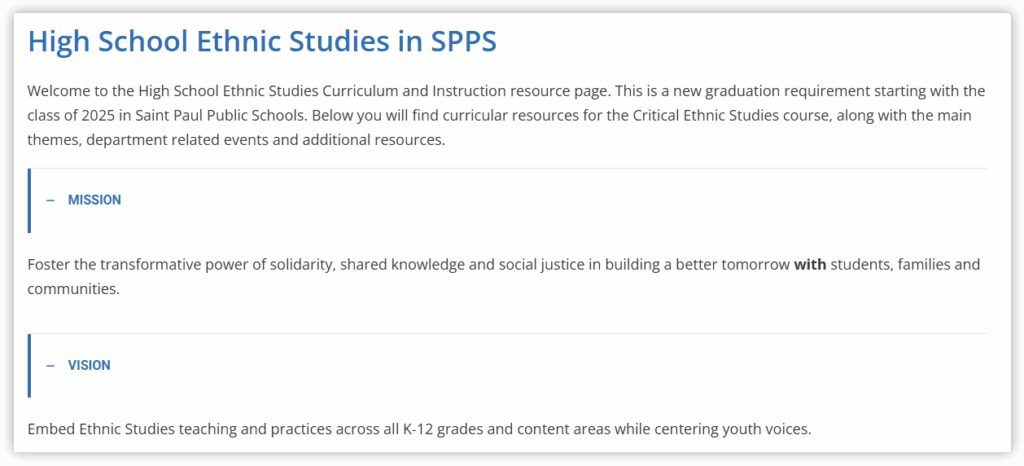
Beginning with the graduating class of 2025, students at Saint Paul Public Schools are required to take Critical Ethnic Studies.
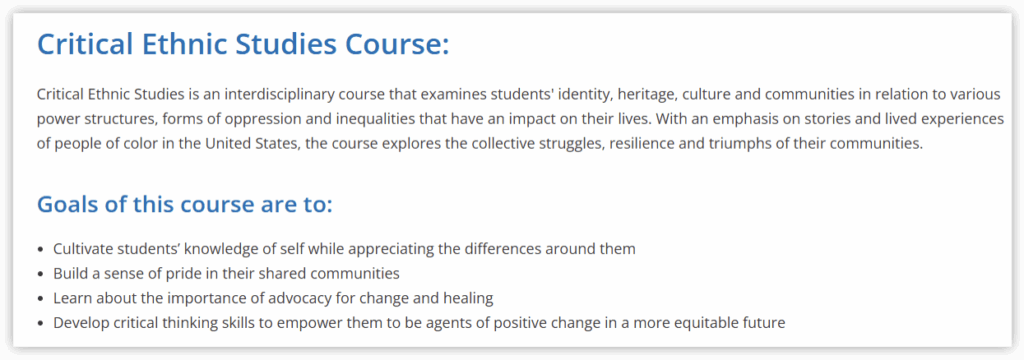
Critical Ethnic Studies examines “students’ identity” in relation to “various power structures, forms of oppression and inequalities.”
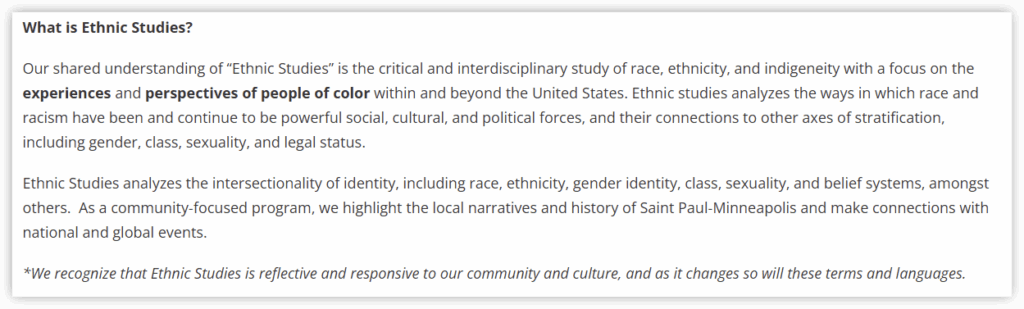
- Critical Ethnic Studies centers on “the intersectionality of identity” and teaches that “race and racism… continue to be powerful social, cultural, and political forces” tied to “gender, class, sexuality, and legal status.”
- Goals of the course include “learning about the importance of advocacy for change and healing.”
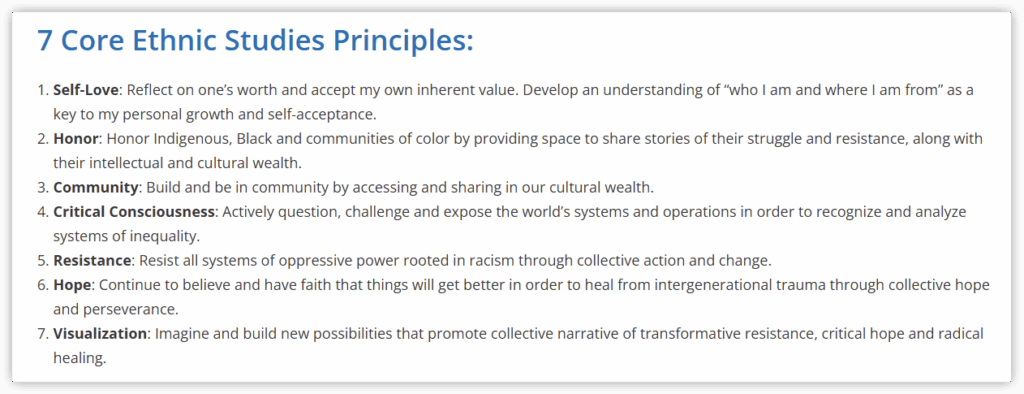
- Core principles of the Critical Ethnic Studies course include “Resistance,” where students are told to “resist all systems of oppressive power rooted in racism through collective action and change,” as well as “Critical Consciousness.”
In August of 2023, the University of Minnesota – Twin Cities, College of Education and Human Development, Center for Applied Research and Educational Improvement, in partnership with SPPS and the University’s Center for Race, Indigeneity, Disability, Gender, and Sexuality (RIDGS), released a report titled An Evaluation of Critical Ethnic Studies in Saint Paul Public Schools: Year 1 District-Wide Implementation.
The report states that the district should “consider expanding critical ethnic studies beyond a one-semester standalone course by integrating it within all disciplinary content in the district as well as creating a year-long CES-focused course and introducing students to the content in earlier grades.”
As part of the 2022-2023 ethnic studies program, the district “Summer Institute” included workshops facilitated by various members and groups from the community, as well as Professor Brian Lozenski (Macalester College).
The report highlights the Critical Ethnic Studies curriculum’s “seven principles” which include “critical consciousness” and “resistance.”
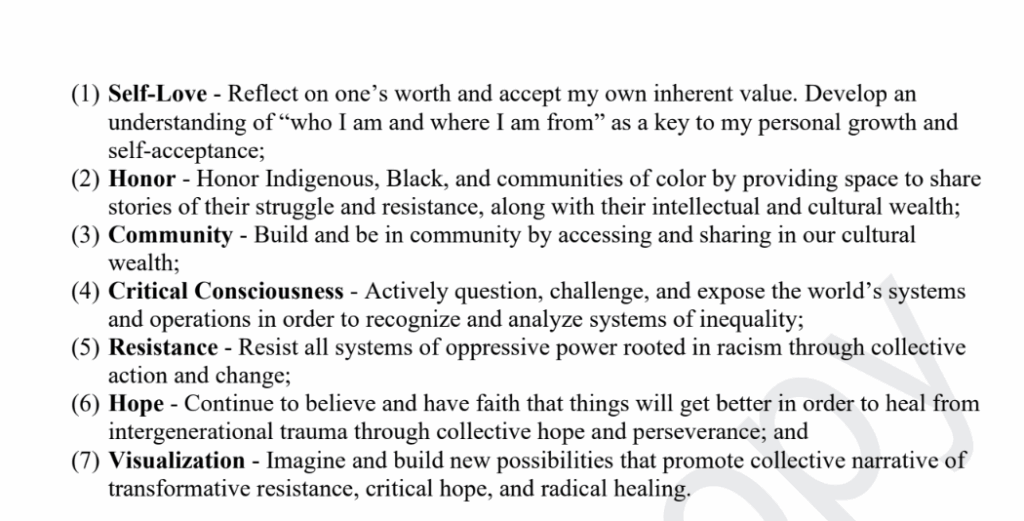
Included as feedback for the report, teachers were asked how they modeled a particular principle. One responded stated that they modeled “resistance” by “‘work[ing] hard to participate in efforts to interrupt and resist systemic racism in education by attending rallies, meetings and doing work through my union.’”

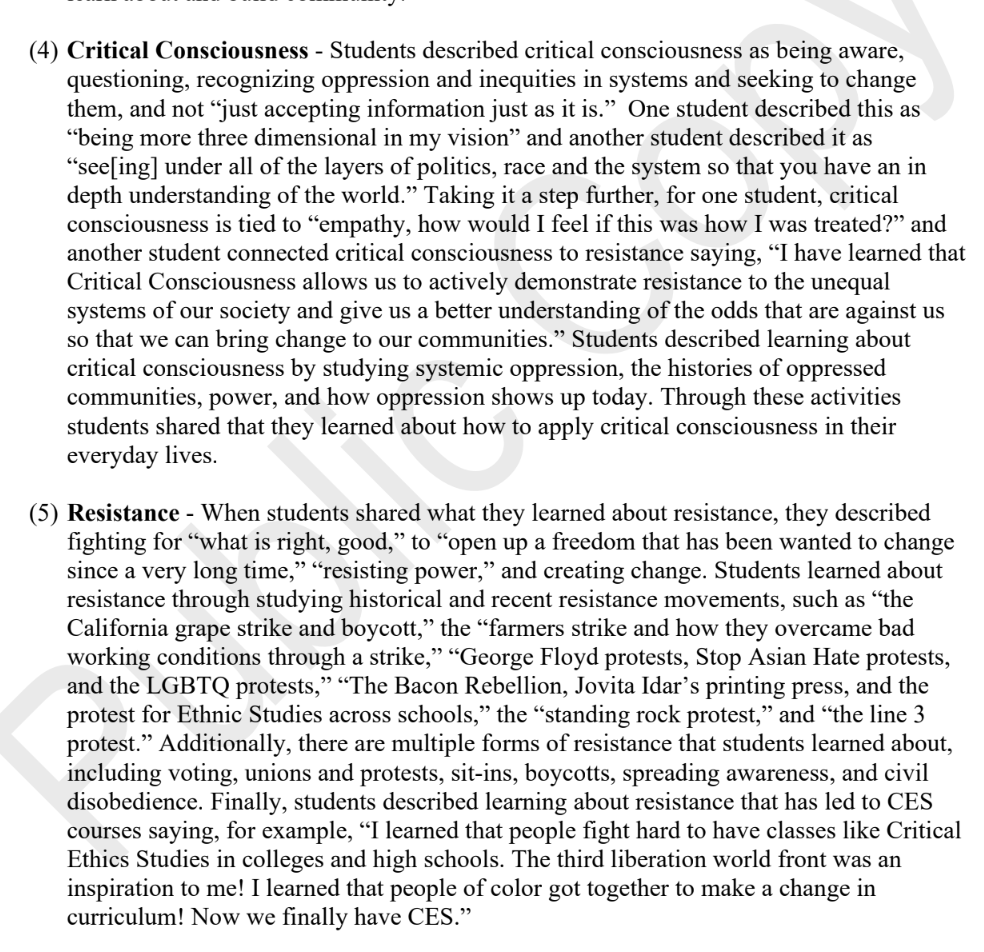
Students were also asked to describe what they felt they learned about each principle. Students shared that they learned about “critical consciousness” by “studying systemic oppression, the histories of oppressed communities, power, and how oppression shows up today.”
Students also learned that “resistance” is “‘resisting power’” and “creating change,” and that there are “multiple forms of resistance” including “voting, unions and protests, sit-ins, boycotts, spreading awareness, and civil disobedience.”
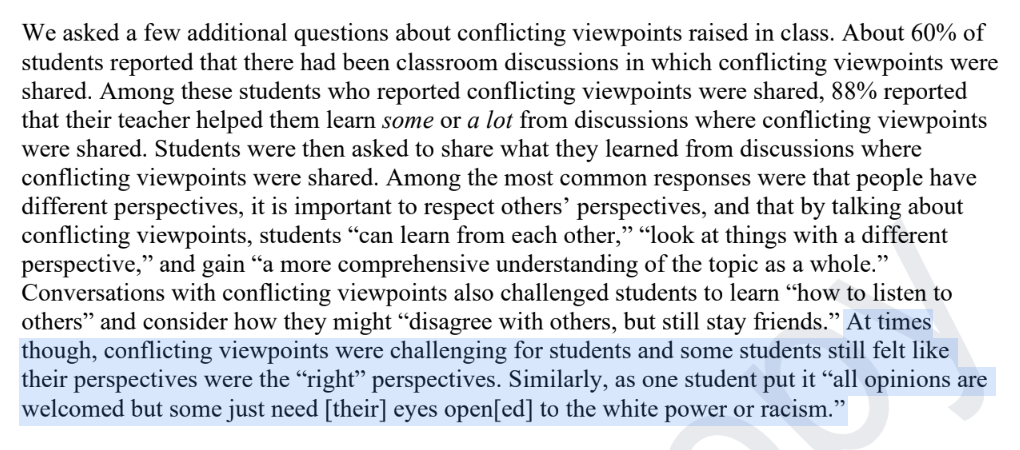
Student feedback on the ethnic studies course included reflection on “conflicting viewpoints.” The report stated that “at times though, conflicting viewpoints were challenging for students and some students still felt like their perspectives were the ‘right’ perspectives. Similarly, as one student put it ‘all opinions are welcomed but some just need [their] eyes open[ed] to the white power or racism.’”
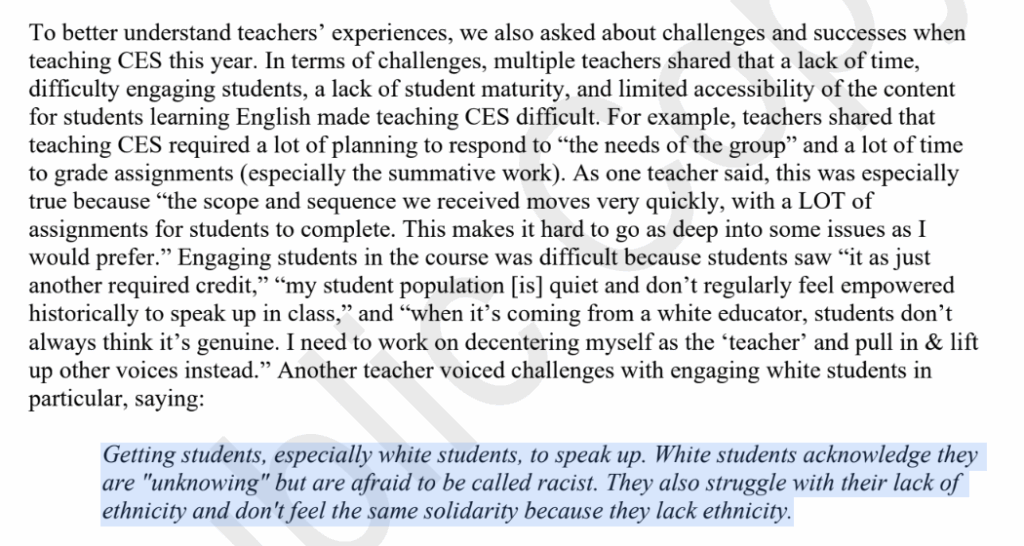
A teacher’s reflection on the course included “challenges with engaging white students” stating that “Getting students, especially white students, to speak up. White students acknowledge they are ‘unknowing’ but are afraid to be called racist. They also struggle with their lack of ethnicity and don’t feel the same solidarity because they lack ethnicity.”
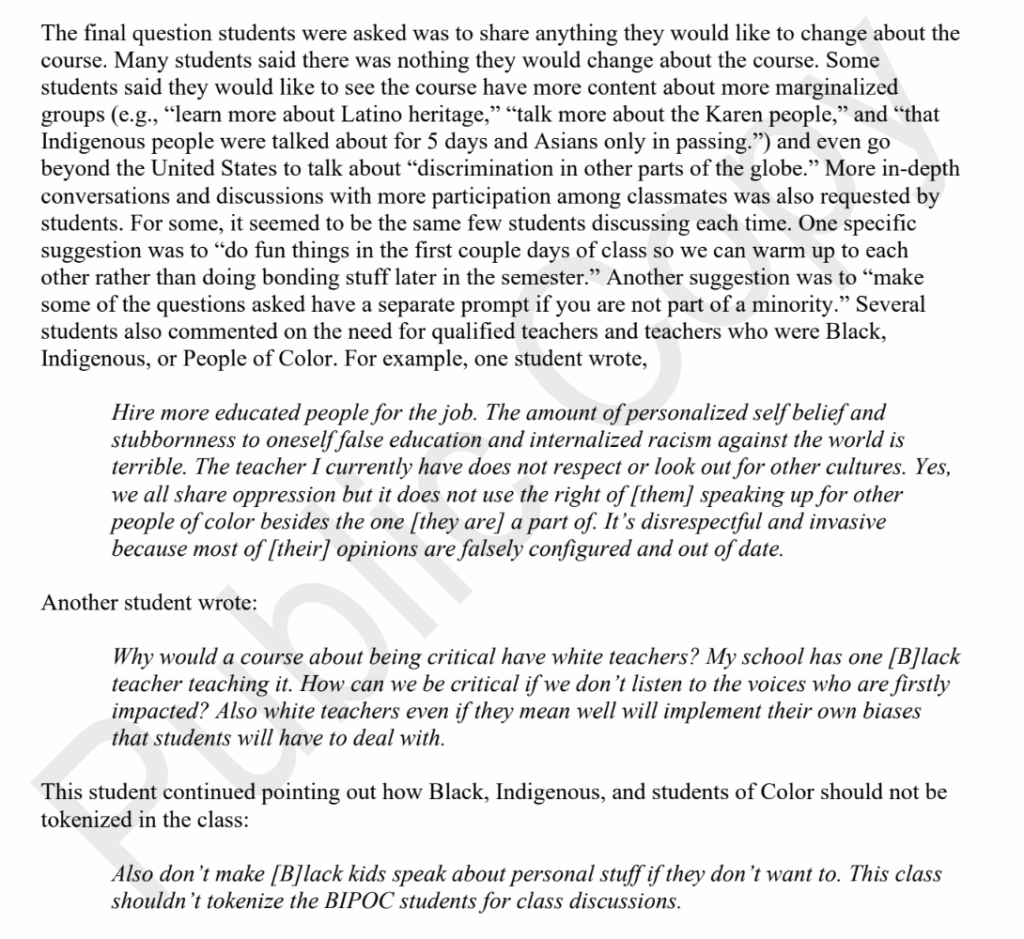
Students were asked to share anything additional about the course. Responses included criticism of people speaking on behalf of racial groups they are not part of, and distrust of white teachers being able to teach about minority cultures without implementing “their own biases that students will have to deal with.”
In a March 2024 video, a SPPS Critical Ethnic Studies teacher claims that parts of the public education system are “racist and restrictive.”
According to the Minnesota Star Tribune, Critical Ethnic Studies classes at SPPS begin with land acknowledgements.
- “To both the Indigenous and African forebearers, we commit to the continued struggle for liberation and reparation, for it is through this freedom and Justice that we truly give honor.” – SPPS Teacher