




LiberatED: Cotati-Rohnert Park Unified School District
Incidents
- Issues
- Ethnic Studies
An ethnic studies course proposed for the 2025/2026 school year at Rancho Cotate High School in the Cotati-Rohnert Park Unified School District aims to help students:
“Understand the politics of privilege and the historical impacts of ideological, institutional, interpersonal, and internalized oppression, while furthering self-understanding and promoting self-empowerment” and “discuss how various demographic identifiers including race and ethnicity influence human experiences, as they develop a better understanding of others.”
In one unit, students will explore the concept of identity, both personal and collective, and how it is shaped by culture, race, ethnicity, gender, language, and history. Through the lens of ethnic studies, students will examine how identity influences their lives and the world around them, including the ways systems of power and privilege impact individual and group identities.
Sources for an assignment include Ibram X. Kendi’s 2020 book Stamped: Racism, Antiracism and You.

In another unit, students examine “the concepts of power, privilege, and oppression within society. Students will explore how power dynamics function in different social contexts, understanding who benefits from privilege and how systems of oppression affect marginalized groups” with a sample assignment about “The FBI’s War on the Black Freedom Movement,” featuring a lesson plan sourced from the Zinn Education Project.
Students also are asked to create a “County Solutions Action Plan in which they examine the broad context of issues and the role of the state, county, and other levels of government to focus on bringing about local change. They will identify issues and choose one issue that impacts local communities, analyze new articles about the issue, and describe the current state of the issue.” The emphasis of the assignment should be about one or more of four groups: African Americans, Asian Americans, Latino Americans, and Indigenous Americans.

A similar Ethnic Studies course was proposed for the district’s Technology High School from the Sonoma County Office of Education’s Ethnic Studies E.A.R.T.H. Framework, which centers “on the cultural wealth and legacies of communities of color.” The framework states:
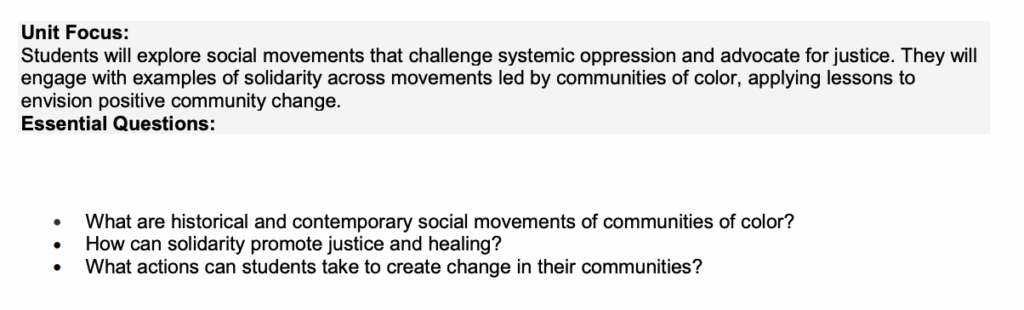
“Students will develop critical consciousness, engage in freedom dreaming, and practice solidarity through inquiry-based learning, discussion, and action projects … encouraging students to think critically about power, oppression, and resistance, while exploring ways to create positive change in their local and global communities.”
The curriculum will discuss the “4 I’s of oppression (Ideological, Institutional, Interpersonal, Institutionalized),” how the different “forms of identity (race, gender class, etc.) intersect,” as well as how students can explore “strategies for resistance, building toward a vision of justice” and resist “systems and structures of oppression.”
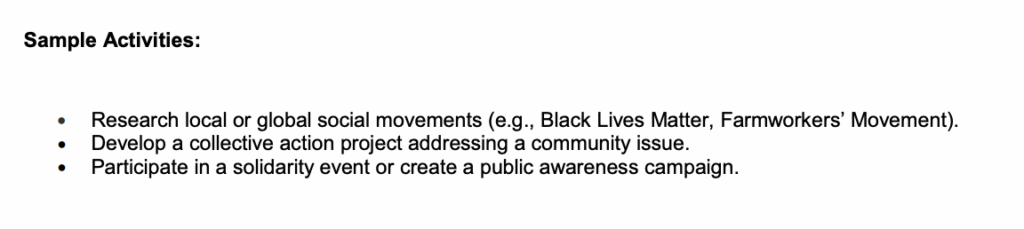
Sample activities include: Researching local or global social movements (e.g., Black Lives Matter, Farmworkers’ Movement), participating in a solidarity event or create a public awareness campaign, and developing a collective action project addressing a community issue.
Textbooks and suggested reading included known Marxist Paulo Freire’s Pedagogy of the Oppressed; Angela Davis’ Freedom is a Constant Struggle; activist Ibram X. Kendi’s Stamped: Racism, Antiracism, and You; The Intersectionality Wars by Kimberlé Crenshaw, a founding scholar of Critical Race Theory; and activist Bettina Love’s Abolitionist Teaching and the Future of Our Schools.
Stay Informed