
What the Decision Means—and What Comes Next
The U.S. Supreme Court upheld Idaho’s and West Virginia’s laws limiting girls’ and women’s school sports to biological females. The ruling is a significant victory for women’s sports and a major step toward restoring the protections Title IX was intended to provide.
While the ruling was not as sweeping as many supporters had hoped, it clarifies two important points: first, that the Court’s reasoning in Bostock does not automatically govern Title IX cases involving school athletics; and second, that states have the authority to determine how athletic competition is structured.
What the Court Decided
The Court held that states may enact laws limiting girls’ and women’s athletic competition to biological females. In other words, these state laws are constitutional.
This gives states clear authority to protect female athletic opportunities if they choose to do so.
What the Court Did Not Decide
The Court did not hold that states are required to separate athletic competition by sex.
That question remains unresolved and is likely to become the next major Title IX battle.
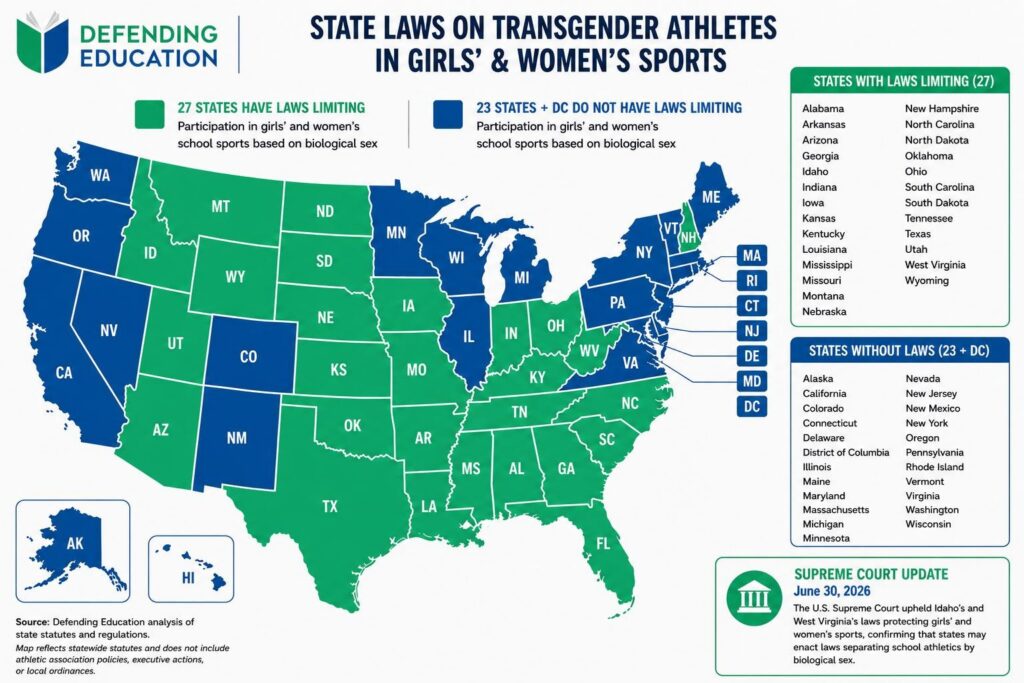
For states that have enacted laws protecting girls’ and women’s sports, today’s decision provides strong constitutional footing. For states that have not, the ruling makes clear that these policy decisions remain in the hands of elected officials and voters—not the courts.
Future challenges are likely to shift away from whether states may protect female sports and toward whether Title IX requires schools to do so.
Future lawsuits are likely to be brought by female athletes arguing that allowing males to compete in girls’ and women’s sports denies women and girls the equal athletic opportunities guaranteed by Title IX.
The next major legal question is straightforward:
- Today’s question: May states protect girls’ and women’s sports?
- The Court’s answer: Yes.
- Tomorrow’s question: Does Title IX require states to protect girls’ and women’s sports?
- Answer: To be determined.
That issue is already making its way through the federal courts.
Today’s ruling is a milestone—not the finish line. It confirms that states have the authority to protect girls’ and women’s sports while leaving broader Title IX questions for another day. For supporters of sex-based athletics, it is a day to celebrate—but there is still important work to do, both in state legislatures and in the courts.