



Minnesota K-12 school districts’ ‘Staff Development and Mentoring’ policy allows for funds to be used for race-based programming
Investigations
Number of school districts with the policy: 50
Number of school districts without the policy: 57
SUMMARY
Over 50 Minnesota K-12 school districts have adopted “Policy 425 – Staff Development and Mentoring” (or a similar title) that includes a section which states that funds can be used in support of race-based affinity groups, other race-focused programmings, and “financial incentives for teachers of color and teachers who are American Indian.” Overall, 100+ districts were vetted for the policy, 57 appeared to either not have adopted it or included the race-based language in the policy.
According to several district documents, these policies appear to be based off of a Minnesota School Boards Association (MSBA) model policy with the same policy number and name. Unfortunately, it is protected behind a login and not accessible for full verification.
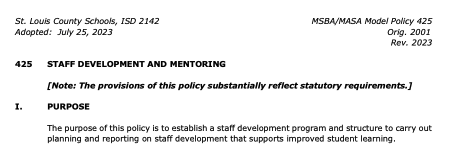
POLICY 425 – STAFF DEVELOPMENT AND MENTORING
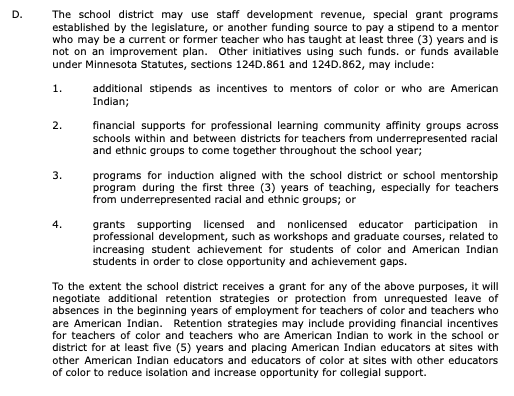
The district’s “Policy 425 – Staff Development and Mentoring” states that the “district may use staff development revenue, special grant programs established by the legislature, or another funding source” for initiatives such as “additional stipends as incentives to mentors of color or who are American Indian,” financial support for affinity groups for “teachers from underrepresented racial and ethnic groups,” and other race-focused professional development programming.
The policy also states that to the “extent the school district receives a grant for any of the above purposes, it will negotiate additional retention strategies or protection from unrequested leave of absences in the beginning years of employment for teachers of color and teachers who are American Indian.” The policy continues, noting that retention strategies “may include providing financial incentives for teachers of color and teachers who are American Indian to work in the school or district for at least five (5) years and placing American Indian educators at sites with other American Indian educators and educators of color at sites with other educators of color to reduce isolation and increase opportunity for collegial support.”
DISTRICTS
Below is a list of the 50 largest school districts in Minnesota that have adopted the policy. This is not a comprehensive list and all districts will be vetted over time.
- Alexandria Public Schools
- Austin Public Schools
- Brainerd Public Schools
- Byron Public Schools
- Centennial School District
- Columbia Heights Public Schools
- Dassel-Cokato Schools
- Delano Public Schools
- Detroit Lakes Public Schools
- East Grand Forks Public Schools
- Eden Valley-Watkins Independent School District
- Edina Public Schools
- Fairmont Area Schools
- Faribault Public Schools
- Fergus Falls Public Schools
- Hermantown Community Schools
- Hinckley – Finlayson Schools
- Hutchinson School District
- Jackson County Central Schools
- Kasson – Mantorville Schools
- Lake City Public SchoolsLake
- Crystal Wellcome Memorial District
- Lake Superior School District
- Mankato Area Public Schools
- Marshall County Central School District
- Marshall Public Schools
- Minnewaska Area Schools
- Monticello Public Schools
- Moorehead Area Public Schools
- New Ulm Public Schools
- North St. Paul – Maplewood – Oakdale School District
- Pequot Lakes Public Schools
- Proctor Public Schools
- Rochester Public Schools
- Rock Ridge Public Schools
- Rocori School District
- Saint Peter Public Schools
- Sauk Rapids-Rice Public Schools
- Shakopee Public Schools
- Southland Independent School District
- St. Anthony – New Brighton Public Schools
- St. Louis County Schools
- St. Michael – Albertville Schools
- Stewartville Public Schools
- Waconia Public Schools
- Warren – Alvarado – Oslo School District
- West St. Paul–Mendota Heights–Eagan Area Schools
- White Bear Lake Area Schools
- Willmar Public Schools
- Worthington Public Schools
Stay Informed