



AccreditED: American Bar Association
Investigations
IN THE REPORT
Number of states: 28 plus the District of Columbia
Total number of law schools that appear to still follow Standard 303(c): 62
Membership dues and accreditation fees collected from 2016-2023: $461,320,718
KEY TAKEAWAYS
- According to 990 tax documents, the ABA took in $461,320,718 in membership dues and accreditation fees from 2016-2023.
- The University of California, Berkeley Law requires the completion of “one or more race and law course(s) totaling at least two units (class of 2026 and beyond) from a menu of classes that substantially focus on how laws and legal institutions shape and are shaped by racism and other forms of systemic inequality.”
- The University of California, Irvine School of Law has a Race and Indigeneity Requirement that states that “students must complete a minimum of 2 credits in a graded course including substantial content relating to, race and indigeneity, structural inequity, and the historical bases for such inequity.”
- Loyola University Chicago School of Law claims its mission is to “prepare graduates who will be ethical advocates for justice and equity, who will lead efforts to dismantle legal, economic, political, and social structures that generate and sustain racism and all forms of oppression, and who will advance a rule of law that promotes social justice.”
- Boston University (MA) Law Professor Jasmine Gonzales Rose, a “leading critical race theorist,” was tasked in 2023 with implementing the school’s programming for ABA Standard 303(c). Gonzales Rose, who previously led legal research and policy projects at BU’s “Center for Antiracist Research,” said she aimed to “enhance our antiracist, anti-bias, and cross-cultural competence learning at BU Law.”
- Rutgers Law School’s (NJ) Academic Requirements and Information includes a “Racial Equity Requirement” which states that all J.D. students “must complete at least one elective course that includes content relating to structural inequality, discrimination, culture context, and cultural competency.” Racial equity themes include “discrimination, oppression, and/or systemic bias based on race,” “how law is shaped by race-based assumptions about justice, rights and morality,” and “how law historically influences and has been influenced by power, privilege, and biases based on race, ethnicity, and/or the intersections of race and national origin.”
- St. John’s University (NY) School of Law states that its mission is to “sustain and foster an equitable, inclusive, anti-racist community of diverse experiences and perspectives, emphasizing respect for the rights and dignity of every person.” The site states that when reviewing applications, the school considers the “challenges faced and overcome” by an applicant such as “adversity, socio-economic impacts, justice impacted, disability, etc.” and a commitment to “joining a community and service orientated institution with a long history and commitment to fairness, equity, anti-discrimination, and anti-racism goals.”
- Villanova University’s (PA) Charles Widger School of Law states in its handbook that it is “committed to an environment where diversity, equity and inclusion are crucial to the success of ALL students.” The school’s Racial Justice Action Plan includes the intention to “increase racial diversity of our student body” through affinity group outreach and making it “easier for applicants of color to apply,” expanding course offerings focused on race and social justice, and other actions focused on DEI.
SUMMARY
This report on the American Bar Association (ABA) highlights the accreditation organization’s standards and goals that promote diversity, equity, and inclusion (DEI) practices in law schools. Despite the ABA suspending one of the two standards in February 2025, it appears that some law schools still have DEI and race-based requirements as necessary for degree completion.
Of the approximately 196 law schools accredited by the American Bar Association (ABA), 62 appear to still require students to complete DEI-related coursework or programming in order to graduate. In addition, 72 law schools appear to maintain DEI offices—or rebranded versions of them—that remain in operation.
However, because DEI policies are evolving and information is often incomplete—as in this information is not publicly available or not accessible through Freedom of Information Act requests—it is difficult to determine whether some schools have fully eliminated DEI requirements and initiatives.
The following includes information about Standards 206 and 303(c), and the most current links to law schools that appear to still be requiring adherence to DEI standards. This is not a comprehensive report and will be updated as new information comes to light.
AMERICAN BAR ASSOCIATION (ABA)
The American Bar Association (ABA) is the primary accreditation organization for university law schools. The ABA states that it was founded on a “commitment to set the legal and ethical foundation for the American nation.” It “exists as a membership organization and stands committed to its mission of defending liberty and pursuing justice.”
The ABA includes two standards in its accreditation criteria that mandate diversity, equity, and inclusion (DEI) efforts at law schools and in degree completion requirements. While Standard 206 was suspended by the ABA on February 21, 2025, Standard 303(c) is currently still in effect. Each standard is highlighted below.
STANDARD 206 – DIVERSITY AND INCLUSION
The ABA’s Rules of Procedure for Approval of Law Schools, Standard 206, states, “A school shall demonstrate by concrete action a commitment to diversity and inclusion.” Under the rule, law schools must commit to having a student body, faculty, and staff that are “diverse with respect to gender, race, and ethnicity.”
Standard 206 has been suspended until August 31, 2026 amid backlash against diversity, equity, and inclusion (DEI).
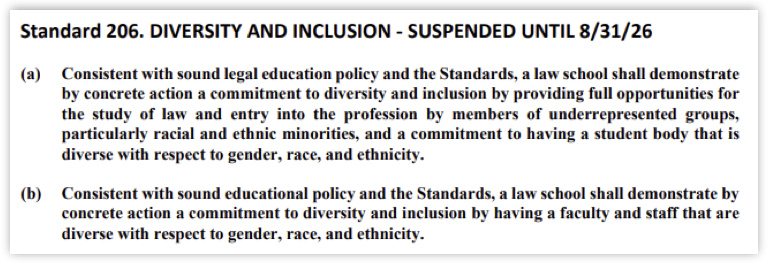
Attorney General Pam Bondi has called Standard 206 unconstitutional and urged the ABA to repeal it entirely, warning that the organization could face punitive action from the U.S. Department of Justice and lose its accrediting authority if it does not comply.
The ABA has proposed renaming Standard 206 to “Access to Legal Education and the Profession” while still requiring schools to commit to DEI.
STANDARD 303(c)
The ABA’s Rules of Procedure, Standard 303(c), requires law schools to “provide education to law students on bias, cross-cultural competency, and racism” at the start of their program and at least once again before graduation. The requirement may be satisfied by orientation sessions, lectures, courses, or “other educational experiences.”

The ABA notes that law students have an “obligation as future lawyers to work to eliminate racism in the legal profession.” It also states that law schools “have the discretion to choose the type of instruction” for this requirement.
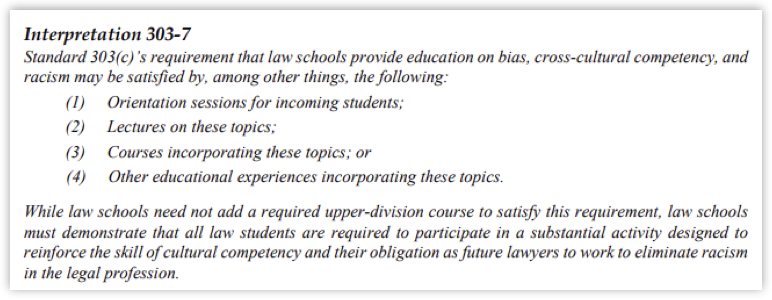
At its February 2022 meeting, the ABA House of Delegates approved Standard 303(c) by a 348 to 17 vote. This standard is reportedly the first time the ABA has mandated non-legal coursework in law school curriculum.
GOAL III: ELIMINATE BIAS AND ENHANCE DIVERSITY
The ABA’s mission consists of four goals, including Goal III: “Eliminate Bias and Enhance Diversity.” Specifically, Goal III calls to “eliminate bias in the legal profession and the justice system.”
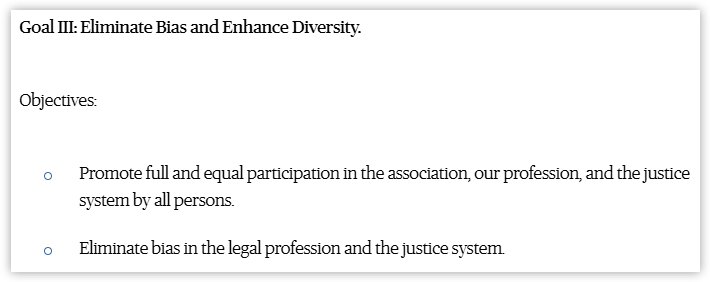
The ABA states, “all ABA entities and members are responsible for advancing ABA Goal III—it permeates everything we do internally and externally as an Association.”

The ABA’s Diversity, Equity, and Inclusion Center “provides guidance, spearheads projects, and enhances collaboration and communication to advance ABA Goal III.” The DEI Center houses nine entities charged with advancing Goal III, such as the “Coalition on Racial and Ethnic Justice,” the “Commission on Sexual Orientation and Gender Identity,” and the “Diversity, Equity, and Inclusion Advisory Council.”
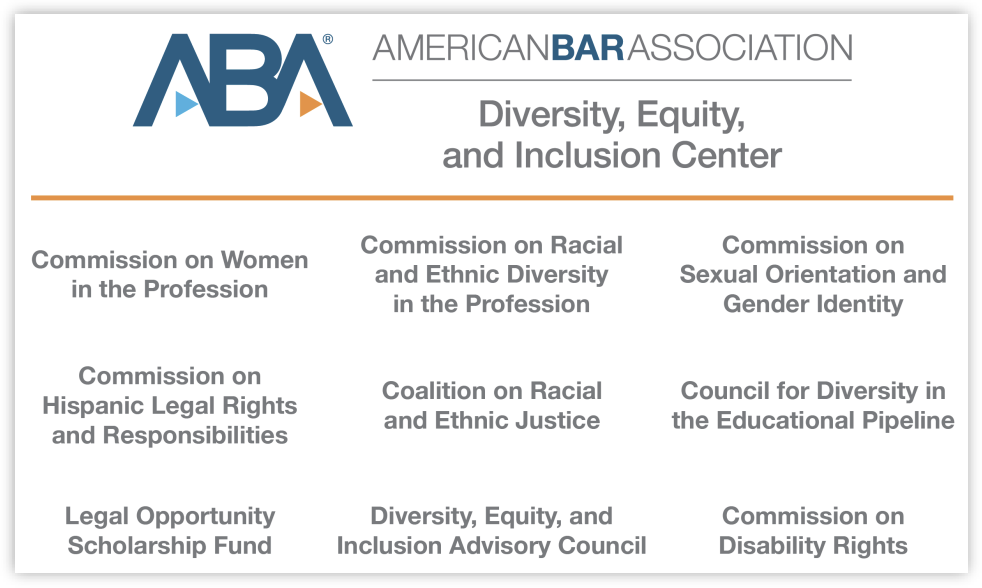
The ABA maintains a “clearinghouse” of “information and resources for attorneys, the legal profession and the public on a wealth of issues addressing bias, racism and prejudice in the justice system and society.” It also produces “short daily assignments (e.g., readings, videos, podcasts etc.) designed to educate and make participants more aware of the historic and current challenges impacting unrepresented communities.”
ADDITIONAL DEI ACTIVISM
In 2021, the ABA published an article defending the teaching of critical race theory (CRT). The organization wrote that CRT “recognizes that racism is codified in law, embedded in structures, and woven into public policy.” The ABA claimed CRT has been “misunderstood” and “distorted,” adding that CRT education is “vital for the civil rights lawyer who seeks to eradicate racial inequality in this country.”
In 2022, the ABA filed an amicus brief with the U.S. Supreme Court arguing that race should continue to be considered as a factor in college admissions. The ABA wrote, “Eliminating race-conscious admissions policies would inflict great harm on the legal profession and the nation. Such policies play a vital role toward eliminating the taint of racism from our justice system and from other areas where lawyers perform vital functions.”
In 2023, the ABA published courses detailing the “importance” of promoting DEI. One course, titled “Being an Activist in the Legal Field,” discussed how to be a “legal activist dedicated to championing justice and equality.”
The ABA offers several online courses studying how to “continue to support DEI initiatives,” “future-proof your DEI strategy,” “maintain inclusive practices,” and “continue DEI initiatives” amid anti-DEI pushback from the Trump administration. It also supports left-wing criminal justice reforms including eliminating cash bail, eliminating mandatory minimum sentences, and expanding “alternatives to incarceration.”
EXPANDED EXAMPLES
UNIVERSITY OF SAN DIEGO
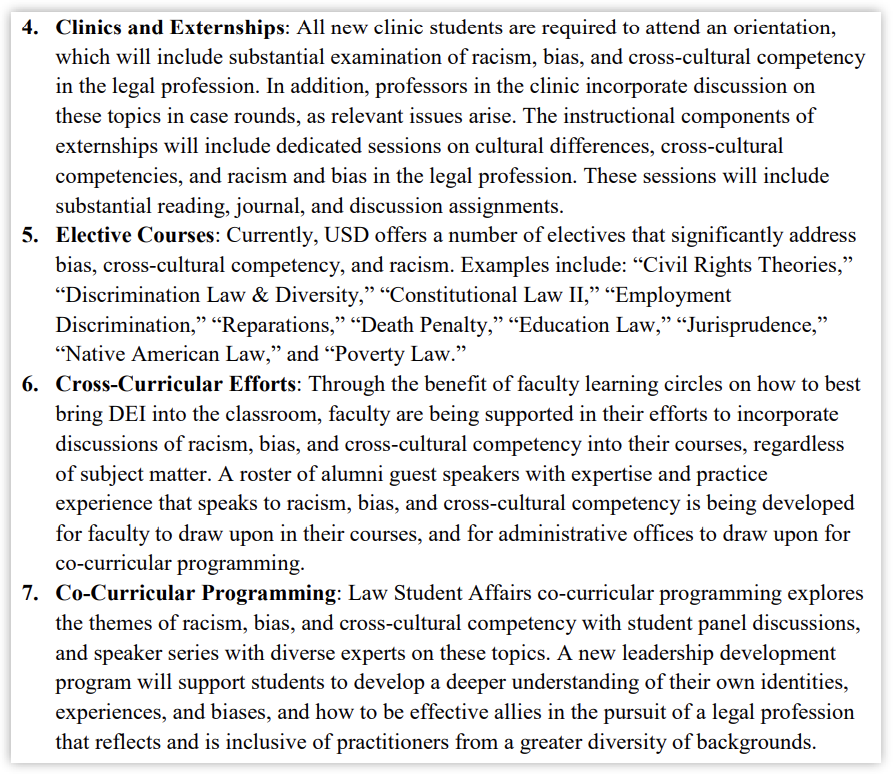
In 2022, the University of San Diego School of Law published its ABA Standard 303(c) compliance efforts.
The school said its student orientation includes a “dedicated session focused on diversity, equity and inclusion in the legal profession” that “explores how implicit bias manifests in the practice of law.”
San Diego’s 2025 orientation included a session on “cultural competency training” and redlining.

The school’s required “Experiential Advocacy Practicum I course” includes “teaching on juries, implicit biases in jury selection, how to engage in self-reflection about students’ own biases and how to mitigate these biases.”
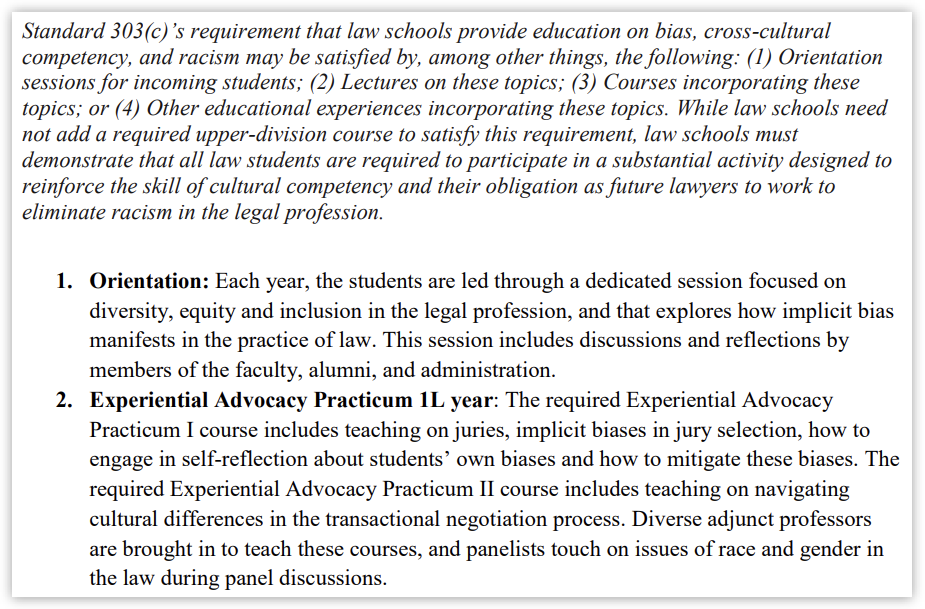
The school also touted several other Standard 303 compliance efforts including upper-level requirements and DEI-related elective options.
UNIVERSITY OF WISCONSIN
In January 2024, UW Law required first-year law students to attend a mandatory “re-orientation” session on DEI. A UW-Madison spokesman told The Federalist the session “was held in partial fulfillment of ABA (American Bar Association) Standard 303.”
Students had also been required to attend a separate DEI training session during their orientation the prior semester.
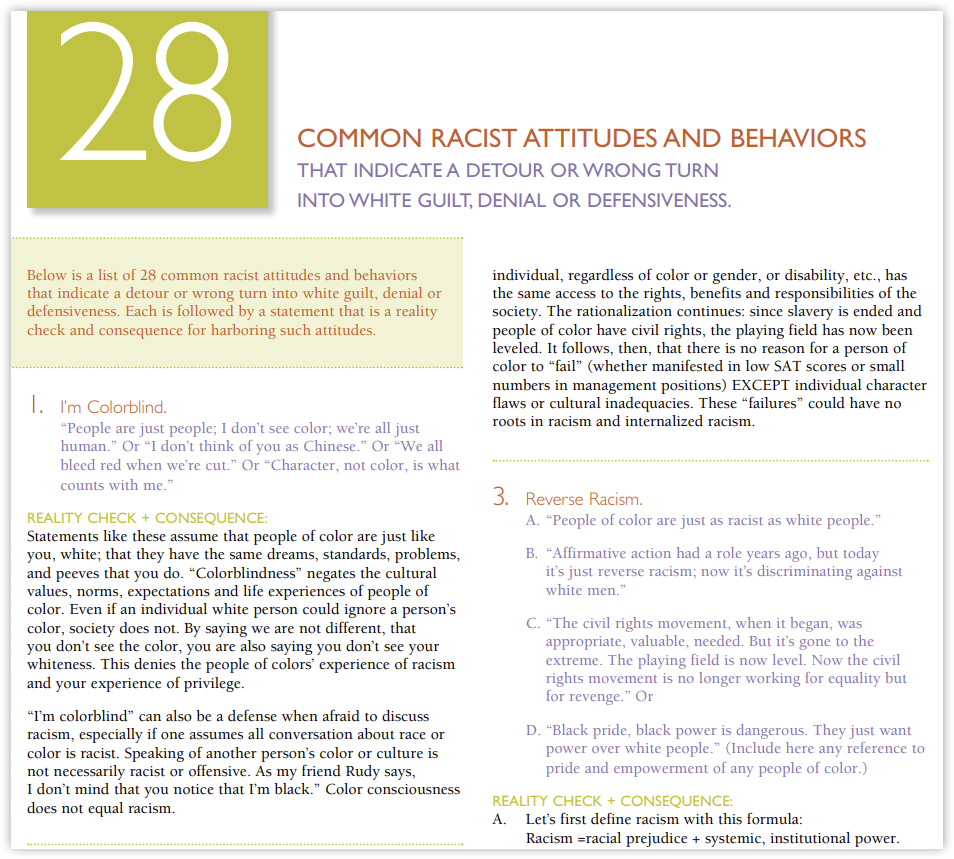
Students were instructed to review an article about “28 Common Racist Attitudes and Behaviors” and complete a “Race Timeline Worksheet” before the two-hour-plus sessions.
The article detailed behaviors that “indicate a detour or wrong turn into white guilt, denial or defensiveness,” followed by a “reality check and consequence for harboring such attitudes.”
The worksheet required students to “create a timeline of significant life events around race.”

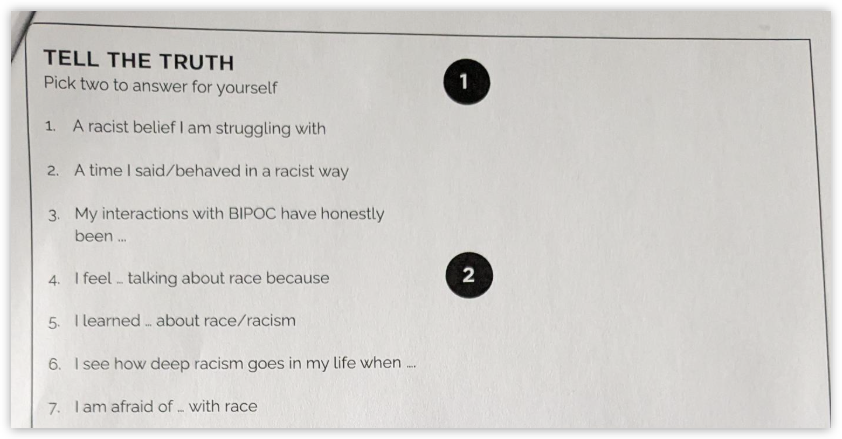
A worksheet titled “Tell the Truth” instructed students to respond to prompts from a list, including a “racist belief I am struggling with,” a “time I said/behaved in a racist way,” and “how deep racism goes in my life.”
UNIVERSITIES
The following is a list of university law programs that still appear to include Standard 303(c) and/or its language as requirements for completion of the degree program. Schools that are accredited by the ABA, but are not included below, appear to have removed the inclusion of Standard 303(c) or its language in publicly available information. This does not imply they have stopped implementing it as a requirement for degree completion, but just that the standard and language has been removed from public view.
In our search, we looked through school learning outcomes, degree requirements, course descriptions, and other sources for “Standard 303(c),” the standard’s specific language such as “cross-cultural competence” or similar, “racism,” and forms of “diversity requirement.”
Because a number of law schools have their handbooks and other documents behind a student login, they were not accessible and could not be vetted, and therefore were not included in this list.
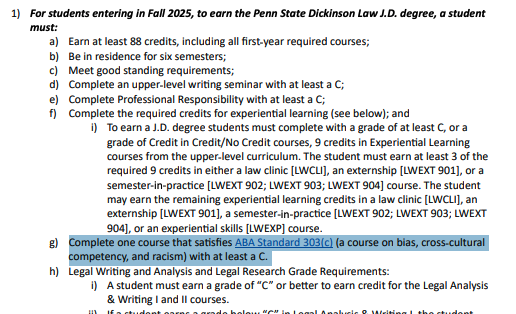
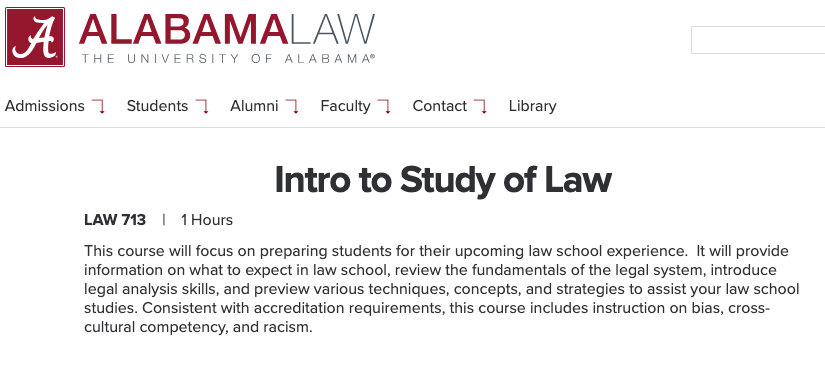
This is not an exhaustive list and will be updated as new information is identified and vetted. To see a full list of law schools accredited by the ABA, go here.
ALABAMA
University of Alabama Law
CALIFORNIA
Loyola Marymount University – Loyola Law School
Pepperdine University – Caruso School of Law
Southwestern Law School
University of California, Berkeley Law
University of California, Davis School of Law
University of California, Irvine School of Law
University of California, Los Angeles School of Law
University of San Diego School of Law
University of San Francisco School of Law
CONNECTICUT
University of Connecticut School of Law
Yale Law School
DELAWARE
Wilmington University School of Law
DISTRICT OF COLUMBIA
George Washington Law
FLORIDA
Barry University Law
Florida International University College of Law
Jacksonville University College of Law
GEORGIA
Emory Law
ILLINOIS
DePaul University College of Law
Loyola University School of Law
Northwestern University Pritzker School of Law
The University of Chicago – The Law School
University of Illinois Chicago Law
IOWA
Drake University Law School
University of Iowa College of Law
LOUISIANA
Loyola University New Orleans College of Law
MAINE
University of Maine School of Law
MASSACHUSETTS
Boston College Law School
Northeastern University School of Law
Suffolk University Boston Law School
Western New England University School of Law
MICHIGAN
Detroit Mercy Law
Wayne State University Law School
MINNESOTA
Mitchell Hamline School of Law
MISSOURI
University of Missouri-Kansas City School of Law
Washington University Law
MONTANA
University of Montana Alexander Blewett III School of Law
NEBRASKA
Creighton University School of Law
NEW JERSEY
Rutgers University
NEW YORK
New York University Law
Pace University Elisabeth Haub School of Law
St. John’s University
Yeshiva University – Benjamin N. Cardozo School of Law
NORTH CAROLINA
Duke Law
OHIO
Capital University Law School
OREGON
Lewis & Clark Law School
University of Oregon School of Law
Willamette University School of Law
PENNSYLVANIA
Duquesne University Thomas R. Kline School of Law
Pennsylvania State University Dickinson Law
Temple University Beasley School of Law
SOUTH CAROLINA
Charleston School of Law
University of South Carolina Joseph F. Rice School of Law
TENNESSEE
The University of Tennessee Knoxville Winston College of Law
TEXAS
University of Houston Law Center
University of North Texas at Dallas College of Law
VIRGINIA
Appalachian School of Law
University of Virginia School of Law
WASHINGTON
Seattle University School of Law
University of Washington School of Law
WISCONSIN
Marquette University Law School
University of Wisconsin Law School
Stay Informed