




Joliet Public Schools’ ‘Teacher Evaluation Framework’ includes assessing district teachers and contracted staff on their ‘critical consciousness’ and adherence to diversity, equity, and inclusion (DEI)
Incidents
SUMMARY
Joliet Public Schools District 86’s “Teacher Evaluation Framework” includes assessing district teachers, and other contracted staff on their “critical consciousness” and adherence to diversity, equity, and inclusion (DEI). District staff earn “excellent” scores when they apply a critical consciousness and cultural competence, and implement DEI into their planning and implementation of services.
What is critical consciousness?
Critical consciousness is a “justice-orientated” framework where an individual constantly engages in critical (critical theories) analysis and reflection on how systems (ex: education) historically and currently marginalize and oppress certain groups. This mindset includes examining how “injustices” are normalized and reproduced through the current system (often called “whiteness” or Western culture) and how to engage in actions and activism (praxis) to end the injustices.
In summary, having a critical consciousness (sometimes referred to as being “woke“) is to be in a mental state where an individual is constantly searching for ways “oppression” manifests in everyday society and interactions. The practitioner believes that “oppression” and “injustices” are everywhere, all the time, and acts to end them through “social justice.”
TEACHER EVALUATION FRAMEWORK
The following sections of the framework document highlight the ways in which the district incorporates critical consciousness and DEI into the evaluation process.
Teacher
Domain 2: Learning Environments
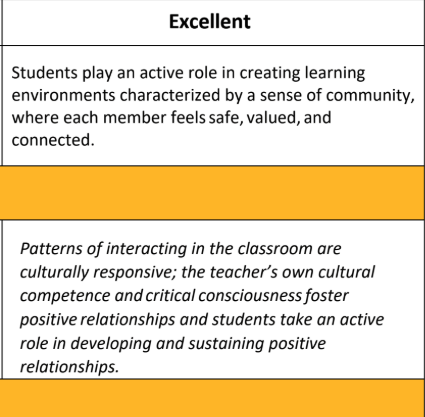
Under “Teacher – Domain 2: Learning Environments,” the framework states that an “excellent” rating is achieved when “patterns of interacting in the classroom are culturally responsive; the teacher’s own cultural competence and critical consciousness foster positive relationships and students take an active role in developing and sustaining positive relationships.”

Instructional Specialist
Domain 1: Planning and Preparation
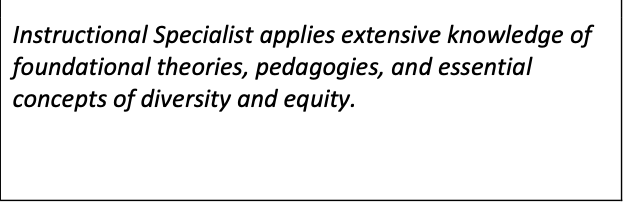
Under the domain titled “Planning and Preparation,” Instructional Specialists are evaluated on the “critical attributes” category labeled “Demonstrates knowledge of diversity and equity and applies that knowledge in planning.” In order to receive an “excellent” rating, they must apply “extensive knowledge of foundational theories, pedagogies, and essential concepts of diversity and equity.”

Domain 2: Professional Practice and Delivery of Service
Under “Domain 2,” Instructional Specialists are required to “ensure a sense of belonging” by advocating for a “school community that cultivates equity and access for all.”

Domain 3: Productive Collaboration
For “Domain 3,” an Instructional Specialist “Demonstrates how issues of equity and access impact the school and Provides leadership and support to teachers, families, and the school community.” This means the instructional specialist “proactively and routinely advocates for change in school and district practices and structures that are inherently biased or prejudiced against certain groups.”

School Nurse
Domain 2: Professional Practice and Delivery of Service
Under “Domain 2,” school nurses receive an “excellent” evaluation when “patterns of interacting are culturally responsive, the nurse’s own cultural competence and critical consciousness foster positive relationships and students take an active role in developing and sustaining positive relationships.”


Social Worker & Counselor
Domain 1: Planning and Preparation
Under “Domain 1,” requires that a social worker or counselor “demonstrates knowledge of diversity and equity and applies that knowledge in planning” through “extensive knowledge of foundational theories, pedagogies, and essential concepts of diversity and equity.”


School Psychologist
Domain 1: Planning and Preparation
Under “Domain 1,” a school psychologists “applies knowledge of diversity and equity and applies that knowledge in planning.” An excellence scoring states that a “school psychologist applies extensive knowledge of foundational theories, pedagogies, and essential concepts of diversity and equity in planning.”


Domain 3: Productive Collaboration
Under domain 3, school psychologists are evaluated on how they share “information about services with colleagues in the school and/or district” which includes making “extensive use of partnerships with school, district, community, and external resources to promote educational equity, student achievement, and success.”


Stay Informed