


DivertED: Oregon Education Association
Investigations
Total Oregon Education Association & PAC spending: $382,355,203.55
Total spending on leftwing politics and ballot initiatives (2016 – 2023): $8,429,036
Total spent on staff, officers, and employee compensation (2016 to present): $219,349,349
Total Oregon Education Association PAC spending (2021 – present): $1,530,463.55
SUMMARY
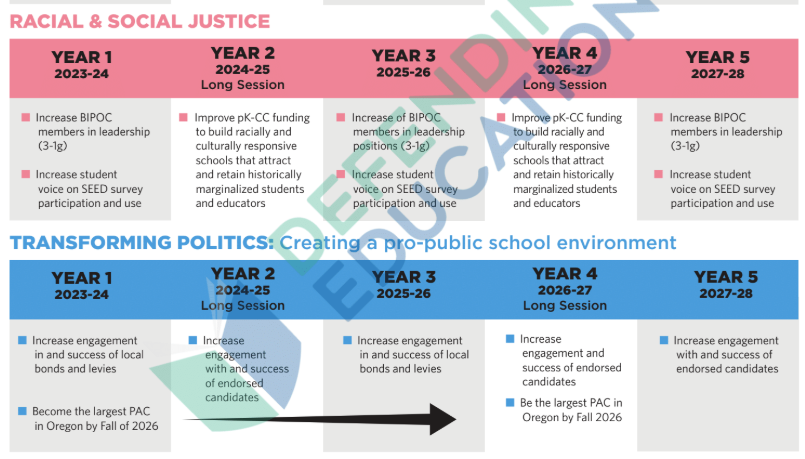
Documents obtained by Defending Education reveal the Oregon Education Association’s (OEA) “strategic metrics,” proposed amendments and resolutions, and budgetary information. The OEA’s 2026 Representative Assembly Handbook highlights the organization’s “strategic metrics” such as increasing “BIPOC members in leadership” and becoming the “largest PAC in Oregon by Fall of 2026.”
Proposed amendments and resolutions include calls that “all tax revenue changes must be equitable” by “more heavily taxing the ultra-wealthy (billionaires and corporate moguls) and the top 5 percent of income earners.” Other proposals include redirecting $20 per member annually into the OEA’s “Public School Funding Campaign” and concerns over “Artificial Intelligence – Powered Weapons” that would “concentrate extraordinary destructive power in the hands of a small number of governments, corporations, billionaires, and technology oligarchs.”
The handbook also includes organization budgetary information that notes that the OEA has been running a fiscal deficit ranging from hundreds of thousands of dollars to $2M+ since 2021. Yet, the OEA, the state affiliate of the National Education Association (NEA), and its Political Action Committee (PAC) have spent over $382M on officers, staff, and employee compensation packages, ballot measures, and leftwing groups since 2016.
KEY TAKEAWAYS
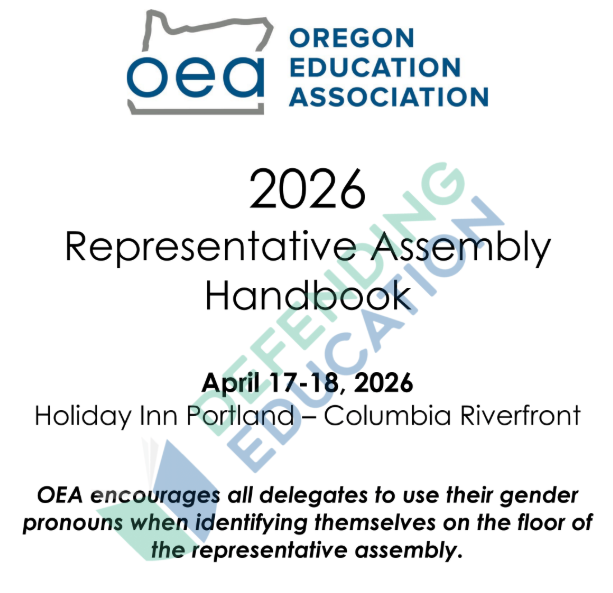
- The Oregon Education Association 2026 Representative Assembly Handbook notes in bold writing that the “OEA encourages all delegates to use their gender pronouns when identifying themselves on the floor of the representative assembly.”
- OEA “Strategic Metrics” include a section titled “Racial & Social Justice” that states the union intends to “increase BIPOC members in leadership” and “improve pK-CC funding to build racially and culturally responsive schools that attract and retain historically marginalized students and educators.”
- Another “Strategic Metric” titled “Transforming Politics: Creating a pro-public school environment” states that the OEA intends to “become the largest PAC in Oregon by Fall of 2026” and seeks to “increase engagement with and success of endorsed candidates.”
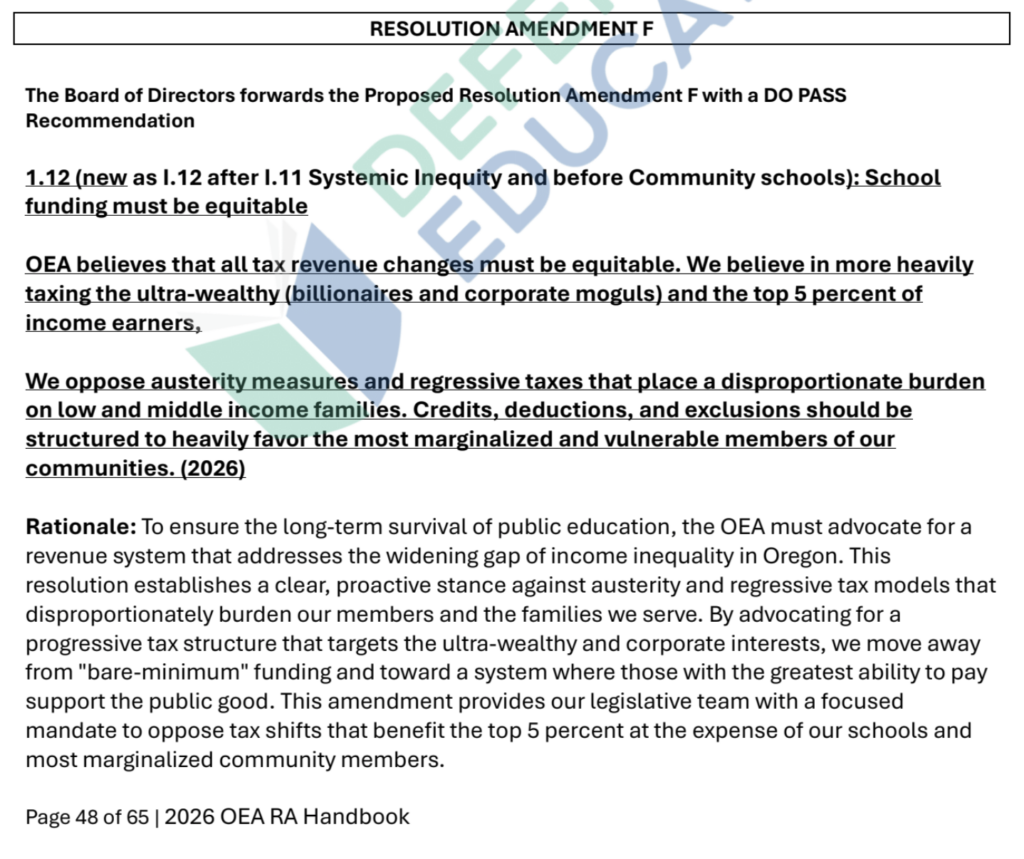
- An OEA proposed resolution states that “all tax revenue changes must be equitable” and that there must be “more heavily taxing the ultra-wealthy (billionaires and corporate moguls) and the top 5 percent of income earners.” The resolution adds that “credits, deductions, and exclusions should be structured to heavily favor the most marginalized and vulnerable members of our communities.”
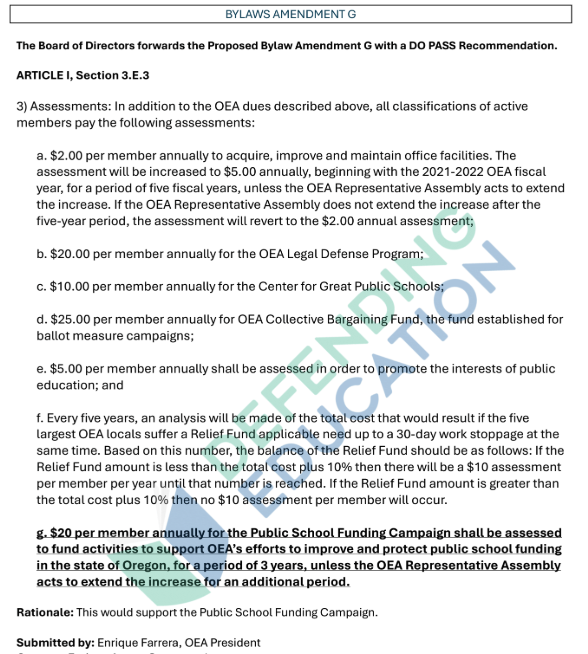
- A proposed bylaws amendment includes the union redirecting $20 per member annually into the OEA’s “Public School Funding Campaign” which will be used to “fund activities to support OEA’s efforts to improve and protect public school funding in the state of Oregon, for a period of 3 years.”
- Proposed Resolution Amendment H declares the OEA’s opposition to “Artificial Intelligence – Powered Weapons” stating that these “AI-Powered weapons concentrate extraordinary destructive power in the hands of a small number of governments, corporations, billionaires, and technology oligarchs, creating dangerous imbalances of power that threaten human rights, global stability, and democratic accountability.”
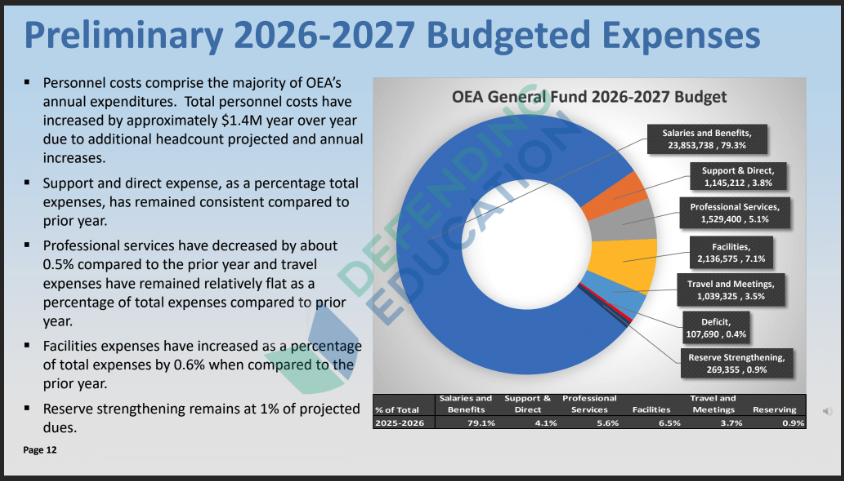
- For 2026-2027, an OEA budget presentation notes that “personnel costs compromise the majority of OEA’s annual expenditures” and have “increased by approximately $1.4M year over year due to additional headcount projected and annual increases.” Ultimately, the OEA budgeted to spend $23,853,738 on “salaries and benefits” and $1,039,325 on “travel and meetings.”
- From 2016 to 2023, the OEA spent $151,436,874 on staff, officers, and employee compensation packages. With the OEA’s 2026-2027 budget, the overall spending on compensation balloons to $175,290,612 over nine years.
- Despite millions of dollars in support each year from the National Education Association (NEA), the OEA still has a fiscal deficit ranging from hundreds of thousands of dollars to $2M+ since 2021.
- According to local reporting, OEA “shelled out nearly $6 million in strike pay for the work stoppage [Portland Public Schools, 2023], which lasted 25 days.”
- Since late 2021, the OEA’s Political Action Committee (PAC) contributed $1.5M to political campaigns and election related expenses. The OEA-PAC donated $375,000 to “Friends of Tina Kotek” in 2022.
- The OEA has given Our Oregon $2,331,550 since 2016.
- In 2016, OEA spent $3,691,486 on “Yes on 97,” a campaign in support of failed Ballot Measure 97 which would have removed the “cap on the corporate gross sales tax, also known as the ‘minimum tax,’ and establish a 2.5 percent tax on gross sales that exceed $25 million.”
2026 REPRESENTATIVE ASSEMBLY HANDBOOK
The Oregon Education Association’s 2026 Representative Assembly Handbook includes the organization’s “strategic metrics,” proposed bylaws and resolutions, and budget information.
The second page of the document notes in bold writing that the “OEA encourages all delegates to use their gender pronouns when identifying themselves on the floor of the representative assembly.”
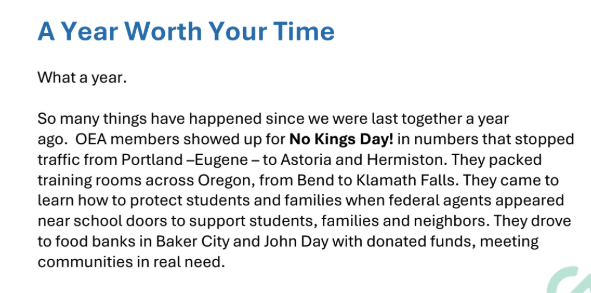
The document celebrates OEA members showing up for “No Kings Day! in numbers that stopped traffic from Portland – Eugene – to Astoria and Herminston.”
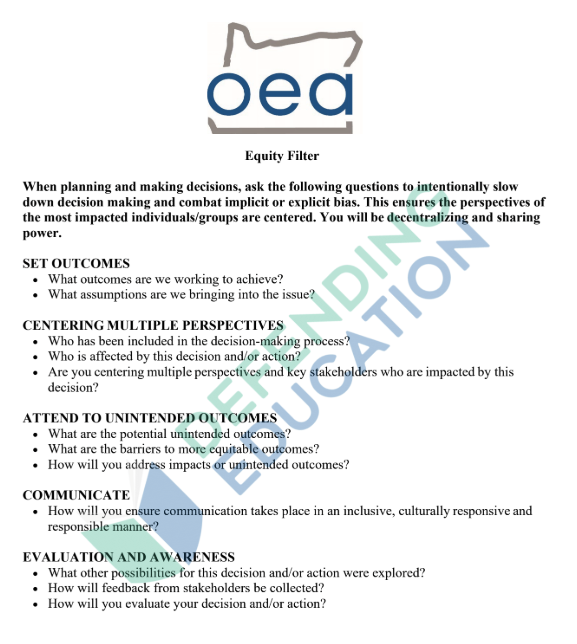
The handbook includes a page titled “Equity Filter” which directs members to “ask the following questions to intentionally slow down decision making and combat implicit or explicit bias.” It also is meant to ensure that the “perspectives of the most impacted individuals/groups are centered.”
The OEA handbook includes “Strategic Metrics” that range from the 2023-24 school year to 2027-28. Under the section “Racial & Social Justice,” metrics include increasing “BIPOC members in leadership” and improving “pK-CC funding to build racially and culturally responsive schools that attract and retain historically marginalized students and educators.”
Another metrics section titled “Transforming Politics: Creating a pro-public school environment” calls for the OEA to “become the largest PAC in Oregon by Fall of 2026” and to “increase engagement with and success of endorsed candidates.”
ACTION ITEMS
Proposed Bylaws Amendments
Below is a list of a few of the proposed amendments and resolutions by the OEA Representative Assembly (RA) that the Board of Directors forwarded with a “Do Pass” recommendation.
Bylaws Amendment G
Included in OEA’s 2026 proposed Bylaws Amendments is “Amendment G,” which states that the teachers’ union wants to designate “$20 per member annually for the Public School Funding Campaign” that will be used to “fund activities to support OEA’s efforts to improve and protect public school funding in the state of Oregon, for a period of 3 years.”
Based on the current estimated membership count, this would amount to over $800,000 per year.
Proposed Resolutions
Resolution Amendment C – Artificial Intelligence
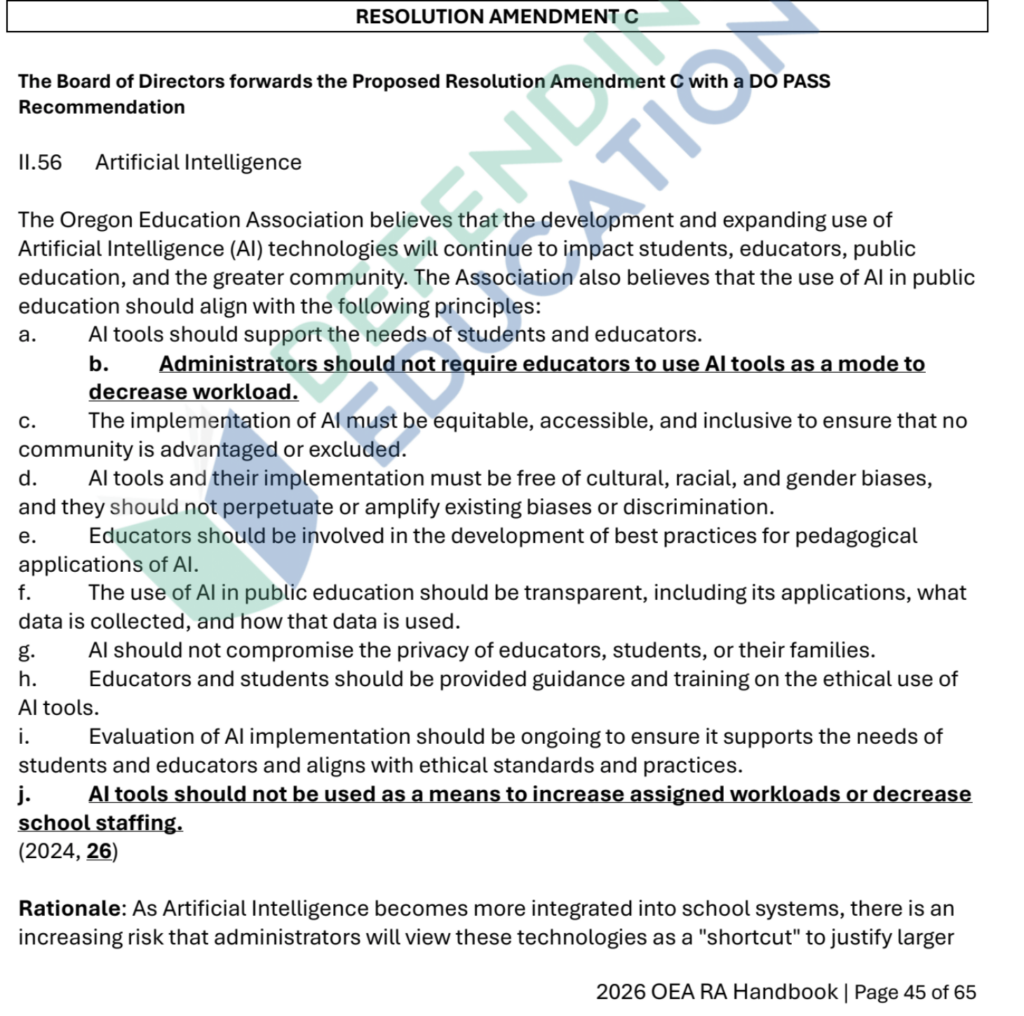
According to “Resolution Amendment C – Artificial Intelligence,” the teachers’ union demands that school administrators not require the use of AI tools as a “mode to decrease workload” or that AI tools “should not be used as a means to increase assigned workloads or decrease school staffing.”
Resolution Amendment F – (Systemic Inequity and before Community Schools): School funding must be equitable
Proposed “Resolution Amendment F – (Systemic Inequity and before Community Schools): School funding must be equitable” states that “all tax revenue changes must be equitable” and that there must be “more heavily taxing the ultra-wealthy (billionaires and corporate moguls) and the top 5 percent of income earners.” The resolution adds that “credits, deductions, and exclusions should be structured to heavily favor the most marginalized and vulnerable members of our communities.”
Resolution Amendment H – Opposition to Artificial Intelligence – Powered Weapons
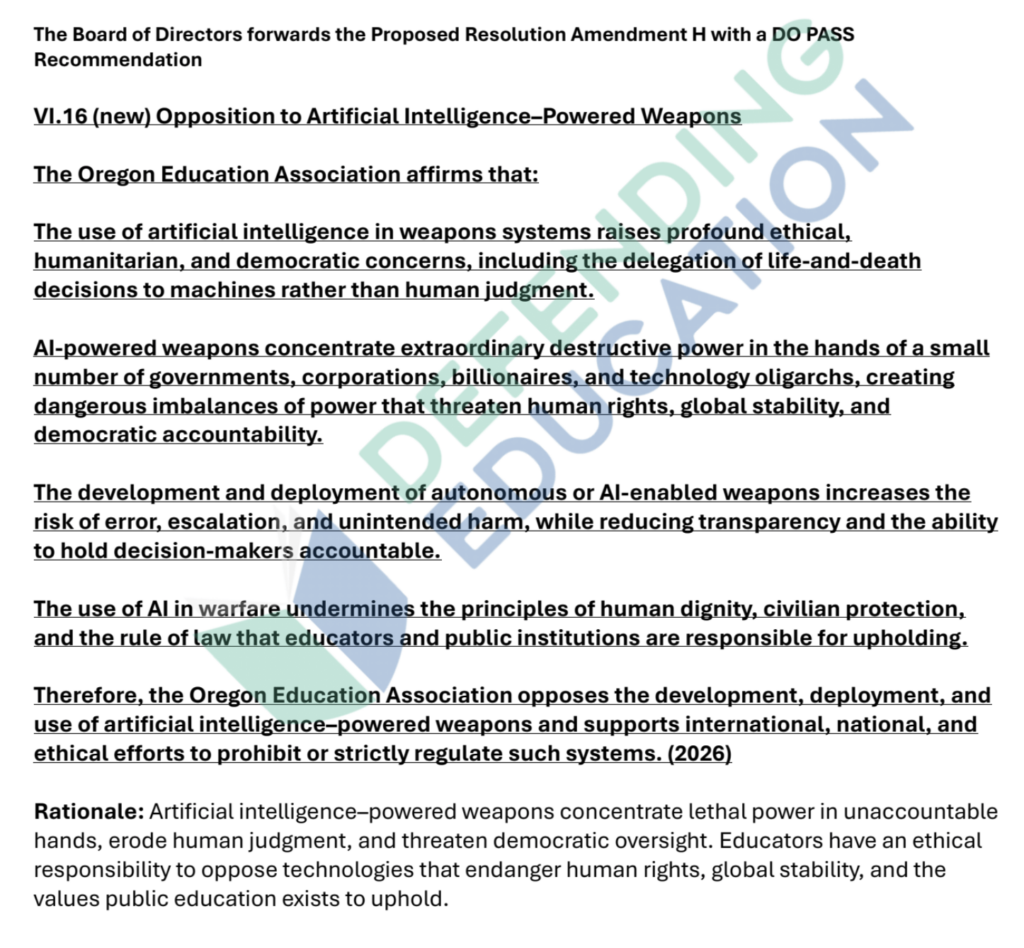
“Resolution Amendment H – Opposition to Artificial Intelligence – Powered Weapons” received a “Do Pass” recommendation from the Board. It states that the “use of artificial intelligence in weapons systems raises profound ethical, humanitarian, and democratic concerns, including the delegation of life-and-death decisions to machines rather than human judgment.”
The resolution adds that “AI-powered weapons concentrate extraordinary destructive power in the hands of a small number of governments, corporations, billionaires, and technology oligarchs, creating dangerous imbalances of power that threaten human rights, global stability, and democratic accountability.”
2026 BUDGET COMMITTEE
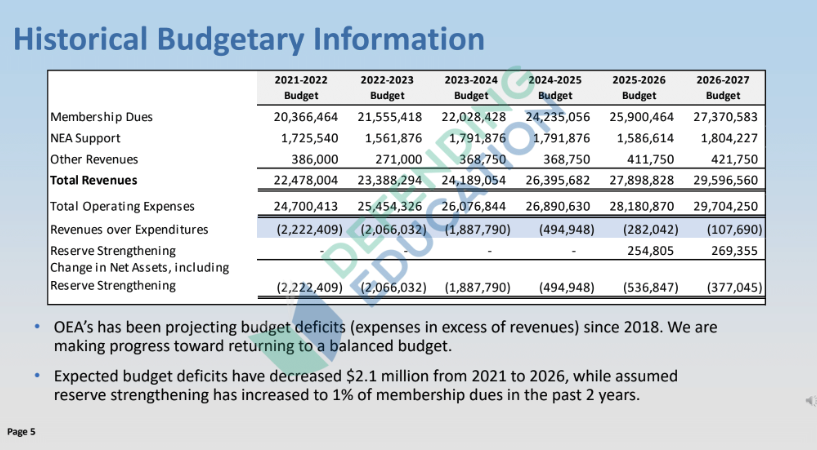
The Oakland Education Association’s 2026 Budget Committee presentation, which was included in the handbook, states that the teachers’ union has “had budget deficits since fiscal year 2018-2019” but has been “making progress toward returning to a balanced budget.” According to a slide titled “Historical Budgetary Information,” it appears that the organization has been able to reduce its deficit from $2M+ in 2021, to $100,000+ in the current 2026-2027 budget cycle.
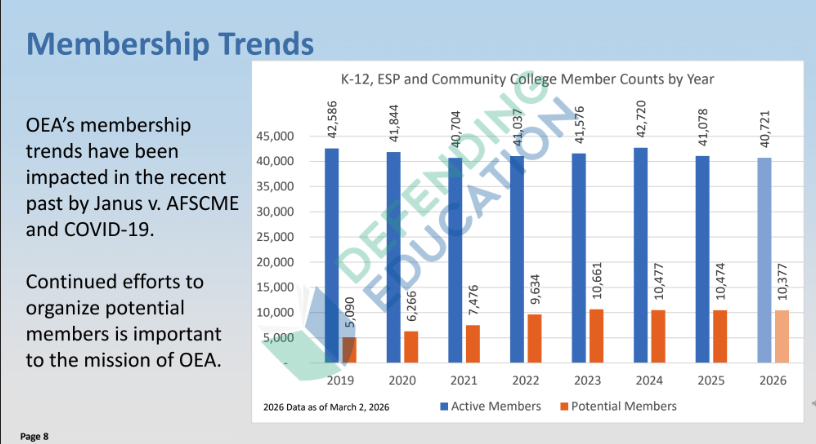
Additionally, the National Education Association (NEA) has also given the state affiliate a combined $10M+ from 2021 to the present. Despite stagnant active membership, the state-level teachers’ union collected $7M more in dues in 2026-2027 compared to 2021-2022.
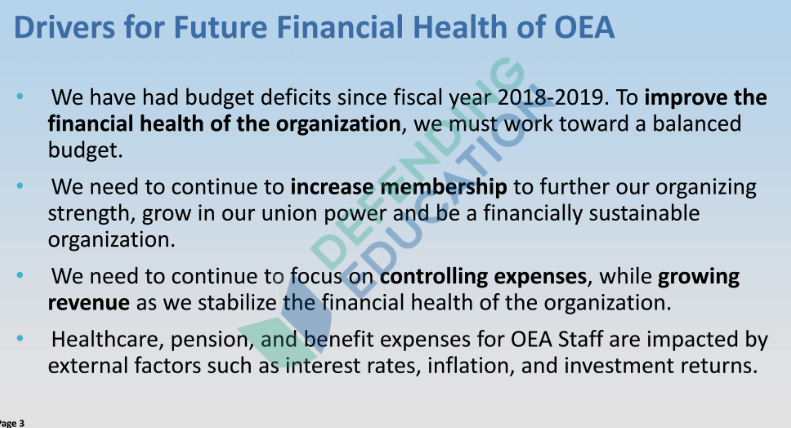
Another slide titled “Preliminary 2026-2027 Budgeting Expenses” notes that the OEA “personnel costs compromise the majority of OEA’s annual expenditures” and have “increased by approximately $1.4M year over year due to additional headcount projected and annual increases.” Overall, the teachers’ union plans to spend $23,853,738 on “salaries and benefits,” $1,145,212 on “support & direct,” $1,529,400 on “professional services,” and another $1,039,325 on “travel and meetings.”
SPENDING
Information gathered from Federal 990 forms (reporting only goes through 2023) and Oregon’s campaign finance website reveals that the Oregon Education Association (OEA) spent a combined $32,006,596.55 on leftwing issues, ballot initiatives, political campaigns, and officer and staff compensation from 2016 to the present.
From 2016 to 2023, the OEA has spent $8,429,036 on leftwing groups and ballot initiative campaigns. Additionally, the OEA spent $219,349,349 on officer, staff, and employee compensation packages from 2016 to the present.
Finally, the OEA’s Political Action Committee (PAC) contributed another $1,530,463.55 to leftwing and pro-teachers union political campaigns.
*It should be noted that the OEA’s 990 forms from 2024 and 2025 have not been publicly posted and therefore the numbers for those years have been pulled from the 2026 Handbook.
Stay Informed