



DEI in AI: Unions and Associations
Investigations
Introduction
Artificial Intelligence (AI) is quickly becoming a part of every industry, every field, and a majority of jobs. Within the next few years, most K-12 schools and colleges will integrate AI into their curricula. This will potentially come through assisting educators with lesson plans, helping students with research assignments, and even creating specialized feedback for each student. The integration of AI into education is not a matter of if but when. The problem is that unions, left-wing activists, and groups in the education field are already setting the foundation to use these AI tools to promote diversity, equity, and inclusion (DEI) initiatives to students during their formative years.
The goal of these groups is to implement DEI ideology into AI before it can be fully integrated into America’s education system. If DEI is embedded in AI before schools adopt these new tools, then DEI, as part of AI, becomes institutionalized in the nation’s schools once the tools are adopted. Defending Education has compiled the following list of significant unions and association groups that are using their platforms and resources to encourage schools and corporations to adopt DEI as a core pillar of AI.
These organizations will often use the phrase “algorithmic bias” with “equity” or even in the place of the word equity. Algorithmic bias is associated with the claim that AI systems are typically created by white or Asian men, and as a result, the answers that AI systems may provide to students or educators will be influenced by these specific white and Asian men who created them. In reality, most AI systems are built to provide the most accurate and truthful answers, regardless of anyone’s race or identity. The goal of these organizations is to embed DEI into AI tools to ensure that students receive politicized answers and receive a politicized education in the nation’s classrooms.
This list is not comprehensive. The list represents the largest unions and associations promoting the adoption of DEI in AI tools for schools.
Key Highlights
- The National Education Association (NEA) has a sample school board policy for school districts to adopt that mandate for DEI-aligned ideology to be integrated into any AI tools used for classrooms in order to avoid “algorithmic bias.”
- The American Federation of Teachers (AFT) created the National Academy for AI Instruction with the intent to provide AI training to teachers with the idea that AI tools have “bias” and “equity” issues that need to be corrected. This is a joint $23 million initiative kickstarted with the United Federation of Teachers (UFT), Microsoft, OpenAI, and Anthropic.
- The California Teachers Association (CTA) assisted the California Department of Education in creating guidance for K-12 schools with language advocating for “educators to approach AI with an equity lens.”
- The American Association of School Administrators (AASA) promoted the idea that “white males” are a problem in the creation of AI and that current AI represents the “New Jim Code.”
- The National Association of Elementary School Principals (NAESP) has published several articles promoting the idea of integrating equity initiatives into AI. The organization published one article that stated: “Create a checklist of must-have features and deal-breakers. Ask vendors about their efforts to address algorithmic biases that might affect students.”
- The National Association of Secondary School Principals (NASSP) claims that AI tools should be used to advance equity by stating: “Ensure that such tools advance and do not undermine equity given that AI systems are trained on human data that may reflect biases, particularly against students of color and those with disabilities.”
Unions
National Education Association
The National Education Association (NEA) is a nationwide teachers’ union that claims to have 3 million members. The NEA has been at the forefront of pushing America’s school districts to embrace DEI in AI. The union has an “AI in Education Hub” posted on the organization’s website to offer “trusted guidance, tools, and professional learning opportunities to help educators navigate the evolving role of artificial intelligence in schools and classrooms.” The teachers’ union then states: “Grounded in equity, ethics, and educator voice, this website brings together policy resources, classroom strategies, and practical support to ensure AI serves all students and empowers the educators who teach them.”
The NEA offers courses that promote the idea that AI produces biased answers that follow the worldview of those who created it. In reality, most AI programs are designed to follow the data and resources to determine the most accurate answer. The NEA would rather AI be designed with equity in mind in determining the solutions of answers. The NEA offers the following courses:
- AI Perspectives – Understanding Algorithmic Bias and Echo Chambers
- Learners explore how AI uses data patterns to offer suggestions (for example, what to watch, buy, or read). Learners determine whether such recommendations broaden their perspective and support learning or reinforce narrow viewpoints or biases.
- AI and Truth: Seeing is not Always Believing
- Educators connect AI’s social and ethical impacts to its technical design, capabilities, and limitations, helping learners understand how AI’s strengths and weaknesses shape its use and societal trust.
- When Technology Isn’t Neutral: Understanding AI and Bias
- Learners examine how AI systems reflect human decisions and data, identify how bias in data or design can lead to unfair or inaccurate outcomes, and apply this understanding to support students in critically analyzing AI in the classroom.
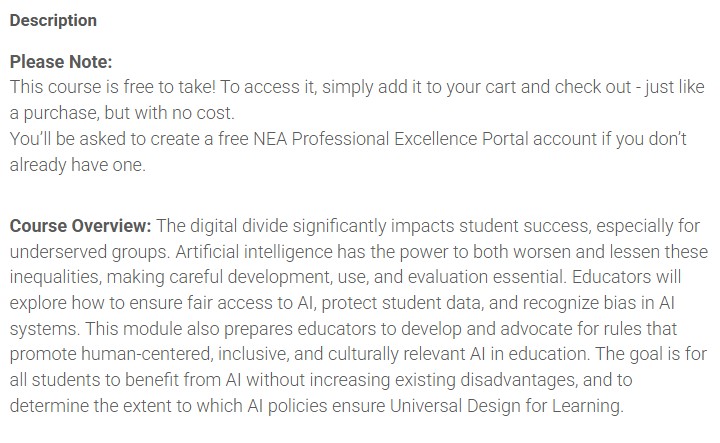
- Promoting AI Equity and Access
- Educators will explore how to ensure fair access to AI, protect student data, and recognize bias in AI systems. This module also prepares educators to develop and advocate for rules that promote human-centered, inclusive, and culturally relevant AI in education.
The NEA also has a sample school board policy that districts throughout the country can adopt and use that would mandate for DEI to be integrated into AI programs before schools can use them. This sample policy claims to establish “guidelines for the ethical, equitable, and effective integration of artificial intelligence technologies in district schools to enhance both administrative functions and teaching and learning for all students and educators.”
One section of this policy is titled “Algorithmic Bias and Fairness.” The policy states in this section: “AI tools and systems utilized in the District shall undergo regular audits to identify and mitigate biases. Oversight committees, inclusive of educators, shall be established to review AI implementation efforts for unintended biases and to ensure alignment with district equity goals.”
The policy further explains that algorithmic bias is the “systemic, unwanted unfairness in how a computer detects patterns or automates decisions” that is “often based on characteristics and identities such as age, class, culture, disability status, ethnicity, gender, location, nationality, political affiliation, race, religious background and practices, and/or sexuality.”
The goal of this language is to promote the idea that AI should not provide students and teachers with the most accurate answer, but rather provide the most politically correct answer that is imbued with the DEI ideology pushed by groups like the NEA.
In a section titled “Vendor and Tool Selection,” the policy explicitly states that equity will play a role in choosing a vendor for AI tools: “The District shall require all vendors of AI tools and resources to meet district standards for transparency, equity, and ethical decision-making. AI tools and resources shall only be adopted once there is data supporting a tool’s appropriateness and efficacy with potential users and, for instruction-focused AI, its alignment with high-quality teaching and learning standards and practices.”
The NEA has a “Task Force on Artificial Intelligence in Education” that produced a report in 2024 that emphasized the importance of equity in AI tools for schools. In this report, the task force explains that it held a meeting focused on “ethics, equity, bias, and intellectual property” at one point. The task force also proposed a policy statement for the NEA to adopt that explicitly states “AI-informed analyses and data alone should never be used for high-stakes or determinative decisions” because the decision must be determined by people “who must consider equity, diversity, access, human rights, and other appropriate contextual considerations.”
The NEA’s task force also placed an emphasis on “racial injustice and social inequities” when discussing how AI should be handled in schools: “It is critical that systems, processes, and structures are created to ensure intentional and ongoing attention is paid to the extent to which biases built into AI technology and uses of AI-generated data further perpetuate racial injustice and social inequities in education.”
American Federation of Teachers
The American Federation of Teachers (AFT) is a nationwide teachers’ union that claims to have 1.8 million members. In 2024, the AFT created guidance called “Commonsense Guardrails for Using Advanced Technology in Schools” with the purpose to “protect students and educators from problematic aspects of the new technology while embracing its potential benefits.” The union’s guidance explicitly provides the following “guardrail” for AI in schools: “Technologies must be deployed so that they advance equity and fairness in public education and cannot be adopted so that they widen, rather than help close, the digital divide and other inequities in our schools.”
AFT’s guidance then provides the following instruction that AI in schools should contribute to “healthy democracy”:
Schools must advance democracy. Technologies can be used to build young people’s capacity for vigorous civic engagement. But technologies can also be used to promote misinformation, disinformation and radicalization. Schools must be incubators for healthy democracy and must instill in students the skills to use technologies accordingly.
AFT notably names “algorithmic bias” as an issue in this guidance. A goal is to “build media literacy and ethical judgment” among students. This includes: “Educators should teach students to understand their own responsibility when sharing information, recognizing the potential impact of spreading inaccurate content. Educators can encourage constructive dialogues about media ownership, algorithmic biases, and the responsibilities of platforms and journalists.”
AFT also believes that teachers should evaluate tools such as AI for equity as part of collective bargaining: “Educators must also be part of continuous assessment and review of any technology used in their schools. By regularly evaluating tools for effectiveness, equity and alignment with learning objectives, teachers can advocate for necessary adjustments or even the removal of underperforming technologies.”
In the announcement of these “guardrails,” the AFT explained that through its “Innovation Fund” that it is “investing over $200,000 in 11 school districts across the country to fund solutions to incorporating, understanding and regulating AI, drawing inspiration from members on the ground.”
In a 2025 resolution on the “Formation of a National Academy for AI Instruction,” AFT prioritized perceived “bias” and “equity” issues: “AI has the potential to help personalize instruction, reduce administrative burden and make learning more engaging, but without proper guardrails it can perpetuate bias, invade privacy, and undermine educational equity, job security and the professional judgment of educators.”
As part of this resolution, the AFT states that “there is an urgent need to create a national institute that trains, empowers and supports educators in using AI as a tool for improving student outcomes; reducing unnecessary bureaucratic tasks; strengthening the teaching profession; and guarding against threats such as surveillance, bias and disinformation.”
As a result, the teachers’ union endorsed “the formation of the National Academy for AI Instruction as an AFT-led initiative” and will include the “Commonsense Guardrails for Using Advanced Technology in Schools” guidance in “affiliate contracts, local and state legislation, and any other policy avenues necessary to protect student privacy, ensure educator voice, and promote ethical, responsible use of AI and advanced technologies in schools.”
AFT created the National Academy for AI Instruction with the intent to “provide training and support” to educators in AI issues. This program is imbued with the idea from AFT’s resolution that “bias” and “equity” are issues within AI in schools. AFT mentions on the academy’s homepage that Microsoft, OpenAI, and Anthropic are partners to the program. These are three of the largest corporations building AI that are used on a global scale and are the AI programs already used by many school districts.


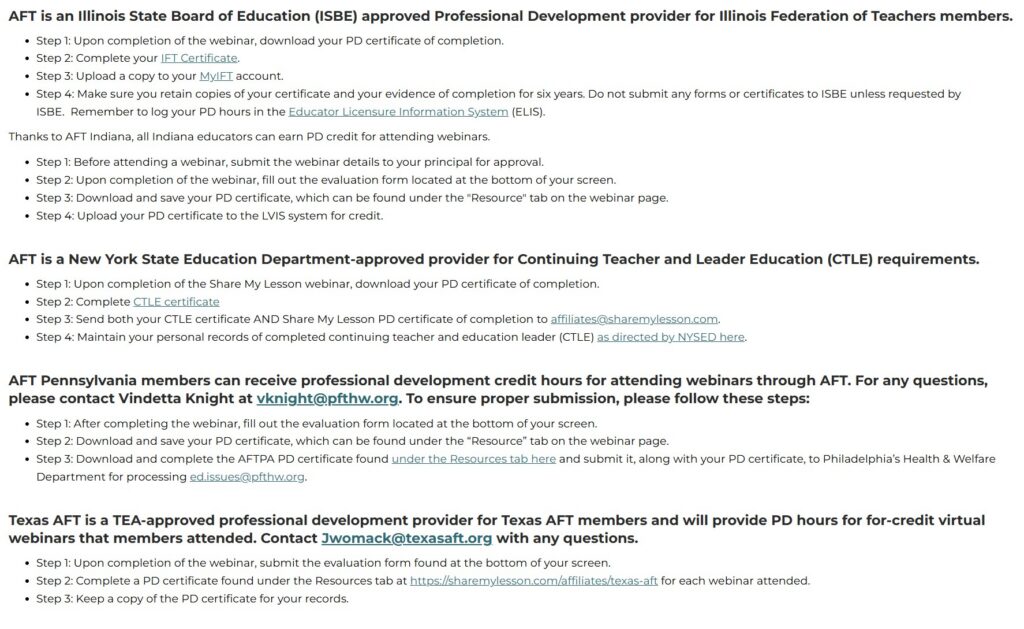
AFT claims that it is an approved provider for professional development and training on AI in several states:
- AFT is an Illinois State Board of Education (ISBE) approved Professional Development provider for Illinois Federation of Teachers members.
- Thanks to AFT Indiana, all Indiana educators can earn PD credit for attending webinars.
- AFT is a New York State Education Department-approved provider for Continuing Teacher and Leader Education (CTLE) requirements.
- AFT Pennsylvania members can receive professional development credit hours for attending webinars through AFT.
- Texas AFT is a TEA-approved professional development provider for Texas AFT members and will provide PD hours for for-credit virtual webinars that members attended.
When announcing the National Academy for AI Instruction in 2025, AFT stated:
The AFT, alongside the United Federation of Teachers and lead partner Microsoft Corp., founding partner OpenAI, and Anthropic, announced the launch of the National Academy for AI Instruction today. The groundbreaking $23 million education initiative will provide access to free AI training and curriculum for all 1.8 million members of the AFT, starting with K-12 educators.
California Teachers Association
The California Teachers Association (CTA) is a statewide teachers’ union that claims to have 310,000 members. The CTA is a part of the California Department of Education’s “Public Schools: AI Working Group” and has a representative in this group. This working group was “established under Senate Bill (SB) 1288 (2024)” and “brings together educators, students, experts, and educational partners to develop guidance and model policy for the safe, equitable, and effective use of AI in schools.” Members of this group “meet publicly to develop statewide guidance and a model policy, addressing topics such as data privacy, academic integrity, professional development, equitable access, and effective classroom integration.”
This working group helped the California Department of Education (CDE) develop AI guidance for K-12 schools. This AI guidance explicitly names “equity” and “bias” in the introduction: “As these technologies advance, TK–12 educators will continue to play an essential role in fostering students’ creativity, critical thinking, authentic voice, and healthy human connection, while also addressing equity, bias, and access concerns that directly affect young learners.”
The guidance has an entire section named “Equitable Access to AI in Teaching and Learning.” The CDE recommends for “educators to approach AI with an equity lens” and should “explore potential inaccuracies, bias, and social impacts of AI.” The guidance also mentions “systematic bias”:
Opportunities for students to engage deeply with AI in K–12 schools can serve as a powerful means to address systemic bias and expand access for traditionally marginalized groups in computer science and science, technology, engineering, and mathematics (STEM) fields. Integrating AI education with a focus on diversity and inclusion helps pave the way for a more equitable future in these disciplines.
The CTA has a magazine called California Educator. In October 2023, the magazine published an article titled “Why AI Doesn’t Worry Me…in the classroom, and why it does” from a guest author. This author explained that he was concerned because “AI will not be equitable, nor will it affirm anyone’s identity, culture or empower anyone.” He stated that a modern teacher’s job is to consider equity and identity:
For AI to do a modern teacher’s job, it would have to complete all of the impossible tasks that a real human does just by being human. But there is more required, because a teacher must also consider equity, culture and identity in their classroom.
New York State United Teachers
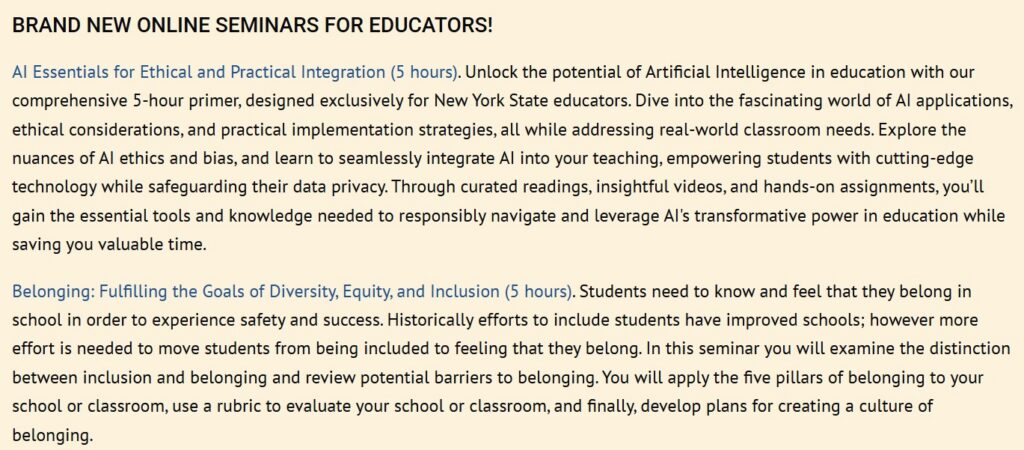
The New York State United Teachers (NYSUT) is a statewide teachers’ union that claims to have nearly 700,000 members. The NYSUT provides online seminars for teachers on several subjects. One seminar is titled “AI Essentials for Ethical and Practical Integration.” Teachers are specifically trained in “AI ethics and bias.” The NYSUT provides the following description for this seminar:
Explore the nuances of AI ethics and bias, and learn to seamlessly integrate AI into your teaching, empowering students with cutting-edge technology while safeguarding their data privacy. Through curated readings, insightful videos, and hands-on assignments, you’ll gain the essential tools and knowledge needed to responsibly navigate and leverage AI’s transformative power in education while saving you valuable time.
Another seminar listed for educators right below this one is titled “Belonging: Fulfilling the Goals of Diversity, Equity, and Inclusion.”
In February 2026, the NYSUT called for state lawmakers to invest $15 million “to advance media and AI literacy, including funding for certified library media specialists in every school, creation of a statewide Media & AI Literacy Task Force, support for pilot programs and professional learning, and the inclusion of Media and AI Literacy as a required instructional topic by NYSED.” The union then clarified that this focus was on perceived “misinformation” and “algorithmic influence”: “In an era of misinformation, algorithmic influence, and rapid technological change, media literacy is inseparable from civic readiness.”

United Federation of Teachers
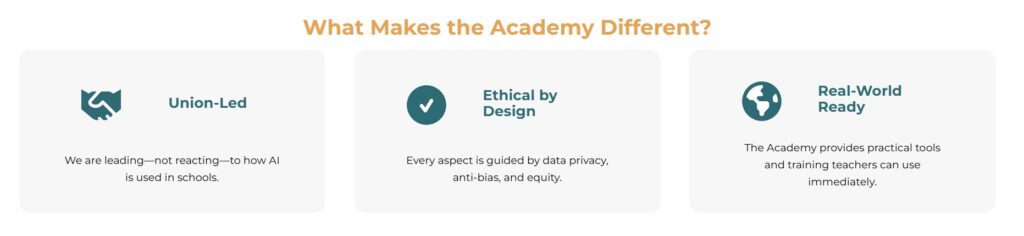
The United Federation of Teachers (UFT) is a teachers’ union for New York City Public Schools that claims to have nearly 200,000 members. The UFT is a founding partner of the National Academy for AI Instruction with the American Federation of Teachers (AFT). The website for this academy explicitly states that “every aspect is guided by data privacy, anti-bias, and equity.” This academy is based on guidance created by the AFT called “Commonsense Guardrails for Using Advanced Technology in Schools” that is intended to “advance equity and fairness in public education.”
Associations
American Association of School Administrators
The American Association of School Administrators (AASA) is an organization that represents school leadership throughout the country. The AASA has used its platform in recent years to promote the idea of “algorithmic bias” existing in AI and that AI tools will be great for implementing equity initiatives in the future, especially with articles from guest authors.
In one article authored by former AASA president Gladys Cruz from January 2026, the AASA promoted these exact ideas. Cruz stated: “For superintendents, the essential question facing our school districts is no longer if AI belongs in schools, but how to integrate it responsibly and effectively to prepare students for a future being fundamentally reshaped by this technology.” She encouraged school districts to adopt policies to enact guardrails, including for perceived “bias awareness.” She stated that this is for “acknowledging the risk of algorithmic bias perpetuating existing inequities and calling for mitigation strategies.”
In another AASA article dated March 2026, a superintendent from Pennsylvania discussed her idea of “responsible, equitable AI integration” in schools. At one point, she praised how schools are operated in China: “In an earlier blog, I wrote about what becomes visible when we look beyond our borders. In Shanghai, the educational system operates with intentional vertical alignment, creating a through line from policy to professional learning to classroom practice. In Uruguay’s Ceibal initiative, AI is designed to centralize access and ensure new tools serve all students, not only those with privilege.”
She discussed that school districts have a “moral responsibility” to regulate AI in schools with a priority on equity. She explained:
My call to fellow superintendents across the country is this: Do not allow artificial intelligence to become another isolated initiative layered onto already complex systems. AI must be integrated as part of a coherent, systemwide strategy aligned to teaching, learning, talent development, and equity.
In an AASA article from 2024, the chief information officer of Denver Public Schools wrote that educators should be concerned of how “AI addresses equity and bias.” He claimed that “biased algorithms” are a significant concern for AI. He then mentioned that “white males” were a problem:
The creation of the internet with its algorithms and codes was heavily influenced by white males. Those biases have profoundly affected the development of both the internet and AI through the present day. The absence of a racially diverse depiction in AI responses is evident.
He followed this by quoting a Princeton University professor in calling these designs the “New Jim Code.” He also said that AI can create responses that “promote sexualization or worsen racial bias” and that district staff need to ensure this does not happen.
National Association of Elementary School Principals
The National Association of Elementary School Principals (NAESP) is an organization that represents elementary school principals and leaders. The organization has used its platform in recent years to promote the idea of “algorithmic bias” existing in AI and that AI tools will be great for implementing equity initiatives in the future, especially with articles from guest authors.
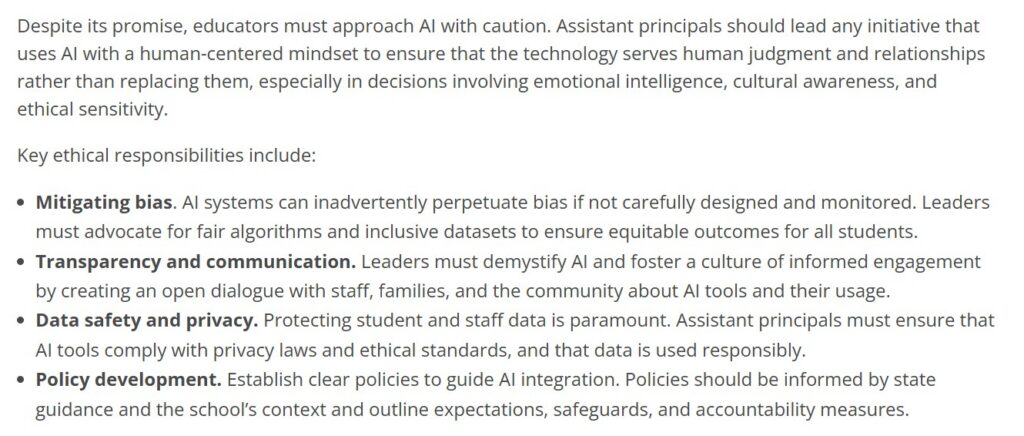
In an article authored by a South Carolina assistant principal from January 2026, the NAESP promoted that “equity” and “excellence” are “complementary pillars of quality education that AI can reinforce when implemented ethically and strategically.” This assistant principal then claimed that AI in schools should consider “cultural awareness” and “ethical sensitivity”:
Despite its promise, educators must approach AI with caution. Assistant principals should lead any initiative that uses AI with a human-centered mindset to ensure that the technology serves human judgment and relationships rather than replacing them, especially in decisions involving emotional intelligence, cultural awareness, and ethical sensitivity.
She then directly advocated for DEI initiatives to be integrated into AI: “AI systems can inadvertently perpetuate bias if not carefully designed and monitored. Leaders must advocate for fair algorithms and inclusive datasets to ensure equitable outcomes for all students.”

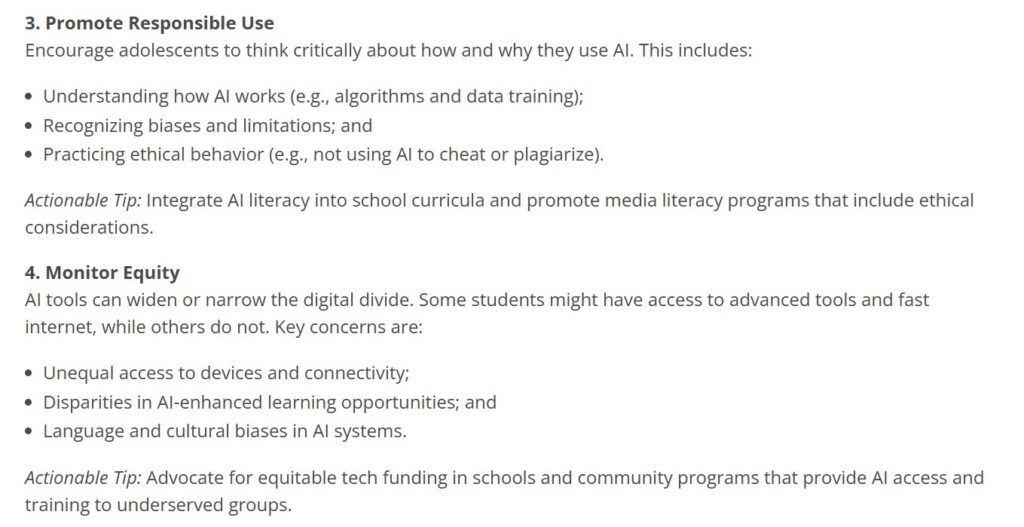
In another article dated October 2025, the NAESP provided a list of action items for educators regarding AI moving forward. In one action item labeled as “Promote Responsible Use,” the organization explained that teachers should start “recognizing biases in limitations.” In another action item labeled “Monitor Equity,” teachers are told to be concerned about “language and cultural biases in AI systems.”
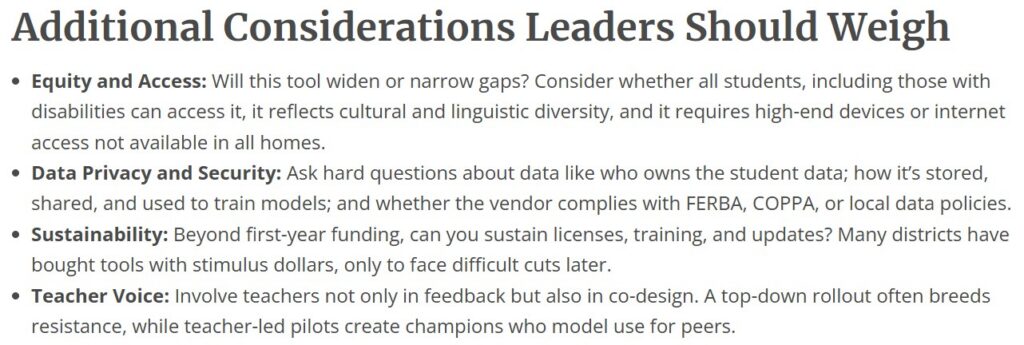
In December 2025, the NAESP published an article stating that schools should consider “equity and access” when adopting AI tools. This included if an AI tool “reflects cultural and linguistic diversity.”
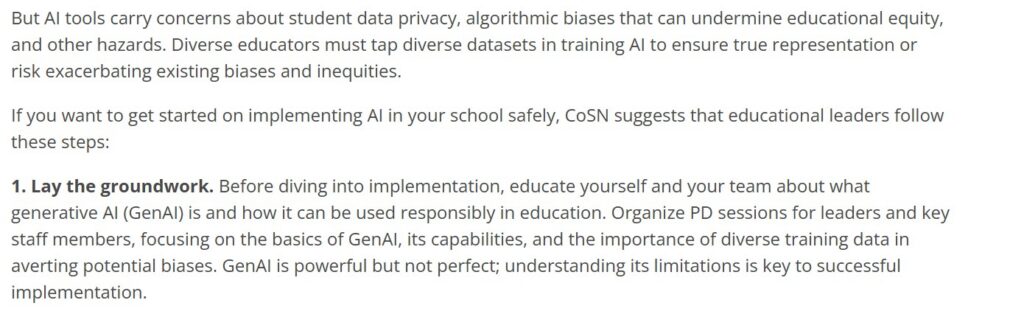
In an article from January 2025, NAESP’s editorial director expressed concern with “algorithmic biases that can undermine educational equity.” She stated: “Diverse educators must tap diverse datasets in training AI to ensure true representation or risk exacerbating existing biases and inequities.” She advocated to “lay the groundwork” with professional development on the “importance of diverse training data in averting potential biases.”
She then advocated to “evaluate and implement” and stated that this involved: “Create a checklist of must-have features and deal-breakers. Ask vendors about their efforts to address algorithmic biases that might affect students.” The editorial director also said: “AI implementation is one part of a broader effort to address bias and foster inclusion in school communities; consider how it aligns with other equity initiatives in your district.”

National Association of Secondary School Principals
The National Association of Secondary School Principals (NASSP) is an organization that represents secondary school principals and leaders. The NASSP has used its platform in recent years to promote the idea of “bias” existing in AI and that AI tools will be great for implementing equity initiatives in the future.
In a webpage discussing the organization’s official position on “Artificial Intelligence (AI) Usage,” the NASSP does cover important topics such as deepfake AI images of minor students. However, the issue arises when one of the NASSP’s recommendations for school leaders specifically claims that AI should “not undermine equity” and that “biases” should be taken into consideration: “Ensure that such tools advance and do not undermine equity given that AI systems are trained on human data that may reflect biases, particularly against students of color and those with disabilities.”
The NASSP is promoting its next National Principals Conference taking place in February 2027. In a webpage discussing the “five strands focused on the most important areas of school leadership today,” the NASSP provides the five core topics for the 2027 conference. One category is titled “Belonging, Well-Being, and Whole-Child Success.” This topic includes “social-emotional learning (SEL),” “equity, inclusion, and identity-affirming practices,” and “trauma-informed and restorative approaches.” By making this a core topic, the NASSP appears to show that equity will be embedded in all initiatives going forward.
Another category for the conference is titled “Innovation, Technology, and AI.” The NASSP explained that AI should be used to protect equity: “This strand focuses on how principals and assistant principals can strategically integrate technology and AI to enhance learning, streamline operations, and protect equity, ethics, and human connection.” A focus area for this topic is specifically called “digital equity and access.”
Stay Informed