



Internal Montgomery County Public Schools curriculum guidance calls for an “intentional shifting of content” to examine “resistance to and liberation from white supremacy”
Incidents
- Issues
- Indoctrination
Photos of internal documents on a Montgomery County Public Schools (MCPS) computer show curriculum promoting anti-racist and anti-bias ideological content for students. The photos were provided to Defending Education by the parent group United Against Racism in Education (UARE), and the curriculum was reportedly discussed at an MCPS PTA meeting on January 20th, 2026.
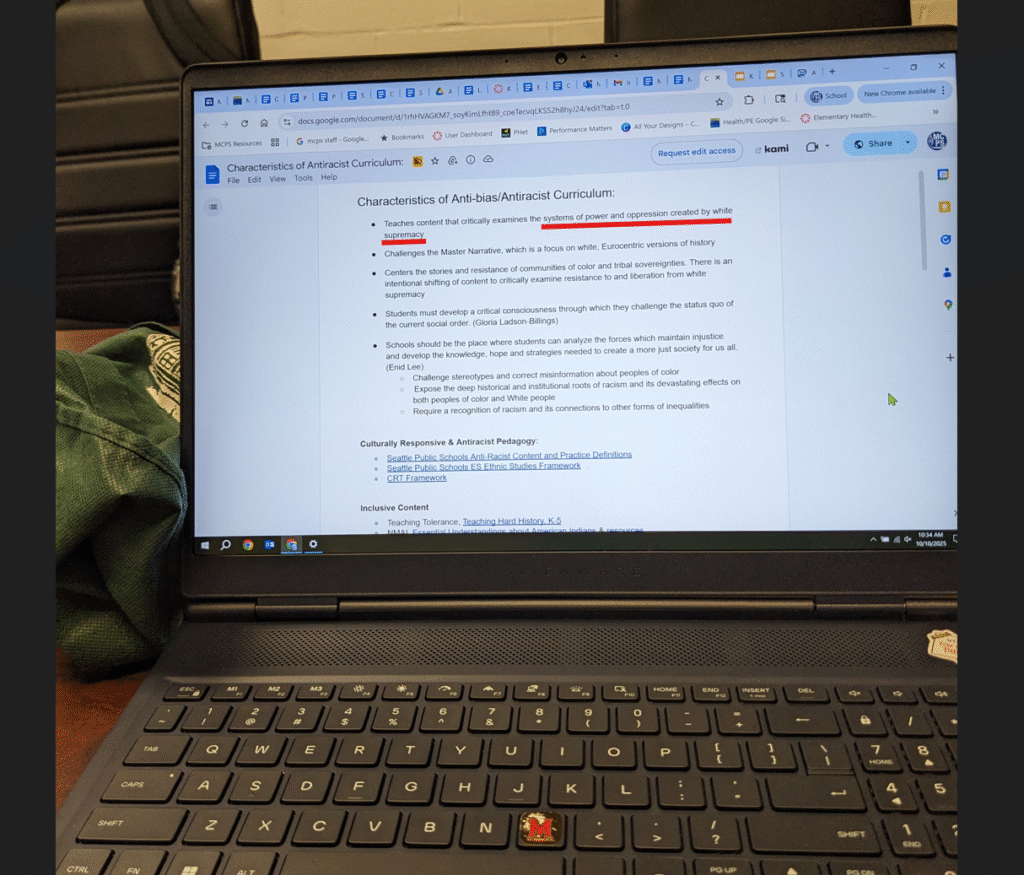
In a document that discusses the “Characteristics of Anti-bias/Antiracist Curriculum,” MCPS states that the purpose is to examine “systems of power and oppression created by white supremacy” and challenges the “Master Narrative, which is a focus on white, Eurocentric versions of history.”
It also “Centers the stories and resistance of communities of color and tribal sovereignties” and explains, “There is an intentional shifting of content to critically examine resistance to and liberation from white supremacy.”
The document also references the work of antiracist education scholar Gloria Ladson-Billings and educator and consultant Enid Lee, both known for K–12 anti-racist and multicultural education frameworks and training resources.
Schools should “be the place” to “Expose the deep historical and institutional roots of racism and its devastating effects on both peoples of color and White people,” the guidance document reads.
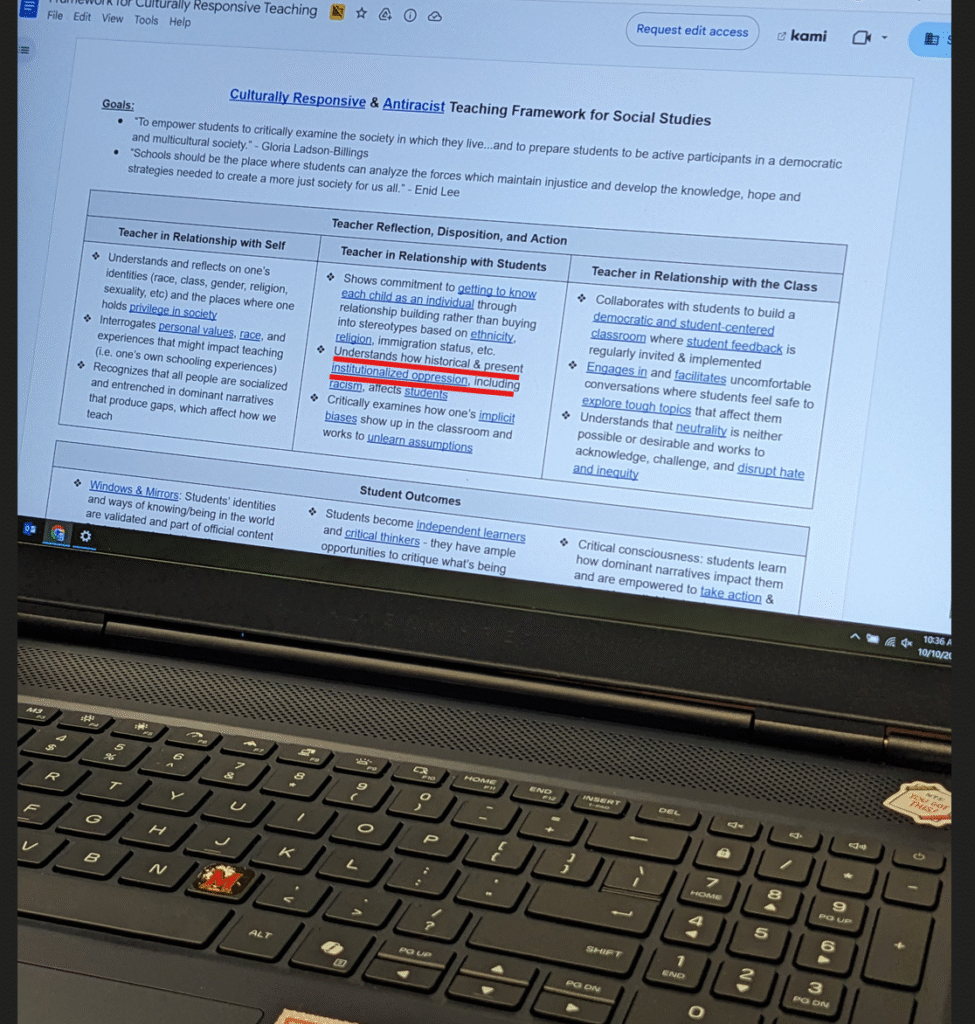
Another document on the “Culturally Responsive & Antiracist Teaching Framework for Social Studies” given to teachers cites two goals of the curriculum:
- “To empower students to critically examine the society in which they live … and to prepare students to be active participants in a democratic and multicultural society.” – Gloria Ladson-Billings
- “Schools should be the place where students can analyze the forces which maintain injustice and develop the knowledge, hope and strategies needed to create a more just society for all.” – Enid Lee
Teachers are instructed to:
- Understand and reflect on their own identities, including race, class, gender, religion ,and sexuality and the places “where one holds privilege in society.”
- Interrogate personal values, race, and experiences that might impact their teaching.
- Recognize that all people are socialized and entrenched in dominant narratives that produce gaps in teaching.
In their relationship with students, teachers should:
- Show commitment to getting to know students “rather than buying into stereotypes based on ethnicity, religion, immigration status, etc.”
- Understand how historical and present institutionalized oppression, including racism, affects students.
- Examine how implicit biases show up in the classroom and work to “unlearn assumptions.”
In their relationship with the class, teachers should:
- Collaborate with students to “build a democratic and student-centered classroom where student feedback is regularly invited and implemented.”
- Engage in and facilitate “uncomfortable conversations where students feel safe to explore tough topics.”
- Understand that “neutrality is neither possible or desirable and works to acknowledge, challenge, and disrupt hate and inequity.”
Internal resources suggested in the “Characteristics of Antiracist Curriculum” document include a link to “CRT [Critical Race Theory] Framework,” as well as “Teaching Tolerance, Teaching Hard History” for kindergarten through fifth grade. Other teacher resources include the “Guide for Selecting Anti-bias Children’s Books” and the “Social Justice Book Lists.”

“Critical Planning/Lesson Analysis Questions” ask teachers:
- “What systems of power are shown?”
- “What examples are provided of people taking action or pushing back on systems of oppression or abuses of power? Who is centered in examples of resistance? Are the people taking action coming from WITHIN the oppressed groups or from OUTSIDE of the oppressed groups?”
- “How does this unit connect to the lives of students? What makes this unit relevant to students and to today’s world? How are students invited to be truth tellers & change agents?”

Stay Informed