


Brooklyn College’s ‘Multicultural Counseling and Consultation’ course focuses on white privilege, ‘white racial identity’ development, and whiteness; assignments include questions specific to students’ racial identity.
Investigations
SUMMARY
Brooklyn College, part of the City University of New York (CUNY) system, features a course titled SPCL 7922 Multicultural Counseling and Consultation which includes content such as colorblindness and its contribution to systemic racism, implicit bias, intersectionality, microaggressions, white privilege, white racial identity development, and whiteness. Several course assignments also require students to answer questions specific to their racial identity.
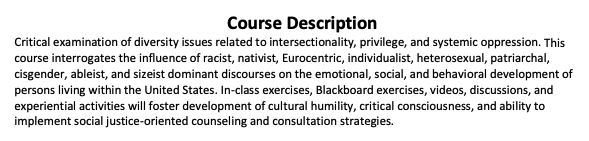
The description for the course states that it is a “critical examination of diversity issues related to intersectionality, privilege, and systemic oppression” and “interrogates the influence of racist, nativist, Eurocentric, individualist, heterosexual, patriarchal, cisgender, ableist, and sizeist dominant discourses on the emotional, social, and behavioral development of persons living within the United States.”
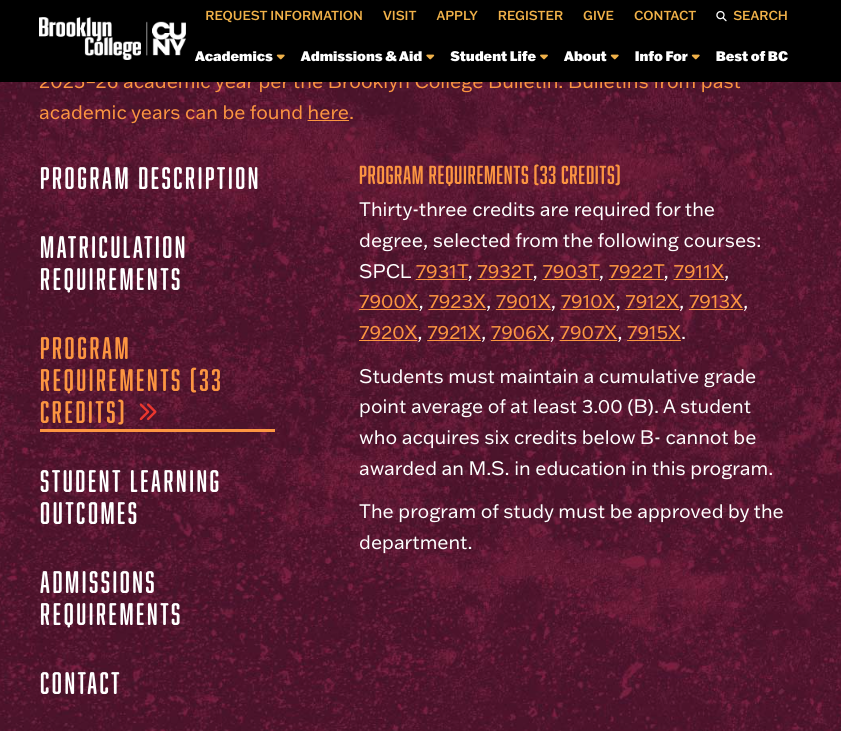
The course is required for completing the School Psychologist, M.S.ED. degree program.
KEY TAKEAWAYS
- The three credit course is required for completion of a Master’s degree in School Psychology.
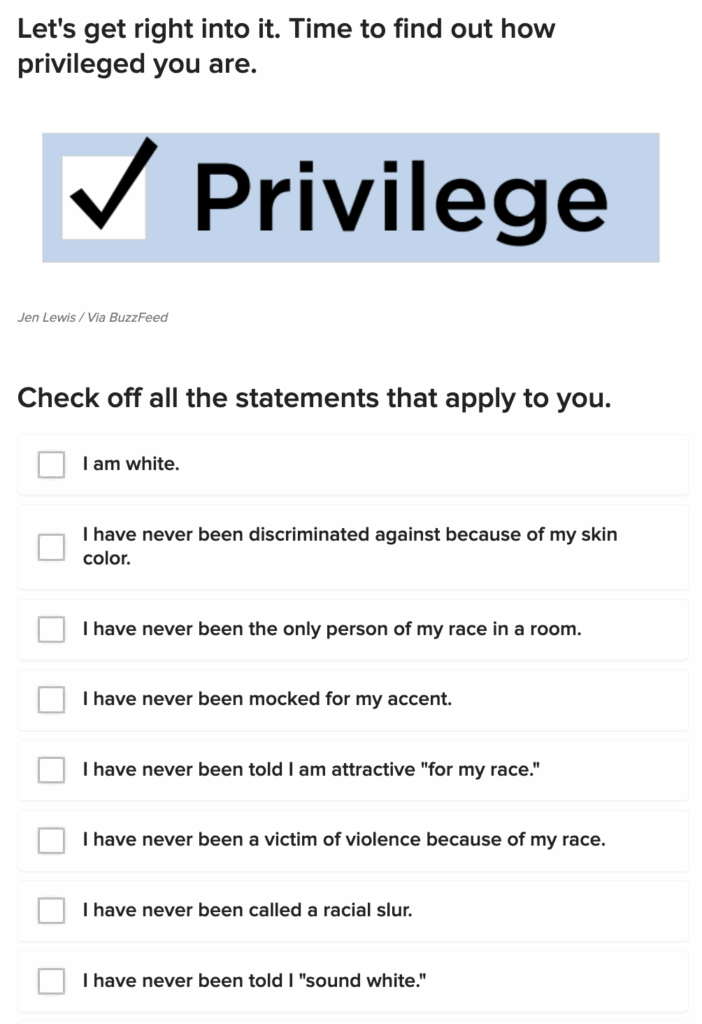
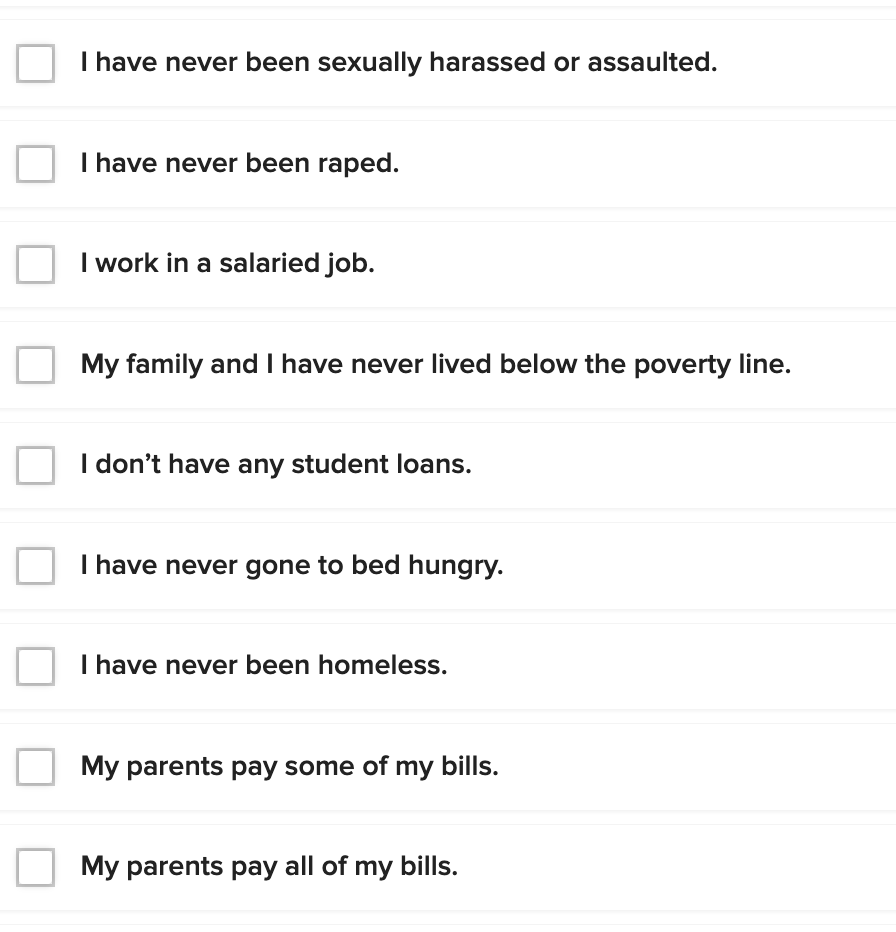
- Module 3: Privilege, Oppression, & Social Justice includes a focus on white privilege and microaggressions and requires students to complete several self-assessment activities such as one from Buzzfeed that claims that being white, male, heterosexual, or having never been raped as proof of being “privileged.”
- Module 4: Race & Racial Identity Development includes a focus on “White Racial Identity Model” and requires students to respond to journal questions and statements based on their race.
- Module 5: Racism, Racial Microaggressions, & White Privilege explores “racism and white privilege” and discusses the “impact of color blindness on systemic racism and explore the process that marginalized individuals go through when they experience microaggressions.” The session reflection asks students to respond to questions and prompts based on their racial background.
- Other modules include content such as ageism, ableism and sizeism, “Cisgender Privilege,” classism, sexism, and “Weaponizing Whiteness.”
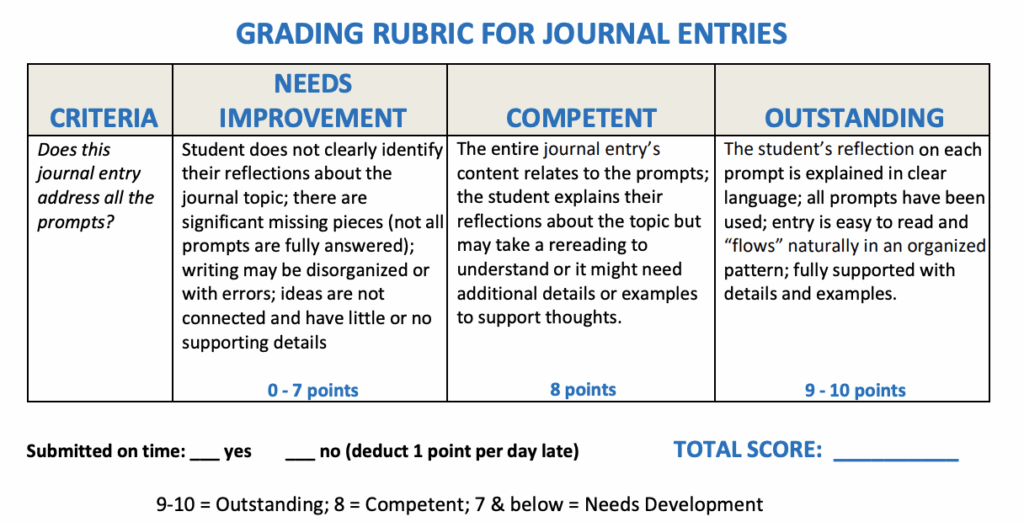
- Students are required to complete module specific journal entries collectively worth 10% of the overall course grade. Entry prompts include “Exploring Privilege, Microaggressions, & My Social Interaction Patterns,” “Exploring Whiteness & Racism,” “Anti-Black and Anti-Asian Racism,” “Exploring Spirituality and Privilege, Islamophobia, & Anti-Semitism,” and “Exploring My Sexual Identity & Heterosexism.”
COURSE CONTENT
Module 3: Privilege, Oppression, & Social Justice
Module 3: Privilege, Oppression, & Social Justice states that “students will continue to reflect on their own intersecting identities to explore the concepts of white privilege and oppressions” and to “explore the way in which microaggressions are tied to implicit bias.”
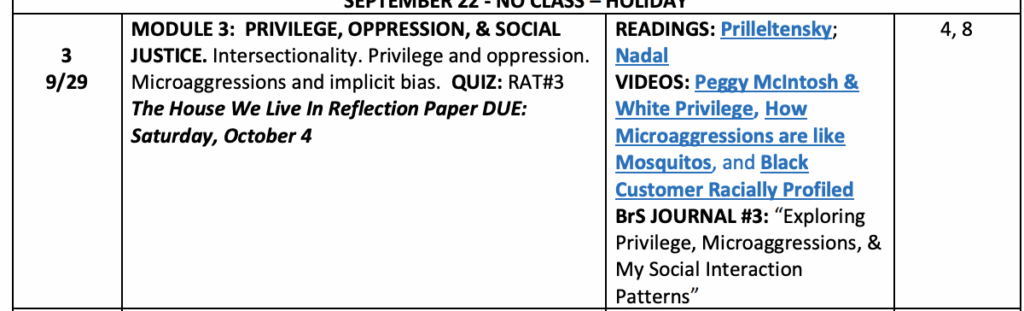
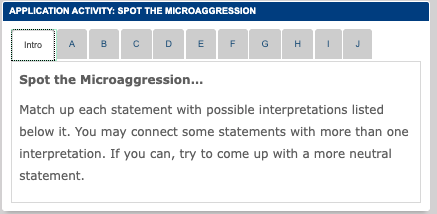
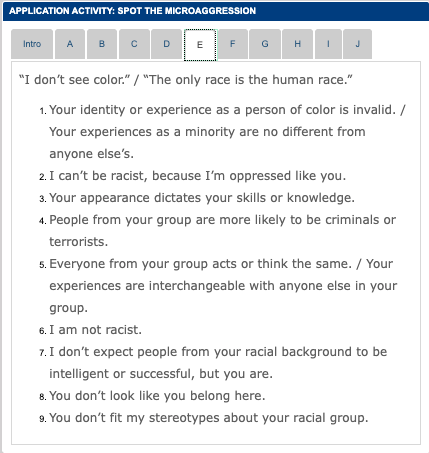
Included in the module is an activity where students “spot the microaggression” through a series of prompts with a list of “interpretations.” Prompts include “‘I don’t see color.’/ ‘The only race is the human race.'” and “[A White woman to a Black woman] ‘As a woman, I understand what you experience as a minority.'”
The session includes an activity titled “How Privileged Are You?” which links to a Buzzfeed site and self-test. Statements in the “privilege” test include “I am white,” “I am heterosexual,” and “I have never been raped.”
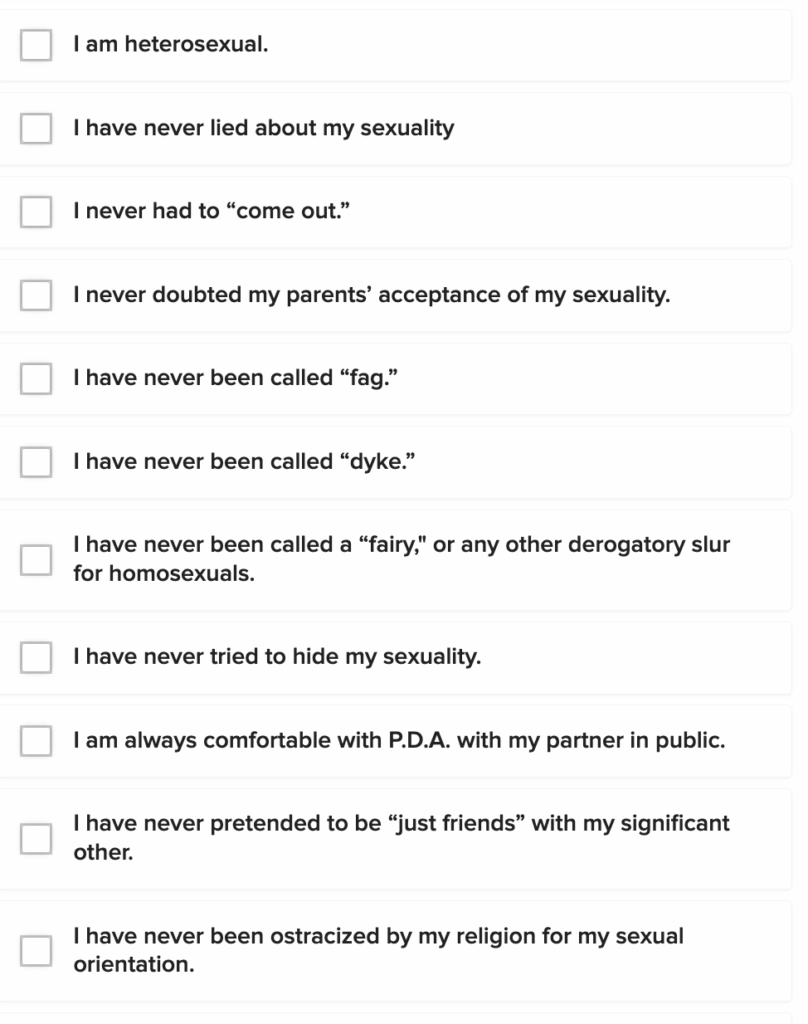
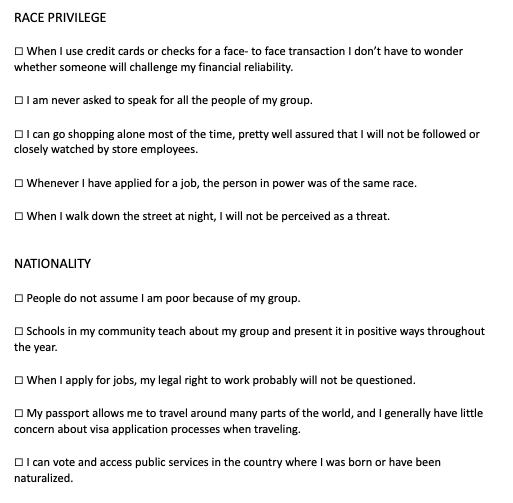
The module also includes reading Peggy McIntosh’s White Privilege: Unpacking the Invisible Knapsack and completing “A Look at Privilege Application Activity” which requires students to check all the boxes next to the “types of privileges” that apply to them.
The unit also includes the completion of a journal entry titled “Exploring Privilege, Microaggressions, & My Social Interaction Patterns.”
Module 4: Race & Racial Identity Development
Module 4: Race & Racial Identity Development focuses on “Race,” “Racial identity development,” “developing a nonracist and antiracist racial identity” and “understanding color blindness.” The module also includes a “supplemental video” titled “Myths about white people” that includes Robin DiAngelo.

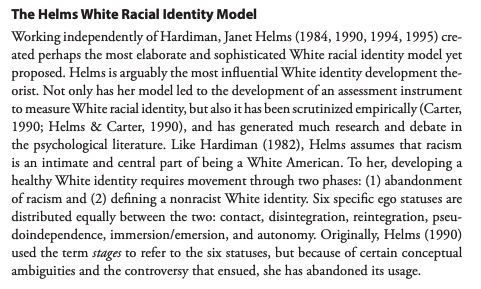
The module features on the two phases of Helms’ “White Racial Identity Model.”
From Multicultural Social Work Practice:
“Helms assumes that racism is an intimate and central part of being a White American. To her, developing a healthy White identity requires movement through two phases: (1) abandonment of racism and (2) defining a nonracist White identity. Six specific ego statuses are distributed equally between the two: contact, disintegration, reintegration, pseudoindependence, immersion/emersion, and autonomy.”
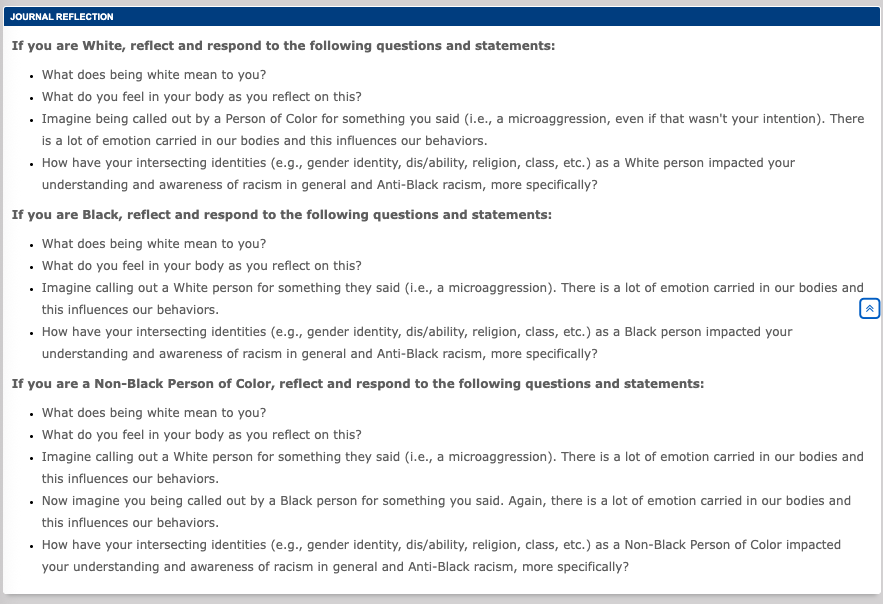
A journal reflection for the module has students answering questions based on their race. Students are required to answer questions such as “What does being white mean to you?” and a variation of the following statement depending on race: “Imagine being called out by a Person of Color for something you said (i.e., a microaggression, even if that wasn’t your intention). There is a lot of emotion carried in our bodies and this influences our behaviors.”
Module 5: Racism, Racial Microaggressions, & White Privilege
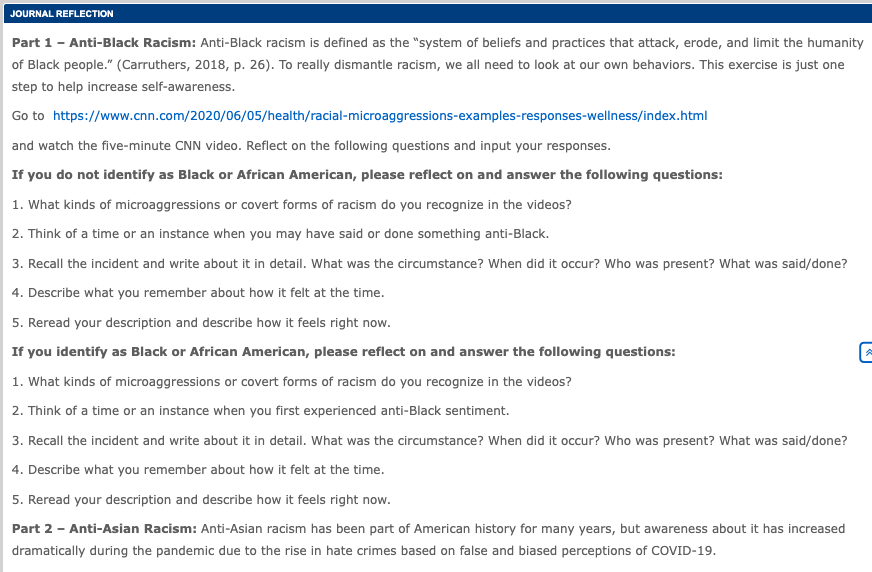
The session titled Racism, Racial Microaggressions, & White Privilege states that students will “explore racism and white privilege” and “discuss the impact of color blindness on systemic racism and explore the process that marginalized individuals go through when they experience microaggressions.”

The module’s “journal reflection” requires students to respond to prompts on “Anti-Black” and “Anti-Asian” racism according to whether the student is “Black or African American,” “Asian or Asian American” or not.
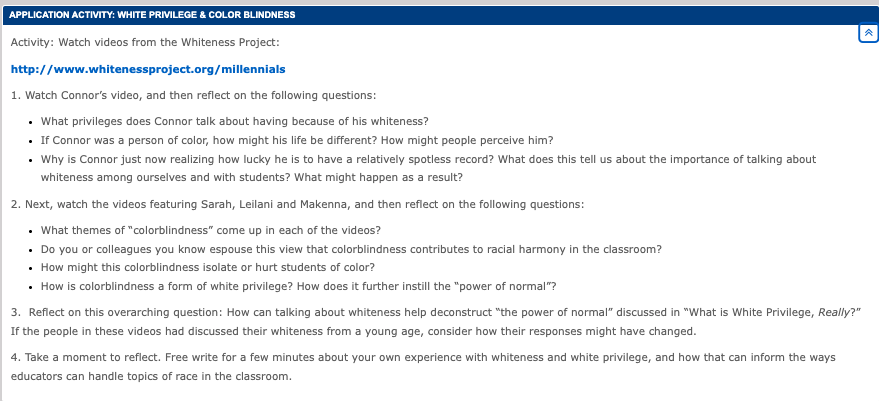
The session also includes an activity on “White Privilege & Color Blindness” and includes the question “How can talking about whiteness help deconstruct “the power of normal” discussed in ‘What is White Privilege, Really?’ If the people in these videos had discussed their whiteness from a young age, consider how their responses might have changed.”
OTHER COURSE ASSIGNMENTS
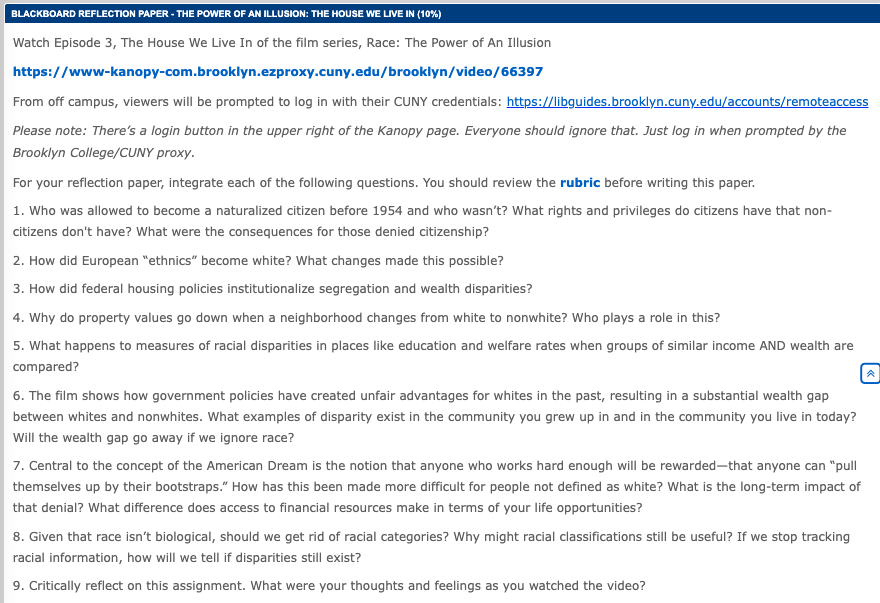
A course assignment worth 10% of the overall grade requires students to integrate into the reflection paper their responses to questions such as “Central to the concept of the American Dream is the notion that anyone who works hard enough will be rewarded—that anyone can ‘pull themselves up by their bootstraps.’ How has this been made more difficult for people not defined as white? What is the long-term impact of that denial? What difference does access to financial resources make in terms of your life opportunities?”
Stay Informed