



Metropolitan State University of Denver’s Writing Center promotes the idea of ‘Linguistic White Supremacy’; claims Standard American English ‘privileges white communities and maintains social and racial hierarchies’
Investigations
SUMMARY
Metropolitan State University of Denver’s (CO) Writing Center promotes the idea of “Linguistic White Supremacy” and claims that Standard American English “privileges white communities and maintains social and racial hierarchies.” The site also suggests that university faculty use “Grading with Equity” practices by offering students “alternative types of ‘writing'” such as “Verbal Ethnographies” and “Service Learning.” The Center also encourages the use of “Restorative Justice Approaches” when students plagiarize.
According to the Center’s webpage for faculty titled Linguistic White Supremacy, “racism and white supremacy exist within every facet of our society, including writing, grading, teaching, and University life.” The site also states that “scholars and activists alike have made it clear that in order to be an anti-racist, an individual must not just be against racism and white supremacy, but must be actively anti-racist, or actively fighting racism and white supremacy.”
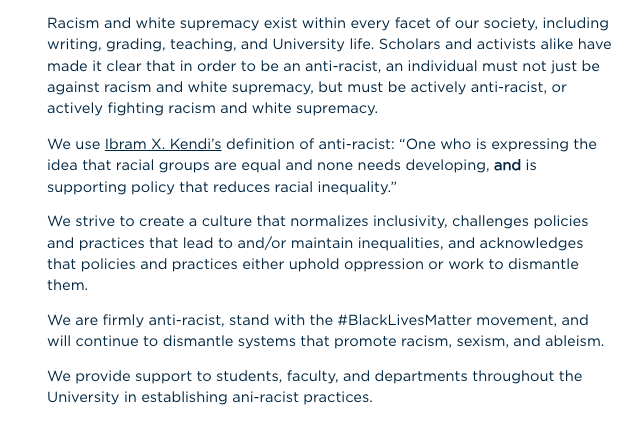
ANTI-RACIST PRACTICES FOR YOUR CLASSROOM
The page includes a section titled “Anti-Racist Practices for your Classroom” which features topics such as to “Reject Standard American English,” “Embrace Code-Meshing in Your Classroom,” “Creating Inclusive, Reflective Writing Prompts,” “Grading with Equity,” and “Restorative Justice Approaches to Plagiarism.”
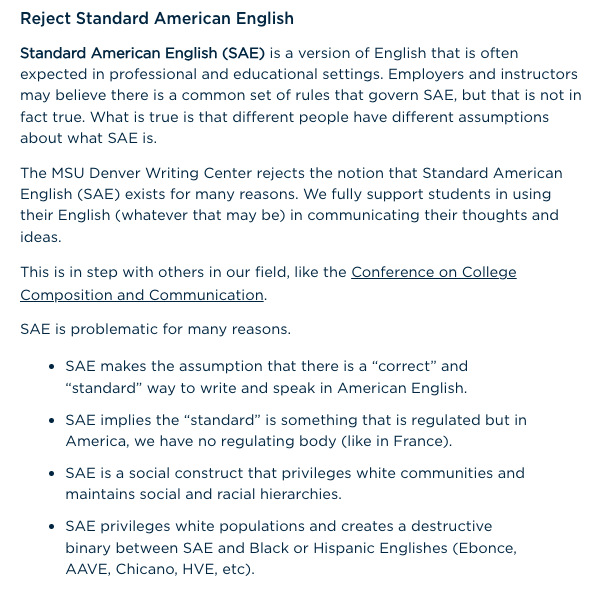
Reject Standard American English
The Center states that while Standard American English (SAE) is “often expected in professional and educational settings,” the Center “rejects the notion that Standard American English (SAE) exists for many reasons.” The site claims “SAE is problematic for many reasons” including that there is a “‘correct’ and ‘standard’ way to write and speak in American English,” that “SAE is a social contract that privileges white communities and maintains social and racial hierarchies,” and “SAE privileges white populations and creates a destructive binary between SAE and Black or Hispanic Englishes.”
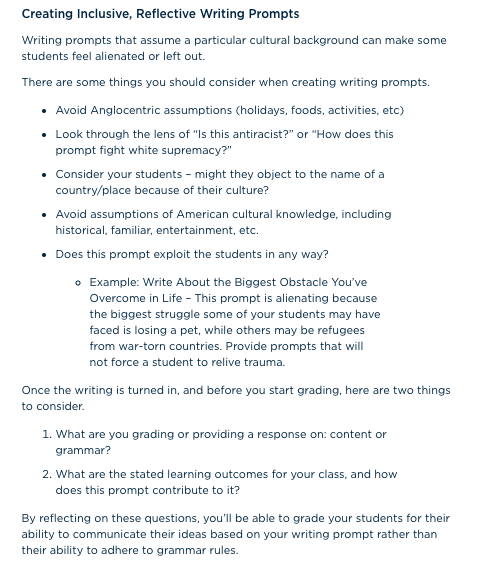
Creating Inclusive, Reflective Writing Prompts
The section titled “Creating Inclusive, Reflective Writing Prompts” states that writing prompts that “assume a particular cultural background can make some students feel alienated and left out.” The Center suggests avoiding “Anglocentric assumptions” and employ a lens of “‘Is this antiracist?’ or ‘How does this prompt fight white supremacy?'” The section also asks faculty to contemplate prior to grading whether they are grading for content or grammar.
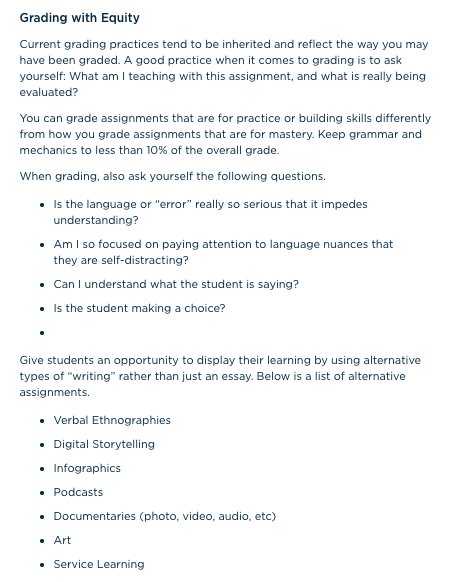
Grading for Equity
Another section titled “Grading for Equity” states that “current grading practices tend to be inherited and reflect the way you may have been graded.” Instead, the Center suggests focusing less on mechanics and grammar. It also adds that students should be given other opportunities to “display their learning by using alternative types of ‘writing’ rather than just an essay.” Examples of alternative assignments include “Verbal Ethnographies,” “Digital Storytelling,” “Infographics,” “Podcasts,” and “Service Learning.”
Restorative Justice Approaches to Plagiarism
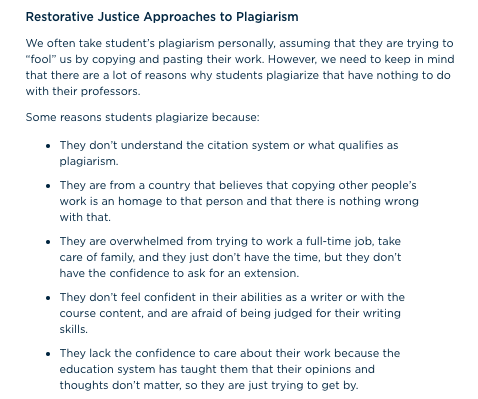
A section titled “Restorative Justice Approaches to Plagiarism” states that faculty need to “keep in mind that there are a lot of reasons why students plagiarize that have nothing to do with their professors” including not understanding the “citation system or what qualifies as plagiarism,” they come from another country where “copying other people’s work is an homage to that person,” they maybe be “overwhelmed from trying to work a full-time job,” or lack confidence.
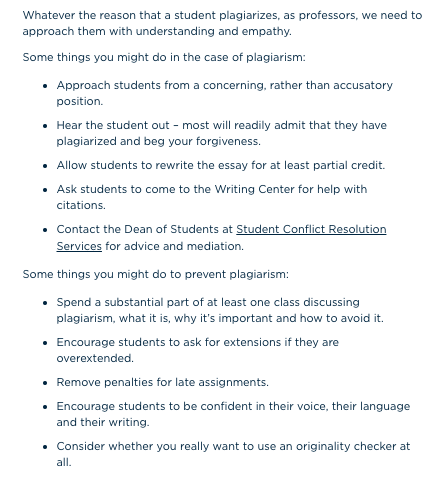
The Writing Center suggests that when plagiarism occurs, faculty should not take on an “accusatory position,” “hear the student out,” allow the student to “rewrite the essay for at least partial credit,” ask the students to go to the Writing Center for help with citations.”
It is also suggested that faculty be preventative by encouraging students to “ask for extensions if they are overextended,” removing “penalties for late assignments,” and to “consider whether you really want to use an originality checker at all.”
Stay Informed