




Chicago Public Schools tells staff to excuse student absences over fear of ICE and other federal agents
Incidents
- Issues
- Immigration
Through a public records request, Defending Education obtained a Chicago Public Schools (CPS) directive that bars cooperation with ICE and other federal agents, allows schools to excuse unlimited absences, tardies, and early dismissals when families cite fear of “federal representative activity” as a health and safety concern.
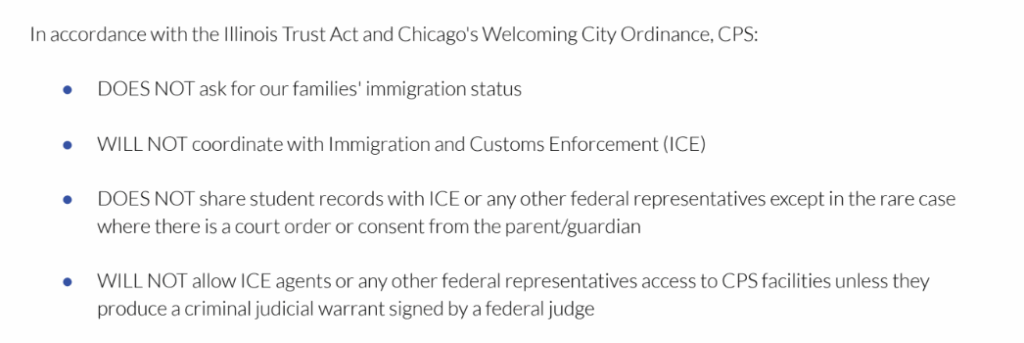
Citing the Illinois Trust Act and Chicago’s Welcoming City Ordinance, CPS states that is does not ask for families’ immigration status, won’t coordinate with Immigration and Customs Enforcement (ICE), won’t share student records with ICE or any other federal representatives and won’t allow ICE agents or any other federal representatives to access CPS facilities.
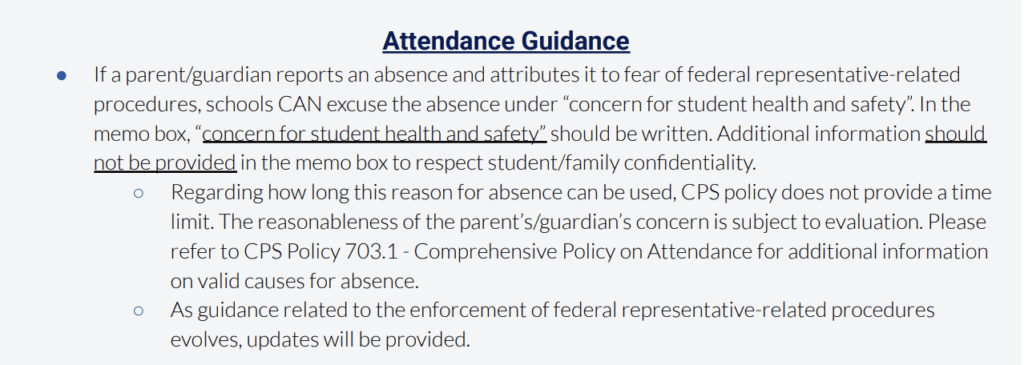
As part of its “Attendance Guidance,” CPS allows schools to excuse absences when a parent or guardian reports that a student is staying home out of “fear of federal representative-related procedures” and cites it as a “concern for student health and safety.”
There also is not a limit on how long this reason for absence can be used.
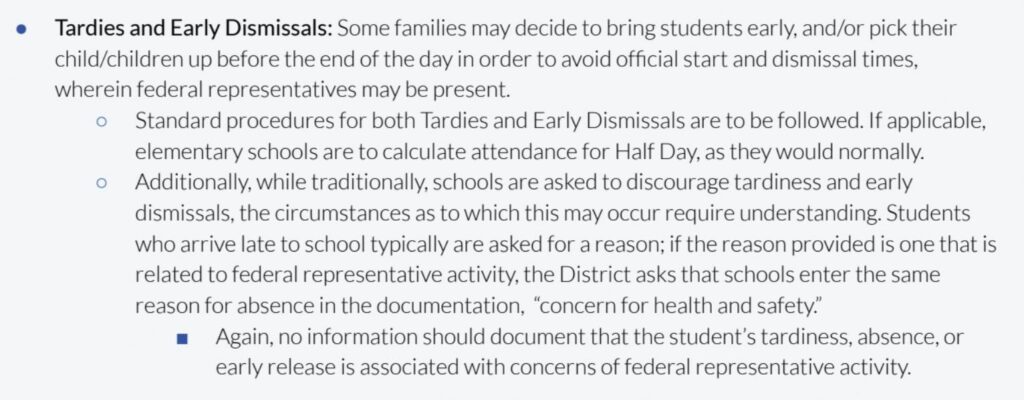
CPS also suggests that some families might want to drop off students early or pick them up before the end of the day “to avoid official start and dismissal times” in the even that a federal representative might be present.
The district admits that schools are usually expected to discourage tardiness and early dismissals, but said “the circumstances as to which this may occur require understanding,” so when a parent’s reason “is related to federal representative activity,” CPS directs schools to document the absence as a “concern for health and safety.”
CPS reiterated that “no information should document that the student’s tardiness, absence, or early release is associated with concerns of federal representative activity.”
These protections and procedures were reaffirmed by the Chicago Board of Education in a November 2024 resolution, which the board passed again in February 2025.
The document states: “While these protections and procedures are related to immigration enforcement, they apply to interactions with all federal agents and representatives, including the National Guard.”
Stay Informed